
You are using an outdated browser and your browsing experience will not be optimal. Please update to the latest version of Microsoft Edge, Google Chrome or Mozilla Firefox. Install Microsoft Edge

September 5, 2019

Update on Thailand’s “Delisting” of Marijuana and Hemp from the Scope of Category 5 Narcotics

On Friday August 30, 2019, a Notification of the Thai Ministry of Public Health (“MOPH Notification”) was published in the Government Gazette. The MOPH Notification went into effect on August 31, 2019, one day after its publication.

This MOPH Notification outlines another Thai Government initiative in connection with the free cannabis policy, this time carving out further aspects of marijuana and hemp use from the stringent regulations under the Narcotics Act.

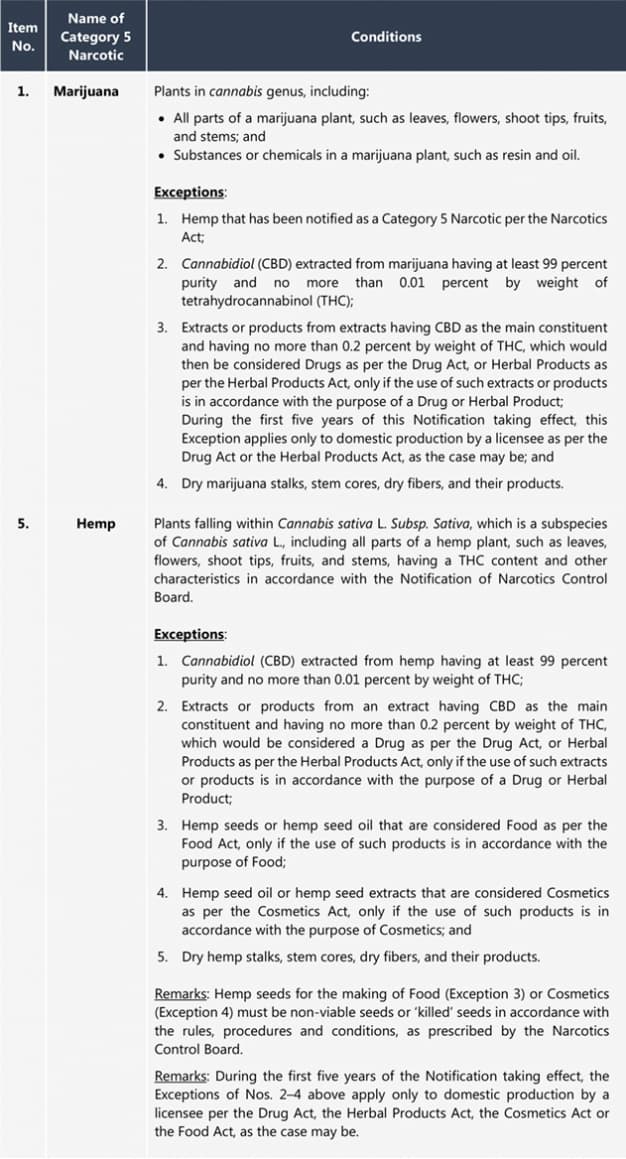
Marijuana is described in the MOPH Notification as plants of the cannabis genus, including all parts of a marijuana plant and the substances or chemicals found in a marijuana plant. Hemp is defined as plants falling within Cannabis sativa L. Subsp. sativa, including all parts of a hemp plant.

In fact, marijuana and hemp are not entirely “delisted” from the classification of Category 5 Narcotics as identified in the Narcotics Act. While these plants are still listed as Narcotics, the MOPH Notification serves to prescribe “exceptions”, meaning aspects and particulars of marijuana and hemp related products that are not considered Narcotics.

The new exceptions are summarized below.

For both marijuana and hemp

(1) Marijuana or hemp stalks, stem cores, and fibers are excepted, if dried. The products made of such dry parts are excepted, as well.

(2) Cannabidiol (CBD) extracted from marijuana or hemp is excepted if having at least 99% purity and no more than 0.01 percent by weight of tetrahydrocannabinol (THC).

(3) Extracts of marijuana or hemp having CBD as the main constituent and no more than 0.2% by weight of THC, which are considered “drugs” as per the Drug Act, or Herbal Products as identified in the Herbal Products Act.

For hemp only

(4) Hemp seeds or hemp seed oil, which are considered Food as identified in the Food Act.

(5) Hemp seed oil or hemp seed extracts, which are considered Cosmetics as identified in the Cosmetics Act.

In other words, hemp products according to the above descriptions may now be classified as Medicinal Drugs, Herbal Products, Food, or Cosmetics under their respective regulations. Marijuana may now be classified as Medicinal Drugs or Herbal Products only.

It should be noted that during the first five years under the MOPH Notification of August 30, 2019, the exceptions per (3) – (5) above apply only to domestic production by a licensee under the respective laws. This means the importation of products that would otherwise fall within those exceptions would still be regulated by the Narcotics Act—highlighting the Thai Government’s agenda in protecting Thai business operators.

According to the Thai Ministry of Public Health’s public conference held on September 2, 2019, the exception per (2) above for high-purity extracts (99% or higher of CBD; 0.01% or lower of THC) are intended to cover laboratory-grade standard extracts. For the (3) – (5) exceptions, the Thai FDA will later issue further rules under the Drug Act, the Herbal Products Act, the Cosmetics Act, or the Food Act to specifically accommodate the use of marijuana and hemp extracts in the respective products.

Moreover, amendments to the previous Industrial Hemp Regulation of 2016 are in the pipeline. The purpose of these amendments are to include non-public entities as parties having standing to apply for industrial hemp licenses.

Abridged Translation of the MOPH Notification
Remarks: The present MOPH Notification (2019) does not affect Items Nos. 2–4 on this list, which were prescribed by the previous MOPH Notification of 2018. Said unaffected items are:

No. 2:    Kratom (Mitragyna speciose);

No. 3:    Opium poppies (Papaver somniferum L. and Papaver bracteatum Lindl.); and

No. 4:    Psilocybin mushrooms.

Details about the above Nos. 2–4 are omitted from this update.

RELATED INSIGHTS​ 

March 7, 2025
On November 22, 2024, the Ministry of Health (MOH) in Laos issued Decision No. 3730/MOH, which regulates the management, processing, production, and use of biopharmaceutical products, genes, and stem cells. This decision came into force on January 18, 2025, 45 days after its publication in the Lao Official Gazette on December 4, 2024. This decision signifies Laos’ recognition and acceptance of biopharmaceutical products, genes, and stem cells for use in medical treatments and the beauty industry, and it aligns with the ongoing development of biomedical sciences in the country. Definitions The MOH’s decision defines biopharmaceuticals, gene therapy, and stem cells as follows: “Biopharmaceutical products” refers to a type of biological or drug product that is produced or synthesized from natural substances, objects, or chemicals. This group of products includes blood, blood components, allergens, cells or cellular components, gene therapies, tissues, protein-based medicines, drugs derived from living cells, and biologics, which can be produced from sugars, proteins, amino acids, or substances with complex characteristics derived from organic sources such as human, animal, and plant parts; yeast; and microorganisms. These products exclude vaccines and biosimilar products, which will be specified under separate regulations. “Gene therapy” refers to a treatment approach that applies the principle of arranging amino acids (which could involve DNA or RNA sent to the patient’s cells in the form of a drug with the purpose of treating a certain disease). “Stem cells” are defined in the decision as cells or immature cells that can be sourced from various organs in the They are characterized by being undifferentiated, having the potential for differentiation, and being self-renewing. Stem Cell Production The decision outlines comprehensive provisions for managing and using raw materials in stem cell production. Key points include: Production location standards: Ensuring facilities meet specific standards of the MOH. Personnel
December 13, 2024
Experts from Tilleke & Gibbins have provided updates for the latest edition of The Pharma Legal Handbook: Vietnam, published by Pharma Boardroom. This comprehensive guide to the legal framework regulating the healthcare and life sciences industries in Vietnam was authored by by the Hanoi-based team of Hien Thi Thu Vu, head of regulatory affairs for Vietnam, and Mai Thi Le, regulatory affairs consultant, the handbook is a must-read for healthcare and life sciences companies that are interested in the Vietnam market. The guide includes eight sections on various important aspects of local regulations: Regulatory, Pricing, and Reimbursement Overview Preclinical & Clinical Trial Requirements Marketing, Manufacturing, Packaging & Labeling, and Advertising Traditional Medicines and Over-the-Counter Products Product Liability Patents and Trademarks Regulatory Reforms Orphan Drugs and Rare Diseases Tilleke & Gibbins has also authored The Pharma Legal Handbook: Thailand, which was updated at the same time as the Vietnam guide. The Pharma Legal Handbook: Vietnam, like all of the country guides from Pharma Boardroom, is available for purchase on the Pharma Boardroom website.
December 13, 2024
Attorneys from Tilleke & Gibbins in Bangkok have provided updates for the latest edition of The Pharma Legal Handbook: Thailand, published by Pharma Boardroom. This comprehensive guide to the legal framework regulating the healthcare and life sciences industries in Thailand was authored by Alan Adcock, partner and director, intellectual property, and head of the firm’s life sciences practice; Dr. Atthachai Homhuan, manager of regulatory affairs; and San Chaithiraphant, senior associate. The handbook is a must-read for healthcare and life sciences companies that are interested in exploring expansion into the Thai market.
December 12, 2024
On November 21, 2024, the National Assembly of Vietnam adopted a law amending and supplementing the 2016 Law on Pharmacy (“Amended Law on Pharmacy”). The Amended Law on Pharmacy simplifies some procedures for the pharmaceutical field, and will take effect on July 1, 2025, except for regulations on drug registration and rights and responsibilities of certain types of pharmaceutical business. Some outstanding points in the Amended Law on Pharmacy are presented below. E-commerce Distribution The Amended Law on Pharmacy allows trading in pharmaceutical products by the e-commerce channel, including e-commerce trading floors, e-commerce sales applications, and e-commerce sales websites with online ordering functions. Accordingly, e-commerce retail of non-prescription drugs is permitted if the drugs are neither specially controlled drugs nor drugs included in the list of drugs restricted for retail sale, and e-commerce wholesale of drugs and drug materials is permitted, as long as they are not specially controlled drugs. New Rights for Import FIEs The amendment provides some additional rights to foreign-invested enterprises (“FIEs”) that import drugs, including the rights to: Repurchase drugs and drug materials manufactured through the technology transfer of the FIE itself in Vietnam, and sell such products to wholesalers; Import drug materials to supply to drug manufacturers in Vietnam that are hired by or receive technology transfer from the FIE itself under a processing contract or technology transfer contract; Deliver and transport drugs and drug materials the FIE has imported, outsourced for processing, or transferred technology for in Vietnam, from the FIE’s warehouse to its wholesalers; Deliver and transport drugs used in aid, sponsorship, humanitarian, and disease prevention and control programs to medical facilities receiving funding; and Transport drug materials imported by the FIE from its warehouse to drug manufacturers that are hired by or receive technology transfer from the FIE itself under a