
You are using an outdated browser and your browsing experience will not be optimal. Please update to the latest version of Microsoft Edge, Google Chrome or Mozilla Firefox. Install Microsoft Edge

September 5, 2019

Update on Thailand’s “Delisting” of Marijuana and Hemp from the Scope of Category 5 Narcotics

On Friday August 30, 2019, a Notification of the Thai Ministry of Public Health (“MOPH Notification”) was published in the Government Gazette. The MOPH Notification went into effect on August 31, 2019, one day after its publication.

This MOPH Notification outlines another Thai Government initiative in connection with the free cannabis policy, this time carving out further aspects of marijuana and hemp use from the stringent regulations under the Narcotics Act.

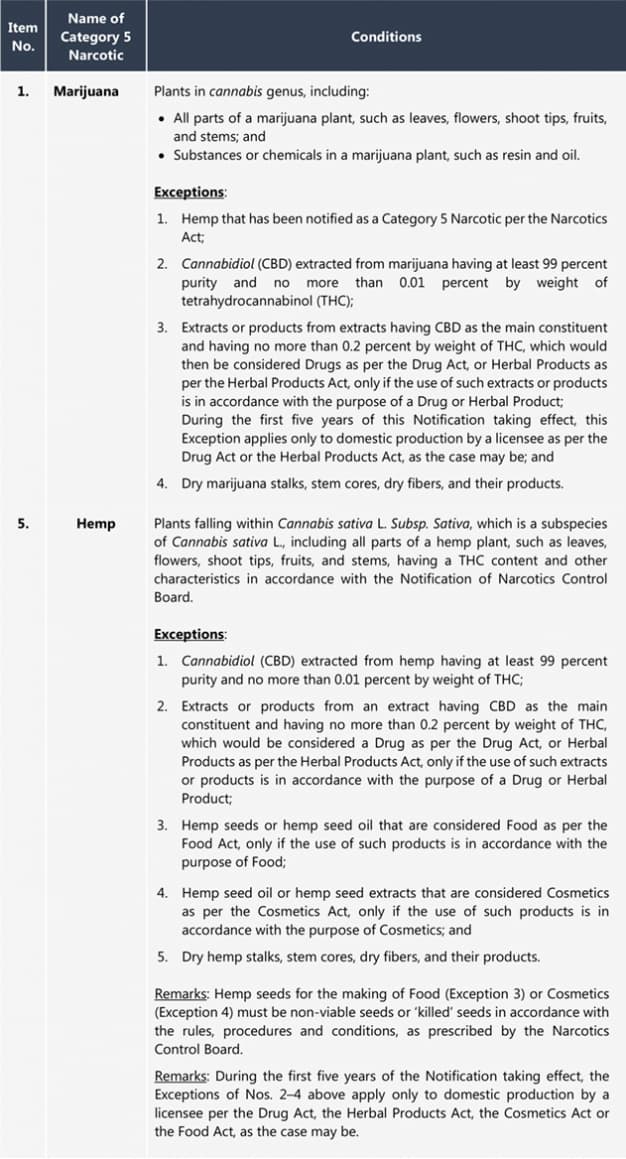
Marijuana is described in the MOPH Notification as plants of the cannabis genus, including all parts of a marijuana plant and the substances or chemicals found in a marijuana plant. Hemp is defined as plants falling within Cannabis sativa L. Subsp. sativa, including all parts of a hemp plant.

In fact, marijuana and hemp are not entirely “delisted” from the classification of Category 5 Narcotics as identified in the Narcotics Act. While these plants are still listed as Narcotics, the MOPH Notification serves to prescribe “exceptions”, meaning aspects and particulars of marijuana and hemp related products that are not considered Narcotics.

The new exceptions are summarized below.

For both marijuana and hemp

(1) Marijuana or hemp stalks, stem cores, and fibers are excepted, if dried. The products made of such dry parts are excepted, as well.

(2) Cannabidiol (CBD) extracted from marijuana or hemp is excepted if having at least 99% purity and no more than 0.01 percent by weight of tetrahydrocannabinol (THC).

(3) Extracts of marijuana or hemp having CBD as the main constituent and no more than 0.2% by weight of THC, which are considered “drugs” as per the Drug Act, or Herbal Products as identified in the Herbal Products Act.

For hemp only

(4) Hemp seeds or hemp seed oil, which are considered Food as identified in the Food Act.

(5) Hemp seed oil or hemp seed extracts, which are considered Cosmetics as identified in the Cosmetics Act.

In other words, hemp products according to the above descriptions may now be classified as Medicinal Drugs, Herbal Products, Food, or Cosmetics under their respective regulations. Marijuana may now be classified as Medicinal Drugs or Herbal Products only.

It should be noted that during the first five years under the MOPH Notification of August 30, 2019, the exceptions per (3) – (5) above apply only to domestic production by a licensee under the respective laws. This means the importation of products that would otherwise fall within those exceptions would still be regulated by the Narcotics Act—highlighting the Thai Government’s agenda in protecting Thai business operators.

According to the Thai Ministry of Public Health’s public conference held on September 2, 2019, the exception per (2) above for high-purity extracts (99% or higher of CBD; 0.01% or lower of THC) are intended to cover laboratory-grade standard extracts. For the (3) – (5) exceptions, the Thai FDA will later issue further rules under the Drug Act, the Herbal Products Act, the Cosmetics Act, or the Food Act to specifically accommodate the use of marijuana and hemp extracts in the respective products.

Moreover, amendments to the previous Industrial Hemp Regulation of 2016 are in the pipeline. The purpose of these amendments are to include non-public entities as parties having standing to apply for industrial hemp licenses.

Abridged Translation of the MOPH Notification
Remarks: The present MOPH Notification (2019) does not affect Items Nos. 2–4 on this list, which were prescribed by the previous MOPH Notification of 2018. Said unaffected items are:

No. 2:    Kratom (Mitragyna speciose);

No. 3:    Opium poppies (Papaver somniferum L. and Papaver bracteatum Lindl.); and

No. 4:    Psilocybin mushrooms.

Details about the above Nos. 2–4 are omitted from this update.

RELATED INSIGHTS​ 

December 9, 2024
Cambodia’s Law on Seed Management and Plant Breeder’s Rights was enacted in 2008, but it was not until recently that new plant varieties could successfully be registered for protection in the country. Although the law has been in place for some time, recent developments confirmed the application process and a schedule of charges for the registration of new plant varieties. With these developments, breeders have been able to register their new plant varieties in Cambodia since March 1, 2024. Applicants for new plant variety protection must be Cambodian nationals, foreign nationals domiciled in Cambodia, or permanent residents of either a country that is a contracting party to the International Union for the Protection of New Varieties of Plants (UPOV) Convention or a country with which Cambodia has signed a memorandum of understanding on plant variety protection. Applicants can also claim a priority date from the first application for the same plant variety filed in any contracting party of the UPOV Convention within 12 months of the earliest application’s filing date. To be eligible for protection, new plant varieties must satisfy the following criteria: Novelty: A variety is considered “new” if, at the date of filing the application for new plant variety protection, it has not been sold, marketed, or otherwise disposed of others—by or with the consent of the breeder—for more than: One year for any plant variety in Cambodia; Six years for trees and vines or four years for all other plant varieties in countries besides Cambodia. Distinctiveness: A variety must be clearly distinguishable from any other existing varieties. Uniformity: A variety must be sufficiently uniform in its relevant characteristics. Stability: A variety must remain unchanged in its essential characteristics at the end of each cycle of propagation and in each generation. The last three criteria are often
December 4, 2024
On October 28, 2024, Indonesia officially amended its existing Patent Law when the president ratified Law Number 65 of 2024. This comprehensive update—the third such amendment in the history of Indonesia’s Patent Law—introduces several key changes that will significantly impact patent protection and application processes in Indonesia. Key highlights and changes are outlined below. Definition of Invention The new law broadens the definition of “invention” to explicitly include systems, methods, and uses. Additionally, the law introduces formal definitions for traditional knowledge and genetic resources. Patentability Criteria Notable changes include: Computer programs are now excluded, with an exception for computer-implemented inventions. Theories and methods in science and mathematics are added to the list of excluded inventions. Previous restrictions on new uses of existing products are removed. Grace Periods The grace periods for some patent-related actions have been adjusted: The grace period for disclosures has been extended to 12 months (from 6 months previously), providing inventors with more flexibility in filing patent applications after initial disclosure. A newly introduced item is the grace period for a conventional patent application claiming priority rights, which is 4 months after the 12-month filing deadline under the Paris Convention. The grace period for annuity payments is 6 months (from 12 months previously) with a fine for late payments of 100% of the annual fee payable. Patent Holder Rights and Obligations Patent holders can now grant permissions to enforce patents. There is a new requirement for patent holders to submit annual statements on patent implementation in Indonesia. Compulsory Licensing Significant changes to compulsory licensing include: Establishment of licenses based on the principle of expediency. Limitations on license scope and transferability. Prioritization of domestic market needs. New provisions for technical improvements and economic significance. Government Patent Exploitation The new law contains specific provisions for the government’s implementation
December 4, 2024
Thailand Legal Basics, a valuable primer for foreign investors, explores all aspects of living and doing business in Thailand. Written by specialists at Tilleke & Gibbins in Bangkok, it is the only comprehensive English-language guide to the Thai legal system with a focus on the concerns of foreign business and investment.
December 2, 2024
Kratom (Mitragyna speciosa) was once listed as a prohibited substance under the Narcotics Act. Kratom was then removed from the narcotics list in 2021 and is now regulated under the Kratom Plant Act B.E. 2565 (2022), which allows the trading, use, import, and export of kratom. Furthermore, the Ministry of Public Health has allowed the use of kratom in food and drink, food supplements, and herbal products. Anyone who wishes to launch kratom food or herbal products must first obtain a product license from the Thai Food and Drug Administration (FDA). On September 4, 2024, the Thai FDA announced guidelines specifically for powdered kratom leaves and kratom leaf extracts (using water or ethanol as solvents) as ingredients in food supplements. These guidelines aim to provide business operators with a clear framework for launching kratom-based food products in Thailand. Key points from these guidelines include: Raw material specifications and standards: Powdered kratom leaves and kratom leaf extracts must contain at least the prescribed amount of mitragynine (one of the primary active compounds in kratom) as a marker of quality. For example, mitragynine must account for at least 1% by mass for powdered kratom leaves. Food supplement specification and standards: Food supplements containing powdered kratom leaves or kratom leaf extracts must not have a dosage of over 0.2 mg/day of mitragynine (including 7-hydroxymitraglynine, which may occur naturally), or 1 mg/day for food supplements containing kratom extracts that use water as a solvent. Addition of 7-hydroxymitraglynine to food supplements is prohibited. Mitragynine content in food supplement products must not exceed the specified dosage limit. Additionally, the food supplement product must be in a ready-to-eat form (e.g., liquid, gel, tablet, or capsule). If powdered kratom leaves or kratom leaf extracts are to be used as ingredients in food categories other than food supplements,