You are using an outdated browser and your browsing experience will not be optimal. Please update to the latest version of Microsoft Edge, Google Chrome or Mozilla Firefox. Install Microsoft Edge

December 31, 2021

VAT Reduced to 7% under Amendments to Lao Tax Laws

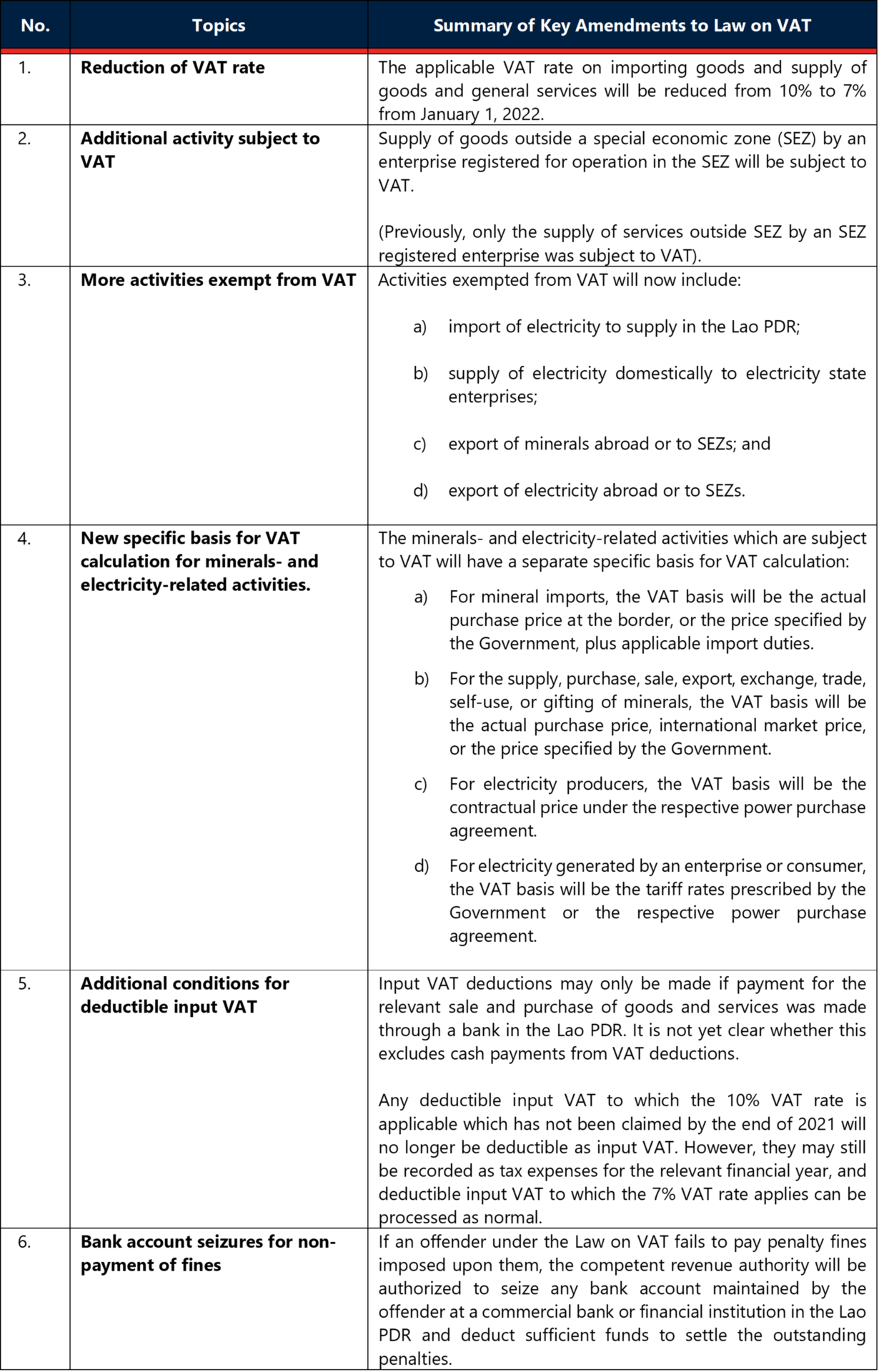
In the last week of December, 2021, the Ministry of Justice published the Law Amending Certain Provisions of the Laws on Tax No. 01/NA, dated August 7, 2021, in the Government Gazette. The Law will come into force on January 1, 2022.

The most notable amendments relate to Value Added Tax (VAT), which are summarized below.

The new law also makes changes to the laws on tax management, income tax, and excise tax, which Tilleke & Gibbins will provide updates on in due course.

RELATED INSIGHTS​ 

June 5, 2023
Vietnam’s Law on the Protection of Consumer Rights (“Consumer Protection Law” or “CPL”) was passed in 2010 and has been effective since July 1, 2011, providing a legal framework for protecting the rights of consumers in Vietnam. Over the past 12 years of implementation and application, however, the CPL has revealed its shortcomings and limitations. For example, there are issues related to inconsistency between the CPL and other laws such as the Civil Code, Law on Competition, Enterprise Law, and Cybersecurity Law. The current CPL also has not kept pace with modern consumption practices, especially the rapid changes and emerging trends in e-commerce, cross-border transactions, and services via digital platforms. The government of Vietnam has therefore entrusted the Ministry of Industry and Trade (MOIT) to take the lead in drafting a new amended CPL to replace the old one, to improve the policies and legislation on consumer protection, and protect the vulnerabilities of consumers in transactions with businesses. During the 5th session of the National Assembly at the end of May 2023, the National Assembly discussed and reviewed the latest draft of the CPL (“Draft CPL”), which is expected to be approved on June 21, 2023. The following are some key contents of the Draft CPL: 1. Revised Subjects of Application Unlike the current CPL, which applies only to consumers; traders of goods and services; and agencies, organizations and individuals involved in consumer protection activities within the territory of Vietnam, the Draft CPL adds “the Vietnamese Fatherland Front, socio-political organizations and social organizations participating in protecting consumers’ interests” as new subjects of its application, and clarifies that “agencies, organizations, and individuals” include both domestic and offshore agencies, organizations, and individuals involved in activities of consumer rights protection. The Draft CPL also removes “within the territory of Vietnam” from the

June 2, 2023
Thailand’s labeling requirements have new rules on product label font size and readability following the issuance of Announcement of the Label Committee Re: Characteristics of the Label for Label-Controlled Goods No. 3, which is a bylaw of the Consumer Protection Act (CPA). The announcement takes effect on June 18, 2023, and applies to all “label-controlled goods,” which are described under the CPA and its bylaws as goods either produced by factories in Thailand or imported into Thailand for sale. The labels of these goods must meet current labeling requirements, such as having information about the product name, quantity, intended use, cautions, and expiry date. Label readability—specifically in terms of the size of text on labels—is also a mandatory requirement, and is the focus of this latest announcement. Text size requirements are an important part of ensuring that consumers are fully aware of the details of a product before deciding to purchase the goods. According to the announcement, any statement or text displayed on a label must be easily visible and readable. The size of the text must be proportional to the label area. Specifically, the text height must not be less than 2 millimeters (or 1.5 millimeters for labels with an area of less than 35 square millimeters). The announcement does not clarify exactly how the height of the text will be determined. Some companies have expressed concern that these requirements are too strict and will be challenging to meet, especially for small businesses. The text size requirements may be expensive to implement, as the larger text requires more space on the label, potentially leading to larger labels or packages, higher production costs, or even expensive recalls to affix new labels. In some cases, text size requirements may even make it impossible to fit all the required information on
May 19, 2023
On May 15, 2023, Vietnam’s Deputy Prime Minister Tran Hong Ha signed Decision No. 500 of the Prime Minister approving the National Power Development Plan for the period 2021-2030, with a vision to 2050 (“PDP VIII”), following extensive public consultations and multiple rounds of review since the first draft version was circulated in 2021. The plan was approved in the context that in the past few years, a number of large power projects have been behind schedule for operation, while new projects have not been able to be implemented due to waiting for additional planning. PDP VIII is the master plan for the development of the power source and transmission grid at 220kV or higher; services in renewable energy and new energy in Vietnam; and works connecting the power grids of Vietnam and neighboring countries. We set out below some quick updates regarding PDP VIII. 1. Development Targets Key development targets are summarized in the table below: Investors in coal, domestic gas, and LNG projects may need to have a conversion plan ready given the 2050 targets to convert to other sources of energy. 2. Solar Projects A list of 27 solar power projects that were planned for the period of 2021-2030 but which have not been assigned to investors are not allowed to be deployed but can be considered after 2030, except in the case of deployment in the form of self-production and self-consumption (Appendix IV). These projects represent 4,136.25 MW of capacity that will be left on the sidelines until 2030. 3. Hydropower Projects A list of 14 potential hydropower projects can be considered if economic and technical conditions allow for more hydropower development (Appendix III). These projects represent 1,244 MW of capacity that can be added to the hydropower targets for 2030. 4. Projects Prioritized for
April 20, 2023
Food safety is one important area of focus as Cambodia continues to improve its regulatory framework surrounding consumer protection. Last year, the new Law on Food Safety set out the main principles to regulate the food sector, providing general rights and obligations of food businesses and requirements for food products traded in Cambodia. Then in the first months of 2023, two implementing regulations were issued to clarify the overarching principles of the Law on Food Safety, as well as its enforcement mechanisms. The adoption of these enforcement-related regulations is once again a clear signal to the market that the Cambodian government is taking the enforcement of consumer protection laws seriously. Food Surveillance, Seizure, and Recalls The first of these implementing regulations was Sub-Decree No. 13 on the Conditions, Formalities and Procedures for Food Surveillance and Seizure, dated January 6, 2023 (SD 13), followed the next month by Prakas No. 080 on the Forms and Procedures to Seize Unsafe Foods or Foods Not Complying with Technical Regulations, dated February 22, 2023 (Prakas 80). These implementing regulations give clarity on how the authorities will monitor and inspect the food sector, and in what cases the authorities may resort to recalls or seizure of foods. Prakas 80 also provides the necessary paperwork for both inspecting officers and companies to use when reporting on unsafe foods to authorities and the public. Lastly, the regulations further clarify the obligations for food businesses and the penalties for noncompliance. The Consumer Protection, Competition, and Fraud Repression Directorate-General (CCF) of the Ministry of Commerce takes a key role as the main enforcement authority under the regulations. The CCF receives reports on unsafe foods, manages voluntary recalls, publishes warnings to the public regarding unsafe foods, seizes unsafe or otherwise noncompliant goods, and applies the administrative fines and penalties