You are using an outdated browser and your browsing experience will not be optimal. Please update to the latest version of Microsoft Edge, Google Chrome or Mozilla Firefox. Install Microsoft Edge

December 31, 2021

VAT Reduced to 7% under Amendments to Lao Tax Laws

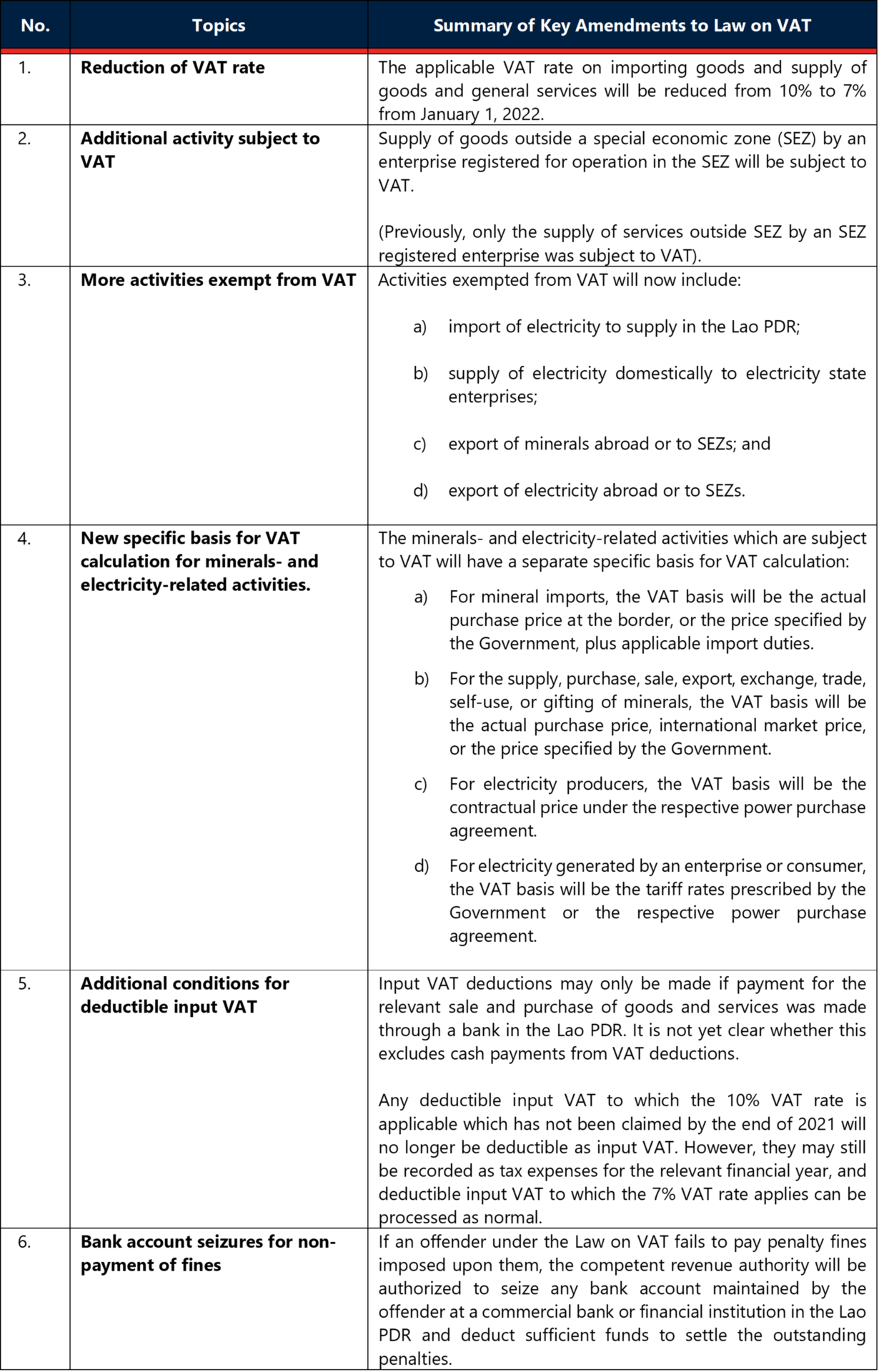
In the last week of December, 2021, the Ministry of Justice published the Law Amending Certain Provisions of the Laws on Tax No. 01/NA, dated August 7, 2021, in the Government Gazette. The Law will come into force on January 1, 2022.

The most notable amendments relate to Value Added Tax (VAT), which are summarized below.

The new law also makes changes to the laws on tax management, income tax, and excise tax, which Tilleke & Gibbins will provide updates on in due course.

RELATED INSIGHTS​ 

March 22, 2023
Attorneys from Tilleke & Gibbins have contributed the Cambodia, Laos, Myanmar, and Vietnam sections to DLA Piper’s Global Government Contracting Country by Country guide, which provides essential information for businesses in 75 jurisdictions on how to source and enter into government contracting opportunities. The guide provides procurement information for jurisdictions in Africa, the Americas, Asia-Pacific, Europe, and the Middle East, and includes information on how to find procurement opportunities, the structure of procurement laws, and in-country resources and relevant publications. Each jurisdictional section includes valuable information on procedures for government tenders, bidding, and contract execution, as well as an overview of the legal and regulatory framework governing government procurement. Businesses can refer to the guide to gain a better understanding of procurement processes and regulations in each jurisdiction, which can help them identify potential opportunities and make informed decisions when pursuing government contracts. The guide’s procurement information for Cambodia, Laos, Myanmar, and Vietnam, combined with the online platform’s comprehensive resources, provides businesses and governments with a valuable tool to navigate the complex regulatory landscape of government contracting in the region. The full Global Contracting Country-by-Country guide is available on the DLA Piper website.
March 7, 2023
Intellectual property experts from Tilleke & Gibbins’ Hanoi office have written the Vietnam chapter of Practical Law Company’s Copyright Litigation Global Guide 2023, a high-level comparative overview of laws and regulations related to copyright law presented in an easy to read Q&A format. The Vietnam chapter, which includes changes introduced by the latest amendment of Vietnam’s Intellectual Property Law, covers the following topics and more: Sources of law and the court system Types of works that can be protected by copyright Acts that constitute copyright infringement Parties to litigation Enforcement options Procedure in civil courts To read the Vietnam chapter, please visit the Practical Law website or click on the link below.
March 1, 2023
In Cambodia, the Ministry of Commerce takes the lead on many consumer protection matters, issuing and enforcing regulations that contribute greatly to a fairer and more transparent legal framework. The regulations protect consumers while simultaneously creating a more a level playing field for businesses. On September 2, 2022, the ministry issued a new regulation concerning household chemical products. The regulation, named Prakas No. 192 on the Requirements for the Labeling of Household Chemical Products, is another big leap forward in light of the consumer protection framework that the Cambodian government has been rapidly updating in recent years. Interesting issues in the regulation include household chemical product classification, labeling and language requirements, product storage requirements, recall requirements, and obligations for companies engaging in business activities related to household chemicals. In addition, the regulation reminds household chemicals businesses operating online of the need to obtain additional e-commerce licensing. Cambodia’s consumer protection authority, the Consumer Protection, Competition and Fraud Repression Directorate-General—commonly known as the CCF—has already started to enforce the new regulation, as the three-month transition period under the regulation has now passed. Classifying and Defining Household Chemicals The regulation classifies household chemicals into three groups based on the product’s purpose—namely detergents, pesticides, and substances for home and garden protection. There is also a separate list of household chemicals identified as “chemicals not allowed for use in food.” This list is just a reminder, as existing legislation already prohibits the use of the identified chemicals in food. The regulation defines household chemicals as finished chemical products, or chemical additives to products, that can be harmful to health and that have one of the three purposes mentioned above. The regulation further states that the products are for use in “normal life,” such as in homes, workshops, or gardens, or for other public use.

February 28, 2023
Influencer marketing and the creation of sponsored content is an increasingly popular way for brands to reach their target audience. Although there is no universal definition of an “influencer,” the term is broadly used to describe people who are able to affect purchasing decisions of others through their relationship with their audience. In the context of social media and the creator economy, influencers are usually people with significant followings on platforms such as Instagram, TikTok, Twitch, or YouTube who are viewed as celebrities, opinion leaders, trendsetters, or experts in their respective field. Based on a study conducted by Nielsen in 2022, 80% of social media users in Asia who follow influencers are likely to purchase products recommended by the influencers. Brand owners should be aware of five key legal considerations when entering into influencer marketing agreements. 1. Making informed decisions through due diligence Every collaboration with an influencer is a business relationship. Brands must conduct thorough due diligence on potential influencers prior to engaging them. This may include deep dives into the individual’s old social media posts, as well as requests for disclosure of prior controversial incidents and existing brand associations. For example, a health and fitness brand may not want—for both legal and commercial reasons—to be publicly associated with an influencer who is a brand ambassador of electronic cigarettes, no matter how impressive the latter’s Instagram following or deadlift record is. Brands should also ensure that their influencer marketing agreements include relevant representations and warranties that the influencer has not and will not commit a crime or act in a way that may cause negative publicity for the brand. This may include racist, extremist, homophobic, violent, or misogynistic acts, or any other acts that are obscene or against public order. 2. Clearly defining the scope of engagement Brands