You are using an outdated browser and your browsing experience will not be optimal. Please update to the latest version of Microsoft Edge, Google Chrome or Mozilla Firefox. Install Microsoft Edge

December 31, 2021

VAT Reduced to 7% under Amendments to Lao Tax Laws

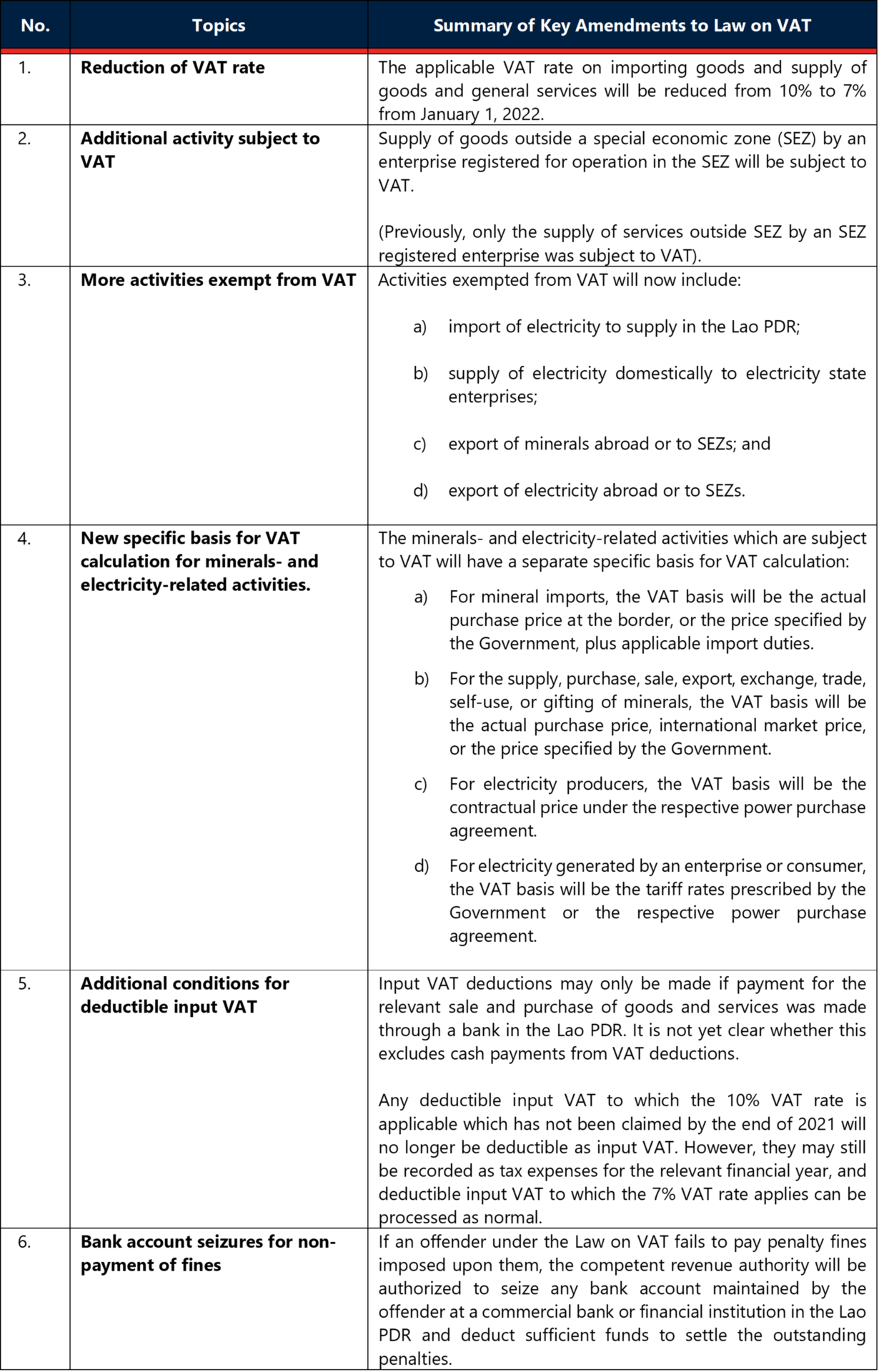
In the last week of December, 2021, the Ministry of Justice published the Law Amending Certain Provisions of the Laws on Tax No. 01/NA, dated August 7, 2021, in the Government Gazette. The Law will come into force on January 1, 2022.

The most notable amendments relate to Value Added Tax (VAT), which are summarized below.

The new law also makes changes to the laws on tax management, income tax, and excise tax, which Tilleke & Gibbins will provide updates on in due course.

RELATED INSIGHTS​ 

February 21, 2023
On December 28, 2022, the Ministry of Health of Laos issued Decision No. 3789/MOH on the Control of Hemp for Medication and Products (the “Decision”). The Decision approves the regulated cultivation, extraction, production, processing, storage, distribution, utilization, import-export, and transport of hemp. The Decision also authorizes the use of hemp and hemp-related products by the general population, although use of certain products is limited to those with medical prescriptions. Background In 2019, the Lao government established an ad hoc committee to consider the legalization of cannabis, as reported previously. The government permitted certain local companies to grow cannabis in specific zones under pilot programs, although it continued to strictly prohibit the use and commercialization, as well as consumption, of cannabis-related products, regardless of the level of psychoactive tetrahydrocannabinol (THC) in the products. Overview of the Decision The Decision was issued by the Ministry of Health (which led the ad hoc committee) and permits authorized companies to engage in certain activities involving the use of hemp and the consumption of hemp and hemp-related products. The Decision defines hemp (“porkeo” in Lao) as a “plant that belongs to the same family as ganja and bears the scientific name Cannabis Sativa L. (Cannabis sativa L. subsp. sativa var. sativa) which is a subspecies of ganja (Cannabis Sativa L.).” This definition aims at differentiating hemp from the general definition of ganja or marijuana, which continues to be listed as a prohibited narcotic in Laos. The Law on Narcotics (2007) and the Penal Code (2017) still prohibit the production, trade and use of all types of cannabis. These laws will need to be amended to ensure that they are aligned with changes set out in the Decision.  Authorized Hemp Activities The Decision allows approved companies to engage in the cultivation, extraction, production, processing, storage,

February 20, 2023
On December 20, 2022, the Notification re: Rules, Procedures, and Conditions on Transfer of Energy Licenses of the Thailand Energy Regulatory Commission (ERC) became effective. The notification sets out the new standard and procedure for transferring licenses for energy industry operation. The notable changes in the notification are provided below. Anti-Competition Consideration and Impact Assessment Report In considering the transfer of a license, in addition to ensuring the transferee meets all the qualifications for an applicant for the license, the ERC will consider if the transfer would (1) create a monopoly, reduce or restrict competition, or result in market dominance; (2) affect the contracting parties of the transferors or energy users; or (3) affect energy security or the public interest. In this respect, the vetting process for an application for license transfer would be separated into two different approaches. If the ERC believes that the transfer of the energy license would affect competition, energy users, energy security, or the public interest, the transferor will need to submit an impact assessment report on the license transfer to the ERC. In this regard, the ERC may establish a sub-committee or an independent consultant to contemplate the transfer at the transferor’s expense. However, if the ERC believes that the transfer of license would not lead to any impact, the transferor will not be required to submit the impact assessment. Also, if the license transfer is related to any transactions specified under the ERC’s Regulation re: Rules and Procedures on Merger and Cross-Shareholding in Energy Businesses, B.E. 2565, the ERC can combine the license transfer application with the M&A application. After approval, the ERC might require the transferee to periodically report to the ERC and comply with measures stipulated by the ERC. Therefore, an energy license holder which plans to carry out M&A
February 9, 2023
Vietnam’s Ministry of Finance is drafting a circular on determining the origin of imported and exported goods. This circular, a draft version of which has been released for public comment (“Draft Circular”), consolidates prevailing regulations and guidelines on determining the origin of imported and exported goods that are stipulated in the following legal documents, which the Draft Circular would replace when it comes into effect: Circular No. 38/2018/TT-BTC dated April 20, 2018, of the Ministry of Finance regulating the determination of origin of imported and exported goods, as amended by Circular No. 62/2019/TT-BTC dated September 5, 2019, of the Ministry of Finance; Circular No. 47/2020/TT-BTC dated May 27, 2020, regulating the time to submit documents proving the origin of goods and form of the documents proving the origin of imported goods applied during the Covid-19 pandemic; and Circular No. 07/2021/TT-BTC dated January 25, 2021, regulating the time to submit documents proving the origin of imported goods under the EU-Vietnam Free Trade Agreement (EVFTA). Generally speaking, the Draft Circular does not increase the administrative procedures for importers and exporters, but rather seeks to codify the recent practices implemented by the customs authorities. The Draft Circular focuses on providing comprehensive guidance for importing/exporting companies when carrying out administrative procedures to certify the origins of imported and exported goods to be in line with current trade practices and international commitments under new-generation free trade agreements. In particular, the Draft Circular supplements guidelines on declaring origins and submitting Certificates of Origin (C/Os) of imported goods under the EVFTA and the Regional Comprehensive Economic Partnership Agreement (RCEP). The Draft Circular also provides some new guidelines to facilitate exports (and imports) and overcome some obstacles and issues when implementing the prevailing regulations. For example, the submission of C/Os online, which was only applicable during the
February 3, 2023
The Federation of Thai Industries (FTI) announced on January 16, 2023, the opening of registration for carbon credit trading on its Renewable Energy and Carbon Credit Exchange Platform. This new online platform supports the domestic carbon market and provides Thai exporters with the ability to purchase carbon credits, allowing them to address demands from importing nations to conform to carbon emission reduction regulations. This is expected to be a positive step forward for the current practice in Thailand, in which the carbon market operates as a voluntary and unregulated buy-sell platform, free from government regulation. Developed in partnership with the Thailand Greenhouse Gas Management Organization (TGO), the FTI: CC/RE/REC X Platform, or FTIX, is intended to increase the promotion of national carbon credits, renewable energy, and renewable energy certificates, thus improving the country’s efforts to mitigate climate change. Entrepreneurs interested in registering for carbon credit trading on the FTIX can do so through the FTIX website at fti-cc.com. The platform initially supports carbon credit trading through over-the-counter methods. In the near future, the FTIX will be developed to support 100% renewable energy (i.e., RE100 energy) and renewable energy certificate trading. However, the related tax and carbon pricing policies have not yet been issued. The TGO is currently in discussions with the Fiscal Policy Office and the Ministry of Finance regarding fiscal policy for the FTIX. For more information on the FTIX, or on any aspect of renewable energy activities in Thailand, please contact Charuwan Charoonchitsathian at [email protected], Napassorn Lertussavavivat at [email protected], or Ratchapat Triteeyaputranonta at [email protected].