You are using an outdated browser and your browsing experience will not be optimal. Please update to the latest version of Microsoft Edge, Google Chrome or Mozilla Firefox. Install Microsoft Edge

December 31, 2021

VAT Reduced to 7% under Amendments to Lao Tax Laws

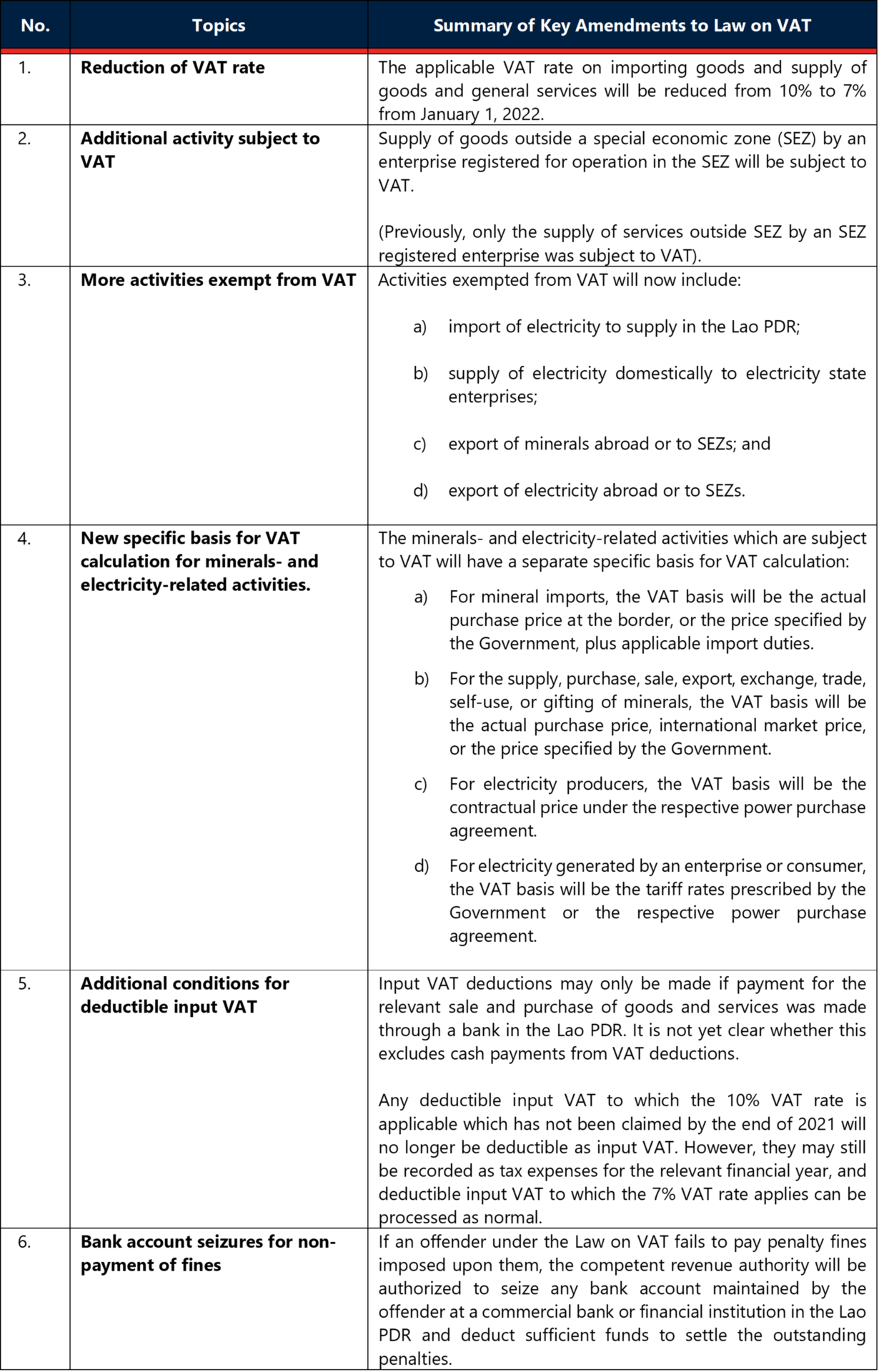
In the last week of December, 2021, the Ministry of Justice published the Law Amending Certain Provisions of the Laws on Tax No. 01/NA, dated August 7, 2021, in the Government Gazette. The Law will come into force on January 1, 2022.

The most notable amendments relate to Value Added Tax (VAT), which are summarized below.

The new law also makes changes to the laws on tax management, income tax, and excise tax, which Tilleke & Gibbins will provide updates on in due course.

RELATED INSIGHTS​ 

March 25, 2024
Tilleke & Gibbins has provided an updated Thailand chapter for Fashion Law 2024 from Global Legal Post. The guide covers 20 key jurisdictions in the global fashion industry, offering insights into local legal frameworks surrounding issues such as brand enforcement and protection, e-commerce and marketing, and sustainability considerations. The Thailand chapter of Fashion Law 2024 provides detailed information on the following topics: Main intellectual property rights for fashion products Contractual arrangements in manufacturing, distribution, and advertising Regulations and enforcement of online marketing Unfair competition rules and judicial interpretation Specific regulations on sustainability and ESG in fashion Special import and export rules for fashion products The full Thailand chapter is available for free through the button below and on the Global Legal Post website. Tilleke & Gibbins also contributed the Vietnam chapter to the guide.
March 22, 2024
Laos has returned its value-added tax rate to 10% from the 7% rate that had been observed for the last two years. The new rate was specified in Ordinance No. 003/PDT, dated March 19, 2024, and announced on the website of the Ministry of Trade and Commerce. Prior to this, the last announcement of an adjustment in the VAT rate came in the last week of December 2021, when the Ministry of Justice published the Law Amending Certain Provisions of the Laws on Tax No. 01/NA, dated August 7, 2021, in the Government Gazette. This law, which entered into force in January 2022, amended the VAT rate from 10% to 7%. Under Lao law, the ordinance is effective from its date of signing by the president of Laos (i.e., March 19, 2024). However, the tax authorities have indicated that the new rate will not be enforced immediately but will be implemented in the near future, such as when it is published in the Lao Official Gazette. This change of the VAT rate to 10% does not come as a surprise. Some international experts and organizations had been recommending that Laos adopt a 10% VAT rate given its current economic challenges, arguing that Laos should prioritize collecting tax and replenishing the state budget. This was, for instance, recommended by the World Bank in the November 2023 Lao PDR Economic Monitor. Tilleke & Gibbins will continue to monitor the situation to determine when the 10% VAT rate will be enforced. For more details on the rate changes, or on any aspect of tax law in Laos, please contact Tilleke & Gibbins at [email protected].
March 22, 2024
Indonesia’s Ministry of Industry (MOI) has issued a new regulation requiring importers of textiles, textile products, bags, and footwear to furnish applicable trademark certificates when applying for an import permit. This means that a letter of appointment to import from the trademark owner or authorized representative is no longer sufficient to obtain an import permit for these goods. The requirement is detailed in MOI Regulation No. 5 of 2024 concerning Procedures for Issuing Technical Considerations for Imports of Textiles, Textile Products, Bags and Footwear, which took effect on March 10, 2024. Affected Products The new regulation applies to the following products: Textiles: Fiber, thread, fabric Textile products: Carpets, other textile floor coverings, clothing, ready-made clothing accessories, other finished textile goods Bags: Suitcases, wallets, school bags, sports bags, handbags, other bags Footwear: Shoes, sandals, moccasins Import Permits In principle, businesses can import textiles, textile products, bags, and footwear as raw materials, auxiliary materials, or consumer goods (for trading) after obtaining the appropriate import permit from the Ministry of Trade (MOT). There are three categories of import permits: General import permits for consumption (API-U), which are required for parties that conduct import activities for the purpose of trading; Import permits for producers (API-P); and Import permits for suppliers of raw or auxiliary materials (PPBB). Applicants for an import permit must submit an application for general importer verification (VIU), the results of which will inform the MOI’s technical consideration process. If the MOI issues a recommendation or approval based on their technical consideration, applicants will be able to proceed with the submission of their import permit to the MOT. The process of applying for and obtaining an API-U import permit has several steps, as shown in the diagram below. New Trademark Certificate Requirement Under the MOI’s March 2024 regulation, when applying for

January 25, 2024
Thailand’s Department of Mineral Fuels (DMF) has developed a framework to regulate carbon capture and storage (CCS) and related activities by introducing “carbon business” to the draft amendment to the Petroleum Act B.E. 2514 (1971). CCS involves the capture, treatment, transport, and underground storage of carbon dioxide produced from industrial power generation. The captured carbon can be used to enhance oil recovery, converted into fuel such as methane or DME (dimethyl ether), or converted to higher-value products. In Thailand, various companies have carried out CCS feasibility studies. Carbon Business and Licensing Under the draft amendment to the Petroleum Act, “carbon business” is defined as exploration for purposes of carbon storage or compression of carbon into carbon storage, while “carbon” is defined as carbon dioxide in the state of gas or supercritical fluid generated as a byproduct or captured from other sources and transported for storage. Any concessionaire, product-sharing contractor, or service contract holder that has been granted permission to explore for or produce petroleum under the Petroleum Act can apply for a carbon business license from the director-general of the DMF with the approval of the Petroleum Committee. Licenses are also available to any other parties who meet the eligibility criteria to be prescribed later by a ministerial regulation. Licenses for these parties will be allocated through competitive bidding according to procedures to be announced by the minister of the Ministry of Energy (MOE). In granting a license, the minister of the MOE and the director-general of the DMF will consider the geological suitability of carbon storage, storage systems, surrounding areas of carbon storage, risk of carbon leakage and movement, environmental impacts, and the applicant’s financial potential and ability in environmental management. Responsibilities of Carbon Business Operators Carbon business operators are required to monitor and inspect their installations, structures,