You are using an outdated browser and your browsing experience will not be optimal. Please update to the latest version of Microsoft Edge, Google Chrome or Mozilla Firefox. Install Microsoft Edge

March 22, 2024

Indonesia Requires Textile and Footwear Importers to Submit Trademark Certificates

Indonesia’s Ministry of Industry (MOI) has issued a new regulation requiring importers of textiles, textile products, bags, and footwear to furnish applicable trademark certificates when applying for an import permit. This means that a letter of appointment to import from the trademark owner or authorized representative is no longer sufficient to obtain an import permit for these goods.

The requirement is detailed in MOI Regulation No. 5 of 2024 concerning Procedures for Issuing Technical Considerations for Imports of Textiles, Textile Products, Bags and Footwear, which took effect on March 10, 2024.

Affected Products

The new regulation applies to the following products:

  • Textiles: Fiber, thread, fabric
  • Textile products: Carpets, other textile floor coverings, clothing, ready-made clothing accessories, other finished textile goods
  • Bags: Suitcases, wallets, school bags, sports bags, handbags, other bags
  • Footwear: Shoes, sandals, moccasins

Import Permits

In principle, businesses can import textiles, textile products, bags, and footwear as raw materials, auxiliary materials, or consumer goods (for trading) after obtaining the appropriate import permit from the Ministry of Trade (MOT).

There are three categories of import permits:

  • General import permits for consumption (API-U), which are required for parties that conduct import activities for the purpose of trading;
  • Import permits for producers (API-P); and
  • Import permits for suppliers of raw or auxiliary materials (PPBB).

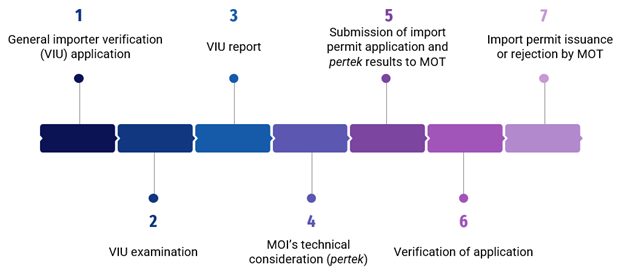
Applicants for an import permit must submit an application for general importer verification (VIU), the results of which will inform the MOI’s technical consideration process. If the MOI issues a recommendation or approval based on their technical consideration, applicants will be able to proceed with the submission of their import permit to the MOT.

The process of applying for and obtaining an API-U import permit has several steps, as shown in the diagram below.
New Trademark Certificate Requirement

Under the MOI’s March 2024 regulation, when applying for an API-U general import permit for textiles, textile products, bags, and footwear, the applicant is now required to submit trademark certificates for any products to be imported, along with the VIU.

Trademark certificates are not required when applying for API-P and PPBB import permits.

Impact

The new requirement to submit trademark certificates for the products to be imported is a significant issue for importers of affected products that have not obtained trademark registration in Indonesia, as they can no longer rely on letters of appointment to import from the trademark owners or authorized representatives.

This added requirement for imports of ready-made clothing, other ready-made textile goods, footwear, and bags comes in response to rapid increases in the circulation of imported goods, both in traditional markets and through e-commerce. The trademark certificate requirement is one of the steps taken by the government to tighten regulations on a number of imported commodities in Indonesia.

Importers need to discuss with brand owners early so that they can provide the proper trademark registration, which usually takes 1–2 years to obtain. This lead time will need to be factored in prior to obtaining the import permit.

For assistance with trademark registration for textiles, textile products, bags, and footwear in Indonesia, please contact Tilleke & Gibbins at [email protected].

RELATED INSIGHTS​ 

August 27, 2026
Franchising in Thailand has matured into a sizeable commercial sector, but the rules governing franchisor–franchisee relationships remain scattered across general legislation rather than consolidated in a dedicated franchise statute. In this environment, the decisions of the Trade Competition Commission of Thailand (TCCT) have emerged as valuable practical guidance. Thailand follows a civil-law system in which judicial and administrative decisions do not create binding precedent; however, past rulings are nonetheless influential. This article examines the most instructive recent TCCT decisions and distills the practical compliance considerations for franchisors and franchisees operating in Thailand. Postcontract Changes: Justified or Unfair? A recurring issue is whether a franchisor may alter the terms of engagement after contract execution. The TCCT has established that midterm modifications are not inherently unfair; the determinative factors are whether there was a reasonable business justification, adequate advance notice, and a transparent process. In a 2023 coffee franchise matter, for instance, the TCCT declined to find a violation where a franchisor increased raw material prices, noting the increase had been communicated in advance and supported by demonstrable cost pressures. A bubble tea franchise matter reinforces this principle. The TCCT found that postcontract mandatory purchases of branded syrup and flavorings were justified, as the agreement reserved the franchisor’s right to modify product requirements, the materials were sold at or below market prices, and the branded ingredients possessed distinctive qualities deemed essential to franchise quality. The complaint was dismissed, with the additional requirements characterized as a legitimate measure to preserve brand consistency. Considered together, these decisions indicate that post‑contract modifications will be evaluated against three criteria: (1) whether there is a legitimate business rationale, (2) whether adequate advance notice was provided, and (3) whether franchisees were treated equitably throughout the transition. Discriminatory Treatment: Are Renewals and Information Equal? A 2024 automotive dealership
August 20, 2026
As part of its membership in Lex Mundi, Tilleke & Gibbins has released the latest edition of its Guide to Doing Business in Thailand, providing an overview of the legal, regulatory, and commercial considerations for companies establishing or expanding operations in Thailand. The 2026 edition offers practical insight into the country’s business environment, investment framework, and operational requirements. The guide covers a wide range of topics relevant to foreign and domestic investors, including: Investment incentives and promotion schemes Financial facilities and banking regulations Exchange controls and money transfers Import and export regulations Business structures and incorporation options Requirements for establishing a business Operational and compliance considerations Business cessation and insolvency procedures Employment and labor laws Taxation Immigration and visa requirements Prepared by Tilleke & Gibbins lawyers across multiple practice areas, the publication outlines key aspects of doing business in Thailand, including foreign investment restrictions, regulatory compliance obligations, corporate structures, employment requirements, and recent legal and economic developments affecting investors. The publication forms part of Lex Mundi’s Country Guides series, a global collection of jurisdiction-specific reference materials prepared by member firms around the world. Together, these guides help companies evaluate opportunities, compare regulatory environments, and plan international business activities across multiple markets. The full Guide to Doing Business in Thailand 2026 is available through the button below.
August 13, 2026
On August 6, 2026, the National Bank of Cambodia (NBC) issued a notice calling on business owners that issue electronic money, such as e-wallet accounts and stored-value membership cards, to notify the central bank within 90 days. The notice targets businesses that are not licensed banking or financial institutions or payment service providers, but have been issuing e-money to facilitate payments within their own networks. Failure to notify the NBC may result in legal action. Background and Regulatory Basis The NBC has observed that certain businesses, including cafes, restaurants, transportation companies, entertainment centers, and gas stations, have been issuing e-money through e-wallet accounts in mobile apps or membership cards to facilitate customer payments for products or services within their own networks. Customers create e-wallet accounts and load balances to pay for goods or services at the issuing business. The NBC describes this as “single-purpose e-money.” Under the 1999 Law on Banking and Financial Institutions, providing payment facilities to customers forms part of the operations of banking and financial institutions and requires an NBC license. In addition, article 20 of the 2017 Prakas on the Management of Payment Service Institutions further prohibits legal entities other than banking and financial institutions and payment service institutions from issuing e-money. However, article 20 also provides that issuing e-money in certain limited cases does not require a license, but the NBC must be notified in advance in writing. A business may issue single-purpose e-money without a payment service institution license provided it meets all the following conditions and submits written notice to the NBC: The maximum balance per account is KHR 200,000 (approximately USD 50) or equivalent. The total aggregate balance across all accounts does not exceed KHR 800 million (approximately USD 200,000) or equivalent. The e-money is used to pay for products or
July 27, 2026
Vietnam’s new E-Commerce Law, which took effect on 1 July 2026 along with its implementing Decree No. 248/2026/ND-CP (Decree 248), marks a significant development in the country’s approach to online intellectual property (IP) enforcement, reflecting a clear shift from a reactive model of intermediary liability to one that expects platforms to play a more active role in preventing infringement. From notice-and-takedown to platform responsibility The most significant change introduced by the E-Commerce Law is the transformation of the legal role of e-commerce platforms. The existing safe harbor provisions under the IP Law and the copyright notice-and-takedown regime established by Decree 17/2023/ND-CP (Decree 17) largely required intermediaries to act only after receiving notice of infringement. Once infringing content had been removed, the platform’s legal obligation was generally considered fulfilled. The new legislation adopts a fundamentally different approach. Article 17 of the E-Commerce Law requires intermediary platforms to screen information relating to goods and services before publication in order to prevent listings involving counterfeit or IP-infringing goods, and goods of unknown origin. Rather than relying exclusively on complaints from rights holders, platforms are now expected to implement preventive measures before infringing listings become publicly available. Decree 248 further requires platforms to update keyword filters based on recommendations issued by competent authorities. These filtering mechanisms are intended to prevent prohibited listings from appearing on the platform and represent a further move away from a purely complaint-driven enforcement model. The legislation also introduces Vietnam’s first statutory stay-down obligation. Under the E-Commerce Law and Decree 248, major digital platforms must maintain automated systems capable of reviewing, warning against, and removing unlawful listings while also implementing measures to prevent repeat violations, defined under Decree 248 as conduct that has previously been identified and handled by the platform, but continues to recur. This obligation addresses one