You are using an outdated browser and your browsing experience will not be optimal. Please update to the latest version of Microsoft Edge, Google Chrome or Mozilla Firefox. Install Microsoft Edge

December 31, 2021

VAT Reduced to 7% under Amendments to Lao Tax Laws

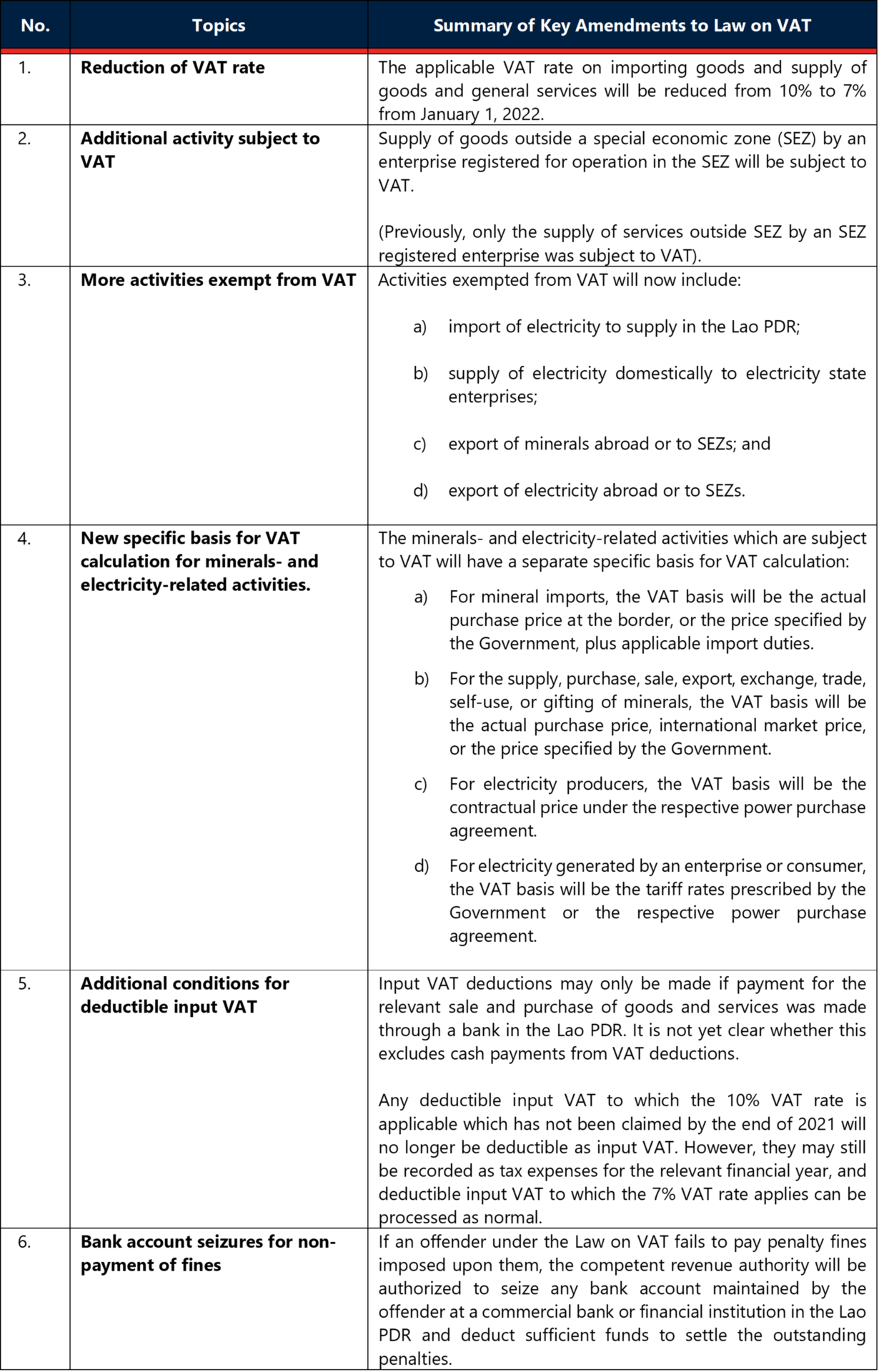
In the last week of December, 2021, the Ministry of Justice published the Law Amending Certain Provisions of the Laws on Tax No. 01/NA, dated August 7, 2021, in the Government Gazette. The Law will come into force on January 1, 2022.

The most notable amendments relate to Value Added Tax (VAT), which are summarized below.

The new law also makes changes to the laws on tax management, income tax, and excise tax, which Tilleke & Gibbins will provide updates on in due course.

RELATED INSIGHTS​ 

January 10, 2024
On December 15, 2023, the Electricity Authority of Cambodia (EAC) issued a notification requiring all owners of solar power systems to report their systems to their local electricity supplier by January 31, 2024. Systems that have already been reported under existing regulations are exempt from this requirement. Systems that remain unreported after the deadline will be deemed illegal and subject to penalties, including possible disconnection from the national grid. The rationale for the reporting requirement is that the EAC expects to adopt a new solar power regulation soon. Electricite du Cambodge (the main state-owned utility provider in Cambodia) and EAC-licensed private electricity providers are now gathering data on the current use of solar power systems in order to prepare for, adopt, and execute the upcoming regulation. The reporting requirement is to facilitate this gathering of data. The upcoming regulation, planned for early 2024 according to the notification, follows last year’s Prakas No. 159, which contained the Ministry of Mines and Energy’s guidelines and principles for rooftop solar systems. The EAC now needs to issue implementing regulations that are in line with the ministry’s guidelines and principles. Although stand-alone solar power systems that did not have a connection to the national grid were previously not regulated and did not require any authorizations, the EAC is now stating that all types of solar power systems need to adhere to the reporting requirement under the notification. According to the EAC, the upcoming regulation will address all types of systems, and the December 15 notification clearly announces that all types of solar power systems will need to obtain EAC approval under the upcoming regulation. Solar power system operators in Cambodia should report their systems to their local electricity providers by January 31, 2024, to avoid any penalties, while remaining vigilant for the upcoming
January 3, 2024
Thailand’s Energy Regulatory Commission (ERC) has issued the Notification on the Criteria for Regulating the Licensed Pool Manager B.E. 2566 (2023), which took effect on November 30, 2023. It followed an earlier notification, which took effect on October 13, 2023, that added the new license for the country’s pool gas manager. The new notification aims to regulate natural gas sale agreements and promote competition among players in the regulated natural gas market—that is, those who utilize natural gas for electricity generation under the Electricity Generating Authority of Thailand (EGAT) scheme, including industrial and NGV (natural gas for vehicles) consumers who rely on natural pool gas. The establishment of the pool gas scheme is aimed at encouraging new shippers to enter the market and providing new natural gas shippers with fair opportunities to compete with existing shippers, as all licensed shippers in the regulated market are subject to the same natural gas costs under this new scheme. Under this pool gas scheme, the pool manager plays a critical part in reselling natural gas in the country. Some of its responsibilities include the following: Purchasing natural gas or liquid natural gas (LNG) from licensed shippers in the regulated market at the rate at which the shippers procured the natural gas, including incidental expenses such as pipeline transportation and LNG station fees; Collecting data on the quantity and price of the gas purchased from the licensed shippers and calculating the pool gas price as specified in the ERC-approved manual, which is basically the average price of the natural gas procurement cost of all shippers in the pool; and Reselling natural gas or LNG to licensed shippers at the pool gas pricing rate in the quantity distributed to the pool by each shipper. Apart from its function in facilitating the primary procedures of
January 2, 2024
Myanmar’s Ministry of Commerce (MOC) has released updated information regarding the registration fees for online retail businesses. The fees and criteria, which are included in the MOC’s Export/Import Newsletter No. 17/2023 dated December 28, 2023, are laid out below. Registration Fees The official registration fees vary depending on the applicant type: Companies or other commercial organizations: MMK 70,000 (approx. USD 33.5) for registration and renewal; MMK 3,000 (approx. USD 1.5) for each amendment. Small and medium enterprises (SMEs): MMK 50,000 (approx. USD 24) for registration and renewal; MMK 3,000 (approx. USD 1.5) for each amendment. Individual applicants: 30,000 MMK (approx. USD 14.5) for registration and renewal; MMK 3,000 (approx. USD 1.5) for each amendment. Validity Period Registrations approved from January 1, 2024, will be valid for two years from the date of grant. The requirement for online retail businesses to register their operations was announced in July 2023. Based on statements from the MOC, online retail businesses need to complete their registration by late January 2024 to avoid potential enforcement actions. Regarding SMEs, the MOC will also evaluate their SME registration certificate issued by the Agency Office under the Small and Medium Enterprises Development Law 2015. For assistance completing the registration process, or for more details on any aspect of online retail operations in Myanmar, contact Tilleke & Gibbins at [email protected].
December 15, 2023
As part of its membership in Lex Mundi, Tilleke & Gibbins has published an updated edition of its Guide to Doing Business in Thailand for 2023. This guide outlines the key factors for starting and operating a business in the Thai market. Issues covered include: Investment incentives Financial facilities Exchange controls Import and export regulations Structures for doing business Requirements for the Establishment of a Business Operation of the Business Cessation or Termination of the Business Labor legislation, relations, and supply Tax Immigration requirements This publication is part of Lex Mundi’s Country Guides series prepared by member firms in more than 100 jurisdictions worldwide. The guides serve as a useful resource for planning international business strategy and researching new markets. The full Guide to Doing Business in Thailand is available through the button below.