
You are using an outdated browser and your browsing experience will not be optimal. Please update to the latest version of Microsoft Edge, Google Chrome or Mozilla Firefox. Install Microsoft Edge

September 5, 2019

Update on Thailand’s “Delisting” of Marijuana and Hemp from the Scope of Category 5 Narcotics

On Friday August 30, 2019, a Notification of the Thai Ministry of Public Health (“MOPH Notification”) was published in the Government Gazette. The MOPH Notification went into effect on August 31, 2019, one day after its publication.

This MOPH Notification outlines another Thai Government initiative in connection with the free cannabis policy, this time carving out further aspects of marijuana and hemp use from the stringent regulations under the Narcotics Act.

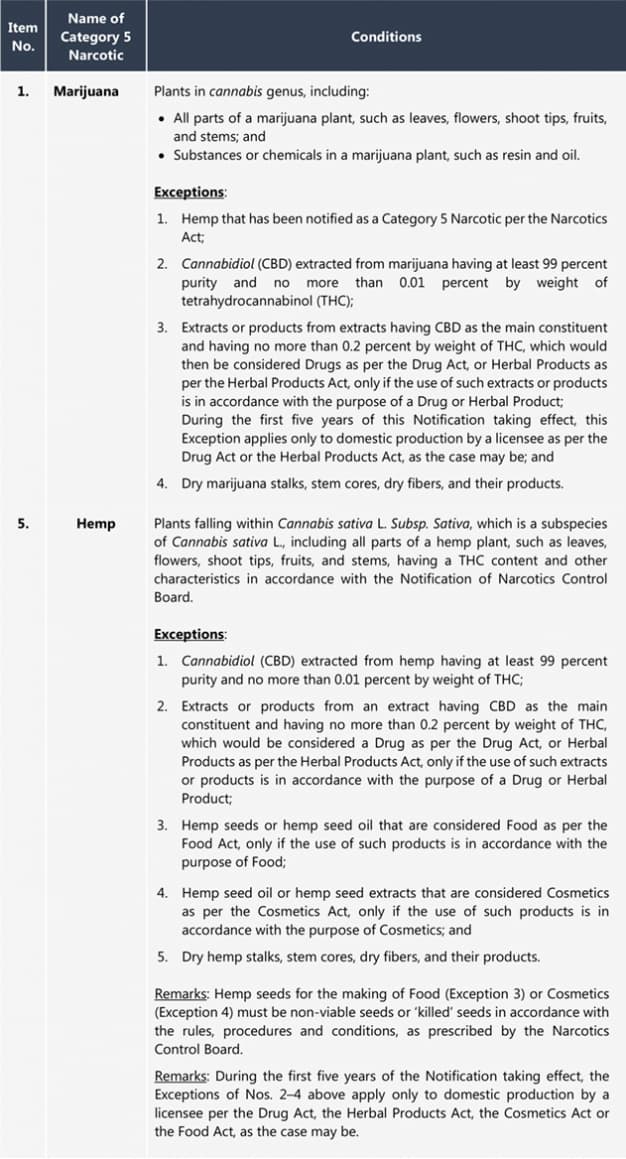
Marijuana is described in the MOPH Notification as plants of the cannabis genus, including all parts of a marijuana plant and the substances or chemicals found in a marijuana plant. Hemp is defined as plants falling within Cannabis sativa L. Subsp. sativa, including all parts of a hemp plant.

In fact, marijuana and hemp are not entirely “delisted” from the classification of Category 5 Narcotics as identified in the Narcotics Act. While these plants are still listed as Narcotics, the MOPH Notification serves to prescribe “exceptions”, meaning aspects and particulars of marijuana and hemp related products that are not considered Narcotics.

The new exceptions are summarized below.

For both marijuana and hemp

(1) Marijuana or hemp stalks, stem cores, and fibers are excepted, if dried. The products made of such dry parts are excepted, as well.

(2) Cannabidiol (CBD) extracted from marijuana or hemp is excepted if having at least 99% purity and no more than 0.01 percent by weight of tetrahydrocannabinol (THC).

(3) Extracts of marijuana or hemp having CBD as the main constituent and no more than 0.2% by weight of THC, which are considered “drugs” as per the Drug Act, or Herbal Products as identified in the Herbal Products Act.

For hemp only

(4) Hemp seeds or hemp seed oil, which are considered Food as identified in the Food Act.

(5) Hemp seed oil or hemp seed extracts, which are considered Cosmetics as identified in the Cosmetics Act.

In other words, hemp products according to the above descriptions may now be classified as Medicinal Drugs, Herbal Products, Food, or Cosmetics under their respective regulations. Marijuana may now be classified as Medicinal Drugs or Herbal Products only.

It should be noted that during the first five years under the MOPH Notification of August 30, 2019, the exceptions per (3) – (5) above apply only to domestic production by a licensee under the respective laws. This means the importation of products that would otherwise fall within those exceptions would still be regulated by the Narcotics Act—highlighting the Thai Government’s agenda in protecting Thai business operators.

According to the Thai Ministry of Public Health’s public conference held on September 2, 2019, the exception per (2) above for high-purity extracts (99% or higher of CBD; 0.01% or lower of THC) are intended to cover laboratory-grade standard extracts. For the (3) – (5) exceptions, the Thai FDA will later issue further rules under the Drug Act, the Herbal Products Act, the Cosmetics Act, or the Food Act to specifically accommodate the use of marijuana and hemp extracts in the respective products.

Moreover, amendments to the previous Industrial Hemp Regulation of 2016 are in the pipeline. The purpose of these amendments are to include non-public entities as parties having standing to apply for industrial hemp licenses.

Abridged Translation of the MOPH Notification
Remarks: The present MOPH Notification (2019) does not affect Items Nos. 2–4 on this list, which were prescribed by the previous MOPH Notification of 2018. Said unaffected items are:

No. 2:    Kratom (Mitragyna speciose);

No. 3:    Opium poppies (Papaver somniferum L. and Papaver bracteatum Lindl.); and

No. 4:    Psilocybin mushrooms.

Details about the above Nos. 2–4 are omitted from this update.

RELATED INSIGHTS​ 

September 4, 2025
With advancements in health technology, telemedicine has taken on a wider online presence in Thailand. Under the Medical Facility Act, licensed clinics and hospitals may now diagnose, prescribe, and issue electronic prescriptions during a video call, provided they maintain patient confidentiality and proper recordkeeping. As a complementary concept, a telepharmacy allows a pharmacist to verify prescriptions, counsel patients, and dispense medication from a remote site. Hospitals, clinic chains, and some retail pharmacy groups have adopted “drive-thru” or “locker” pick-up points where drugs are bagged only after a real-time video consultation with a registered pharmacist. The clear benefits of telehealth include shorter waiting times and broader access to specialists, which is in the public interest. Drug Distribution and Advertising in Thailand The online pharmacy ecosystem creates a legal bridge in that once a teleconsulting doctor issues an e-prescription, a licensed pharmacy can lawfully dispense and deliver the medicine prescribed to the patient’s door. Nonetheless, the critical compliance component remains the advertising of medicinal drugs. It is still not allowed to advertise prescription/pharmacy-dispensed drugs to the public in Thailand. Although Thailand’s Drug Act of 1967 was written more than half a century ago, it still governs the trading of every medicinal drug that makes its way to consumers in Thailand—whether bought at a pharmacy or delivered with a few taps on a smartphone. First and foremost, the pharmacy must hold a license to sell medicinal drugs as a retailer. It is also mandatory that arrangements be made for a pharmacist to be on duty during opening hours. Drugs are classified into three main categories: prescription drugs, pharmacy-dispensed drugs, and over-the-counter (OTC) drugs. The listing of OTC drugs with their prices via an online platform is allowed, as only OTC drugs may be advertised directly to the public. However, naming or showing
August 8, 2025
In response to persistent challenges in food safety management and recent high-profile incidents involving counterfeit supplemented foods, infant formula, and health supplements, the Ministry of Health of Vietnam is initiating comprehensive regulatory reforms. These reforms include proposed amendments to the Law on Food Safety and its implementing Decree No. 15/2018/ND-CP (Decree 15), introducing significant changes to the registration procedures for food products, especially supplemented food products and health supplements. While awaiting public consultation and approval of the amended Law on Food Safety, the Ministry of Health is developing an interim mechanism, which includes a draft decree to replace Decree 15 and a draft resolution to address urgent issues until the amended law becomes effective, expected in July 2026. To align with the new Law on Quality of Products and Goods, the draft resolution stipulates that the declaration and registration of food products will follow the following procedures: Declaration of applied standards for food products, which is currently known as the “self-declaration” procedure, applies to processed packaged foods, food additives, food processing aids, containers or utensils that come into direct contact with food, packaging materials in direct contact with food, and micronutrients. Granting of circulation numbers, which is the current “registration of product declaration” procedure, applies to specific categories of food including health supplements, medical nutrition foods, special dietary foods, nutritional products for children up to 36 months, and, especially, supplemented foods, which are currently subject to self-declaration but will be shifted to this registration procedure. In addition, the following new procedure is introduced in the draft decree: Registration of declaration of conformity, which applies to the same product category as in “declaration of applied standards” above, but is for products that are already subject to technical regulations covering both safety indicators and quality indicators. Changes to the Food Product
July 23, 2025
On June 26, 2025, the National Assembly of Vietnam adopted Resolution No. 216/2025/QH15 to extend the duration of agricultural land use tax exemption through December 31, 2030. This policy extension reaffirms the government’s ongoing efforts to support the agricultural sector, ensure national food security, and promote rural development. Key Takeaways Tax Exemption Period Extended: The new resolution continues the full exemption from agricultural land use tax as stipulated under Resolution No. 55/2010/QH12, as amended in 2016 and 2020. The tax exemption, which was originally set to expire at the end of 2025, will now remain in effect until December 31, 2030. Scope of Exemption: The exemption applies to all types of land currently eligible under the existing legal framework for agricultural land use tax relief. This typically includes land used by households, cooperatives, and non-commercial organizations for agricultural production, aquaculture, salt-making, and reforestation. Effective Date: Resolution 216 will take effect on January 1, 2026. During the interim period, tax exemption remains valid under existing laws and resolutions until the end of 2025. Implementation Guidance to Follow: The government is tasked with issuing detailed guidance to ensure effective implementation of this extended exemption. Businesses, cooperatives, and individuals engaged in agricultural activities should monitor upcoming regulations and instructions from relevant ministries. Outlook Vietnam’s extension of agricultural land use tax exemption demonstrates a strong policy commitment to rural economic stability and environmental sustainability. For land users, the exemption represents meaningful financial relief that can be reinvested into modernizing farming techniques, improving land efficiency, or transitioning to sustainable practices. While the extension itself is automatic, it is recommended that agricultural land users and stakeholders review their land use documentation and tax profiles to ensure alignment with eligibility requirements. Future implementation regulations may also introduce new compliance obligations that should be tracked closely.
July 15, 2025
On July 1, 2025, Vietnam’s Ministry of Health issued Circular No. 30/2025/TT-BYT providing updated guidance on the application of drug quality standards, testing of drugs and pharmaceutical ingredients, and procedures for the recall and handling of noncompliant drugs (Circular 30). Circular 30 officially came into effect on the same day and replaces Circular No. 11/2018/TT-BYT and its amendments. Key highlights of Circular 30 are presented below. Drug and Pharmaceutical Ingredient Quality Standards Circular 30 maintains consistency with previous regulations regarding the selection of an applicable quality specification. Pharmaceutical businesses and drug preparation establishments may still choose to apply standards from the Vietnamese Pharmacopoeia, reference pharmacopoeias (including the United States Pharmacopoeia, the European Pharmacopoeia, the British Pharmacopoeia, the Japanese Pharmacopoeia, and the International Pharmacopoeia), or an in-house specification. Priority is given to the Vietnamese Pharmacopoeia and reference pharmacopoeias, encompassing quality indicators, quality levels, and testing methods. If alternative pharmacopoeias or in-house specifications are used, they must meet the requirements outlined in the corresponding monographs of the Vietnamese or reference pharmacopoeias. At the time of registration, the quality standards of drugs and pharmaceutical ingredients must comply with either the current version of the pharmacopoeia or a previous version of the pharmacopoeia that is no more than two years older than the current version. The requirement for updating quality specifications in line with the quality under the corresponding pharmacopoeia also applies to products that have already been granted marketing authorization. Testing Drugs and Pharmaceutical Ingredients in Quality Management Similar to the regulations under the previous circular, if pharmaceutical businesses disagree with the sample testing results, they may, within five working days of receiving the test report, request that the state quality inspection authority designate an alternative testing facility. The testing period for establishments listed as foreign drug manufacturers with quality violations remains