
You are using an outdated browser and your browsing experience will not be optimal. Please update to the latest version of Microsoft Edge, Google Chrome or Mozilla Firefox. Install Microsoft Edge

September 5, 2019

Update on Thailand’s “Delisting” of Marijuana and Hemp from the Scope of Category 5 Narcotics

On Friday August 30, 2019, a Notification of the Thai Ministry of Public Health (“MOPH Notification”) was published in the Government Gazette. The MOPH Notification went into effect on August 31, 2019, one day after its publication.

This MOPH Notification outlines another Thai Government initiative in connection with the free cannabis policy, this time carving out further aspects of marijuana and hemp use from the stringent regulations under the Narcotics Act.

Marijuana is described in the MOPH Notification as plants of the cannabis genus, including all parts of a marijuana plant and the substances or chemicals found in a marijuana plant. Hemp is defined as plants falling within Cannabis sativa L. Subsp. sativa, including all parts of a hemp plant.

In fact, marijuana and hemp are not entirely “delisted” from the classification of Category 5 Narcotics as identified in the Narcotics Act. While these plants are still listed as Narcotics, the MOPH Notification serves to prescribe “exceptions”, meaning aspects and particulars of marijuana and hemp related products that are not considered Narcotics.

The new exceptions are summarized below.

For both marijuana and hemp

(1) Marijuana or hemp stalks, stem cores, and fibers are excepted, if dried. The products made of such dry parts are excepted, as well.

(2) Cannabidiol (CBD) extracted from marijuana or hemp is excepted if having at least 99% purity and no more than 0.01 percent by weight of tetrahydrocannabinol (THC).

(3) Extracts of marijuana or hemp having CBD as the main constituent and no more than 0.2% by weight of THC, which are considered “drugs” as per the Drug Act, or Herbal Products as identified in the Herbal Products Act.

For hemp only

(4) Hemp seeds or hemp seed oil, which are considered Food as identified in the Food Act.

(5) Hemp seed oil or hemp seed extracts, which are considered Cosmetics as identified in the Cosmetics Act.

In other words, hemp products according to the above descriptions may now be classified as Medicinal Drugs, Herbal Products, Food, or Cosmetics under their respective regulations. Marijuana may now be classified as Medicinal Drugs or Herbal Products only.

It should be noted that during the first five years under the MOPH Notification of August 30, 2019, the exceptions per (3) – (5) above apply only to domestic production by a licensee under the respective laws. This means the importation of products that would otherwise fall within those exceptions would still be regulated by the Narcotics Act—highlighting the Thai Government’s agenda in protecting Thai business operators.

According to the Thai Ministry of Public Health’s public conference held on September 2, 2019, the exception per (2) above for high-purity extracts (99% or higher of CBD; 0.01% or lower of THC) are intended to cover laboratory-grade standard extracts. For the (3) – (5) exceptions, the Thai FDA will later issue further rules under the Drug Act, the Herbal Products Act, the Cosmetics Act, or the Food Act to specifically accommodate the use of marijuana and hemp extracts in the respective products.

Moreover, amendments to the previous Industrial Hemp Regulation of 2016 are in the pipeline. The purpose of these amendments are to include non-public entities as parties having standing to apply for industrial hemp licenses.

Abridged Translation of the MOPH Notification
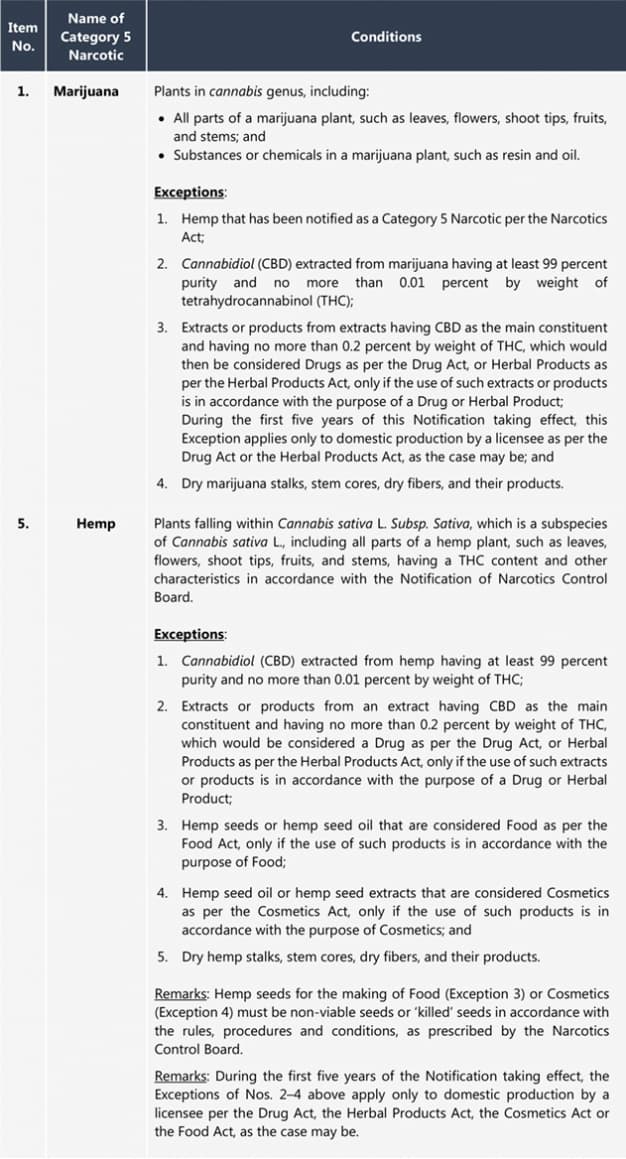
Remarks: The present MOPH Notification (2019) does not affect Items Nos. 2–4 on this list, which were prescribed by the previous MOPH Notification of 2018. Said unaffected items are:

No. 2:    Kratom (Mitragyna speciose);

No. 3:    Opium poppies (Papaver somniferum L. and Papaver bracteatum Lindl.); and

No. 4:    Psilocybin mushrooms.

Details about the above Nos. 2–4 are omitted from this update.

RELATED INSIGHTS​ 

July 14, 2025
Life sciences specialists from Tilleke & Gibbins have updated the firm’s guide to pharmaceutical data exclusivity regulations and practices in Southeast Asia. This guide contains quick-reference information on the availability of data exclusivity protections and limitations in Cambodia, Indonesia, Laos, Malaysia, Myanmar, Thailand, and Vietnam. Developing and launching a new drug on a commercial scale requires an enormous amount of time and investment in research and development (R&D), including pre-clinical testing and clinical trials. When considering the aggregate amount of drug development costs, it is important to recognize that this includes not only the investment in developing new drugs that get approved by a government food and drug regulator and are successfully brought to market, but also the R&D expenditures on a large number of potential pharmaceutical compounds and products that never actually make it to market. In particular, considerable investment is required in order to conduct and produce clinical trial data—to prove safety, efficacy and effectiveness of a new drug—that would warrant marketing approval by the regulatory authority. Such data is proprietary in nature and highly valuable for a research-based pharmaceutical company that develops an original drug. On the other hand, patent law typically confers generic drug manufacturers with the ability to engage in various preparatory activities with a view to obtaining marketing approval for a generic product before the patent for the original drug expires (commonly known as a “Bolar provision”). Since a generic drug maker may submit an application for marketing approval of a generic product before the relevant patent expires, the extent to which the drug originator’s data submitted to the regulatory authority is protected—or in other words, the extent to which the generic company may rely on the drug originator’s previously filed data, which underpins the safety and efficacy of the drug, to support
July 8, 2025
On July 3, 2025, Vietnam’s Ministry of Health (MOH) issued Circular No. 34/2025/TT-BYT amending some articles of Circular No. 06/2011/TT-BYT on the management of cosmetics products (Circular 34), which provides the current regulations on the product notification process for cosmetics (cosmetic notification). Circular 34 will come into effect on August 18, 2025. Changes to Cosmetic Notification Some of the key stipulations of Circular 34 are outlined below. Addition of submission route for notification Circular 34 officially adds online submission via the National Public Service Portal as an accepted type of cosmetic notification, in addition to direct submission and submission via post. Clearer regulations on preparing cosmetic notification form Circular 34 provides clarification on the signing requirements for cosmetic notification forms. For online submissions, both e-signatures and digital signatures are accepted. For offline submissions, the circular explicitly states that stamped/generated signatures are not acceptable. There are no substantive changes to existing requirements regarding grouping of products in a single declaration, ingredient listing, or language used in the notification form. Circular 34 only introduces formatting adjustments to these provisions. Updated administrative procedures Circular 34 updates requirements on digital procedures and authentication for online submission with references to new government decrees. In addition, processing timelines for cosmetic notification are further clarified, in particular, five working days for feedback on incomplete dossiers and five working days for approval after receiving complete supplemental dossiers. Revised requirements for import of samples for testing and research An updated Appendix 14-MP form is introduced with Circular 34, in which the receiving authority is updated from the Drug Administration of Vietnam to the specialized health agency under the provincial People’s Committee. Both online and direct submission of the request are allowed. The approval timeline is three working days from the date of reviewing the request. Transition clause Notifications
July 8, 2025
On June 29, 2025, the government of Vietnam issued Decree No. 163/2025/ND-CP providing detailed guidance on the implementation of the amended Law on Pharmacy (Decree 163). Decree 163, like the amended Law on Pharmacy, took effect on July 1, 2025, officially replacing Decree No. 54/2017/ND-CP (Decree 54). The new decree introduces comprehensive regulations across key areas of pharmaceutical management such as pharmacy practice certificates, certificates of eligibility for pharmaceutical business, import and export of drugs and drug materials, GMP inspection of foreign manufacturers, drug and drug material recall, certificates of drug advertising content, and drug price management. Key Changes in Decree 163 Some outstanding changes and additions in Decree 163 are presented below. Destruction of Specially Controlled Drugs It is no longer required to obtain approval from the competent authority before the destruction of narcotic, psychotropic, and precursor drugs, and pharmaceutical ingredients that are narcotic or psychotropic substances, or precursors used in drugs. Instead, notification must be provided at least seven working days in advance, including the proposed destruction date and a detailed list of items to be destroyed. E-commerce in Pharmaceuticals Pharmaceutical businesses operating via e-commerce platforms must publicly disclose the following information to ensure transparency and consumer safety: (i) certificate of eligibility for pharmaceutical business, (ii) pharmacy practice certificate of the person responsible for pharmaceutical expertise, and (iii) drug information. Shelf-Life Requirements for Imported Products For drugs and ingredients with a total shelf life of nine months or less, at least one-third of the shelf life must remain at the time of customs clearance. Drugs with a shelf life of 30 days or less must still be within their shelf life at the time of clearance. Control of Imported Products Drugs subject to import control include all drugs with marketing authorization (MA), except for (i) drugs that
May 28, 2025
Tilleke & Gibbins attorneys in Vietnam have contributed the 2025 edition of Doing Business in Vietnam, a comprehensive Q&A-style resource from Thomson Reuters Practical Law that provides essential insights for companies navigating business operations in Vietnam. The guide presents a detailed overview of the country’s legal framework and regulatory environment, reflecting recent updates in Vietnamese legislation and practice. This annually updated guide offers key information on the following areas: Legal system: Structure of the Vietnamese judiciary and the role of codified law. Foreign investment: Conditions for market access, licensing requirements, foreign ownership restrictions, and investment incentives. Business vehicles: Formation and operation of legal entities, including limited liability companies, joint-stock companies, and representative offices. Employment: Employment contracts, social insurance, labor rights, and procedures for hiring foreign nationals. Tax: Overview of corporate income tax, personal income tax, value-added tax, and other tax obligations. Intellectual property: Procedures for protecting and enforcing patents, trademarks, copyrights, and other IP rights. Data protection: Compliance requirements under Vietnam’s data privacy laws, including the Personal Data Protection Decree. Competition law: Antitrust rules and regulatory oversight under the Law on Competition. Anti-bribery and corruption: Legal framework and enforcement practices aimed at curbing corrupt activities. E-commerce and digital business: Regulations governing online platforms, digital content, and cross-border services. Marketing and advertising: Laws and guidelines on advertising standards and consumer protection. Product regulation and liability: Safety requirements, product liability issues, and roles of relevant authorities. Doing Business in Vietnam is part of Practical Law’s global series of legal guides designed to support international practitioners and businesses. To access the most recent edition of the Vietnam guide, visit the Practical Law website and sign up for a free trial.