
You are using an outdated browser and your browsing experience will not be optimal. Please update to the latest version of Microsoft Edge, Google Chrome or Mozilla Firefox. Install Microsoft Edge

August 25, 2025

The Impact of Recent Franchise Regulation Changes in Indonesia

Indonesia’s current regulations on franchises, as stipulated under Government Regulation No. 35/2024 on Franchising and its implementing regulation, Ministry of Trade (MOT) Regulation No. 71/2019 regarding Implementation of Franchising, highlight fundamental changes in franchise registration. These changes have introduced additional complexities and challenges in the franchise registration procedure, making it more difficult for franchise owners to navigate the process.

New procedure

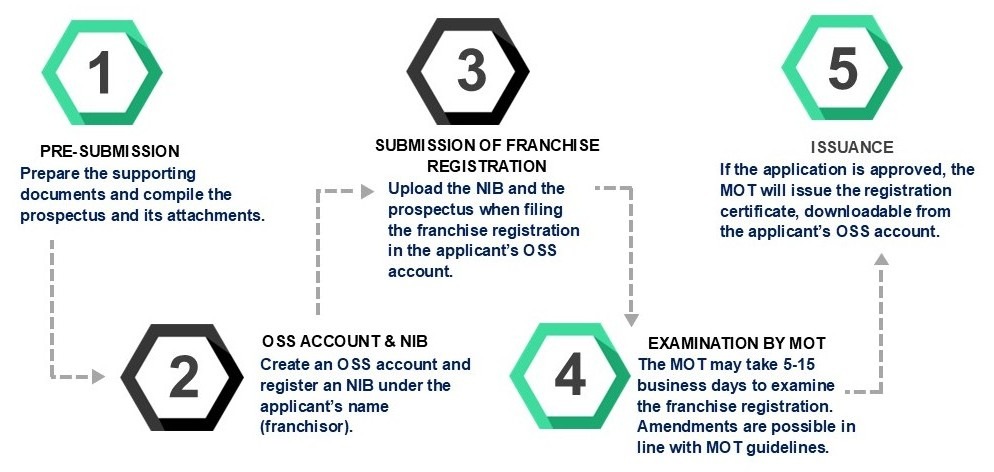
Franchise applications are still submitted through the Online Single Submission (OSS) portal of the Capital Investment Coordinating Board (BKPM). However, the new procedure requires each applicant, including foreign franchisors, to have an OSS account and a business registration number (NIB) issued by BKPM. An application for franchise registration must be submitted under the applicant’s own account—submissions can no longer be made through the account of a consultant.

Once a franchise application is submitted, the authority will distribute the submission to the MOT—the authorized ministry for franchise registration. Any notification or decision upon the registration made by the MOT will be available in the OSS system. Applicants should regularly monitor the status of the franchise application because no notifications will be sent to applicants to alert them of any deficiency.

Here is the summary of the new procedure for franchisors:
Notable Requirements

The disclosure document, or prospectus, is the key focus for the MOT in examining a franchise registration for a franchisor. This document is subject to thorough scrutiny by the MOT to ensure that all mandatory information meets the requirements set in the franchise regulations.

The current regulations specifically require that the mandatory clause “business system” in the prospectus cover operational standards and procedures, which should include human resource management, administration, operational management, standard operating methods, business location selection, business premises design, employee requirements, and marketing strategies.

Other clauses that are equally important to pay attention to are:

  • Identity of the franchisor: The identity should be in line with the IP owner. If not, a license agreement will be required.
  • Business legality of the franchisor: The business license must be attached to the prospectus.
  • Profit statements for the last two years: Audited financial report showing profit and loss.

Impact

The requirement for franchisors and franchisees to have an OSS account introduces additional steps and expenses in the franchise registration process. This requirement can be particularly burdensome for franchise business actors, as franchise registration is often facilitated by third parties, such as consultants. The new regulation mandates that the registration be submitted under the franchisor’s own account, which can be especially challenging for franchisees located overseas.

Ideally, creating an OSS account would be an option rather than a compulsion—this would ease the registration process for franchise business owners. Additionally, the OSS system should be made easier to navigate.

Nonetheless, the requirements stand for now, and business operators should take note of the additional steps that apply to them.


RELATED INSIGHTS​ 

November 3, 2023
Vietnam’s new Law on Protection of Consumer Rights No. 19/2023/QH15 (CPL 2023) was promulgated by the National Assembly on June 20, 2023, and will replace the existing Law on Protection of Consumer Rights No. 59/2010/QH12 (CPL 2010) when it enters into effect on July 1, 2024. The main points of interest of the CPL 2023 are summarized below. 1. Definition of Consumer Under the CPL 2023, a consumer is defined to be “a person who purchases and/or uses products, goods and services with the aim of consumption for daily needs of individuals, families, or organizations, and not for commercial purposes” (Article 3.1). Compared to the CPL 2010, this definition introduces the phrase “and not for commercial purposes” to emphasize the exclusive focus on the consumption of goods and services. However, the CPL 2023 retains the use of the term “person” for defining a consumer, leading to uncertainty regarding whether an organization or a family can qualify as a consumer. Similarly, the CPL 2023, as in the CPL 2010, maintains an ambiguous comma between “purchase” and “use,” so it remains somewhat ambiguous whether purchase (without use) or use (without purchase) of goods/services is sufficient to qualify as a consumer under the law. 2. Vulnerable Consumers The CPL 2023 introduces a new concept known as the “vulnerable consumer.” This term pertains to a consumer who, at the time of purchase or use of products/services, is potentially subject to various adverse situations in terms of information access, health, property, or dispute settlement. This category encompasses individuals such as the elderly and disabled, children, ethnic minorities, people of remote or economically difficult regions, pregnant women and breastfeeding mothers of infants under 36 months, individuals with severe illnesses, and members of poor households (Article 8.1). The rights and privileges of vulnerable consumers must be
October 30, 2023
On October 9, 2023, Laos issued Presidential Decree No. 003, which raised excise tax rates for certain goods, effective immediately. The move to increase excise tax rates comes amid the marked depreciation of the Lao kip (LAK). The Lao government is trying to monitor and discourage imports of non-essential products in order to reduce the outflow of foreign currency from the country. Increasing the tax rate for some of these products is part of these efforts. The specific products and excise tax rates are listed in the table below.   This new rate policy is also in line with recent government efforts to encourage avoiding payment in foreign currency to prevent the depletion of foreign currency reserves in Laos. In this regard, commercial banks have already taken action to ration the supply of foreign currency by prioritizing imports of essential goods, such as fuel. The products listed above formalize this impetus to prioritize certain imports and discourage others deemed not essential. In addition, the increased excise tax rates on fuel-powered vehicles show the commitment of the Lao government to move toward electric vehicles, which would also lessen the country’s dependence on fuel imports. For more information on these excise tax changes, or on any aspect of Laos’ international trade regulations, please contact Tilleke & Gibbins at [email protected].
October 17, 2023
On June 20, 2023, Vietnam’s new Law on Protection of Consumers’ Rights (“CPL 2023”) was officially promulgated, followed two days later by a new Law on E-Transactions (“LOET 2023”). The new laws, which will both take effect from July 1, 2024, replacing the CPL 2010 and the LOET 2005, respectively, provide new regulations for e-commerce platforms and will impact e-commerce activities in Vietnam. Some of the more significant changes are outlined below. Law on Protection of Consumers’ Rights Regulation of offshore entities: Previously, the CPL 2010 regulated only organizations and individuals in the territory of Vietnam. Under the CPL 2023, both onshore and offshore agencies, organizations, and individuals related to protecting consumers’ rights are regulated. In other words, Vietnam intends to monitor and manage activities of platforms with no legal presence in Vietnam. Remote transactions: Previously, the laws on consumer protection regulated “remote contracts.” The CPL 2023 introduces and defines “remote transactions” as transactions made online, by electronic means or by other means wherein consumers cannot check or have direct contact with products, goods or services before participating in the transaction. In addition, the CPL 2023 also provides for additional responsibilities of business entities offering remote transactions such as adequately and precisely providing consumers with information when entering into these remote transactions, including the rights of consumers in case of incomplete or inaccurate provision of information and complaint handling mechanisms. Online businesses: The CPL 2023 introduces “online businesses,” which are defined as (i) those trading products, goods, and services via their self-established platforms or digital platforms or (ii) those establishing or operating intermediary digital platforms. According to the Vietnam Competition Commission in a recent workshop, the definitions of “digital platforms” and “intermediary digital platforms” can be referred to in the LOET 2023 (see below). Under this new category, online
October 4, 2023
Extended producer responsibility (“EPR”), a strategy whereby producers are held accountable for the environmental impact of their products throughout their entire life cycle, including disposal and recycling, has become more and more familiar to manufacturers in Vietnam. According to the director of the legal department of the Ministry of Environment and Natural Resources, EPR is an alternative financial solution for managing waste and increasing recycling without raising environmental protection taxes and fees, which may help Vietnam to maintain a closed loop of resources in manufacturing. New EPR Regulations Applicable to Producers and Importers In 2020 and 2022, the new Law on Environmental Protection 2020 and its guiding Decree No. 08/2022/ND-CP were promulgated, introducing a legal framework for EPR (“New EPR Regulations”) imposed on not only producers but also importers. Under the New EPR Regulations, producers and importers of certain types of products and packaging are responsible to collect and treat waste and recycle their products and packaging. The responsibility to collect and treat waste took effect on January 10, 2022, while there are different timelines being phased in from 2024 to 2027 for the recycling of products and packaging, depending on the type. For the purpose of compliance with the recycling requirement under the New EPR Regulations, the producers and importers can implement the recycling obligation by themselves, or engage a third party to recycle or organize the recycling, or make a financial contribution to the Vietnam Environment Protection Fund to support the recycling process. This will cause an increase in cost and, hence, an impact on prices of certain products in the near future. Exceptions to the recycling obligation include: Producers and importers of products and packaging for (i) export or temporary import for re-export or (ii) manufacture or import for research, study, or testing purposes. Packaging producers