
You are using an outdated browser and your browsing experience will not be optimal. Please update to the latest version of Microsoft Edge, Google Chrome or Mozilla Firefox. Install Microsoft Edge

August 25, 2025

The Impact of Recent Franchise Regulation Changes in Indonesia

Indonesia’s current regulations on franchises, as stipulated under Government Regulation No. 35/2024 on Franchising and its implementing regulation, Ministry of Trade (MOT) Regulation No. 71/2019 regarding Implementation of Franchising, highlight fundamental changes in franchise registration. These changes have introduced additional complexities and challenges in the franchise registration procedure, making it more difficult for franchise owners to navigate the process.

New procedure

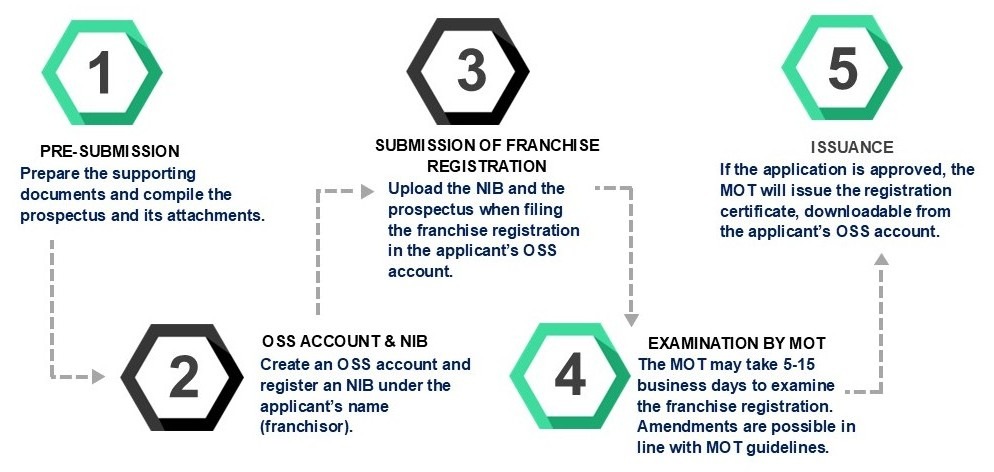
Franchise applications are still submitted through the Online Single Submission (OSS) portal of the Capital Investment Coordinating Board (BKPM). However, the new procedure requires each applicant, including foreign franchisors, to have an OSS account and a business registration number (NIB) issued by BKPM. An application for franchise registration must be submitted under the applicant’s own account—submissions can no longer be made through the account of a consultant.

Once a franchise application is submitted, the authority will distribute the submission to the MOT—the authorized ministry for franchise registration. Any notification or decision upon the registration made by the MOT will be available in the OSS system. Applicants should regularly monitor the status of the franchise application because no notifications will be sent to applicants to alert them of any deficiency.

Here is the summary of the new procedure for franchisors:
Notable Requirements

The disclosure document, or prospectus, is the key focus for the MOT in examining a franchise registration for a franchisor. This document is subject to thorough scrutiny by the MOT to ensure that all mandatory information meets the requirements set in the franchise regulations.

The current regulations specifically require that the mandatory clause “business system” in the prospectus cover operational standards and procedures, which should include human resource management, administration, operational management, standard operating methods, business location selection, business premises design, employee requirements, and marketing strategies.

Other clauses that are equally important to pay attention to are:

  • Identity of the franchisor: The identity should be in line with the IP owner. If not, a license agreement will be required.
  • Business legality of the franchisor: The business license must be attached to the prospectus.
  • Profit statements for the last two years: Audited financial report showing profit and loss.

Impact

The requirement for franchisors and franchisees to have an OSS account introduces additional steps and expenses in the franchise registration process. This requirement can be particularly burdensome for franchise business actors, as franchise registration is often facilitated by third parties, such as consultants. The new regulation mandates that the registration be submitted under the franchisor’s own account, which can be especially challenging for franchisees located overseas.

Ideally, creating an OSS account would be an option rather than a compulsion—this would ease the registration process for franchise business owners. Additionally, the OSS system should be made easier to navigate.

Nonetheless, the requirements stand for now, and business operators should take note of the additional steps that apply to them.


RELATED INSIGHTS​ 

September 28, 2023
Protecting the aesthetic features of consumer items, such as household appliances, is essential for businesses looking to gain a competitive edge, particularly in the dynamic markets of Vietnam, Indonesia, and Thailand. Industrial design registrations (or design patents in Thailand) provide an effective means to protect the unique and ornamental designs of products, ensuring that their distinctive appearance is not imitated by competitors. This article provides a general overview of design systems in Vietnam, Indonesia, and Thailand, as well as some key considerations for businesses and rights holders. All three of these countries use an examination system for assessing applications to protect designs. While all three jurisdictions are members of the Paris Convention, only Vietnam has fully completed the process of becoming a member of the Hague Agreement. The table below offers a general comparison of the three countries’ design systems, with additional details provided in the subsequent sections. Vietnam Owners of a household appliance design may seek design rights in Vietnam by filing a national design application at the Vietnam IP Office or by filing an international design application designating Vietnam either directly with the World Intellectual Property Organization (WIPO) or indirectly through the office of the applicant’s contracting party under the Hague Agreement. Vietnam’s 2022 IP Law redefines “industrial design” as the external appearance of a product or part thereof to be assembled into a complex product, represented by shapes, lines, colors, or a combination thereof, and visible in the process of exploiting the utility of the product or complex product. The two options for obtaining design rights in Vietnam are detailed below. Vietnam National Design Application As Vietnam is a signatory to the Paris Convention, applicants are entitled to a six-month convention priority period from the filing date of the corresponding application in another jurisdiction. Under Vietnam’s
September 26, 2023
Cambodia has issued a set of regulations that aim to encourage greater energy efficiency from appliances marketed in the country. The regulations follow Cambodia’s adoption of its National Energy Efficiency Policy, which sets out the government’s energy efficiency targets and policies to reach them by 2030, including the ambitious national target of reducing the country’s total energy consumption by at least 19%. This set of regulations for appliances marketed in Cambodia is contained in Sub-Decree No. 254 on the Management and Improvement of Energy Efficiency of Electrical Appliances, dated August 11, 2023. This sub-decree sets out product registration and energy efficiency labeling requirements for electrical appliances marketed in Cambodia. It further provides that appliances should meet energy efficiency standards and all other mandatory standards that apply to electrical appliances. During the product registration process, the appliances are checked against such standards, and registration is only granted if the standards are met. The sub-decree identifies the Ministry of Mines and Energy as the main ministry responsible for the implementation of the sub-decree. To assist with the wide scope of regulations as set by the sub-decree, it further appoints assisting ministries that may implement and enforce only certain aspects. These effective implementation and enforcement mechanisms suggest that once the sub-decree’s 12-month implementation period has passed, there is likely to be a rather strict enforcement approach to the requirements. Key Features of the Sub-Decree Several mandatory standards have already been applied to most electrical appliances over the past years, but the required product registration process to check for compliance with those standards has not always been completed by those importing, distributing, or manufacturing electrical appliances in Cambodia. The new sub-decree clearly mandates a product registration requirement as a check to verify the applicable standards are met, and sets penalties for non-compliance. Penalties
September 21, 2023
Myanmar’s Ministry of Commerce has announced its E-commerce Guidelines to regulate stakeholders engaging in e-commerce. The guidelines—which were issued on September 5, 2023, and took immediate effect—are mandatory for e-commerce business operators (both entities and individuals), and failure to comply with the guidelines’ requirements may result in penalties under relevant laws. The E-commerce Guidelines come as Myanmar seeks to increase its regulation of e-commerce activities. The guidelines were preceded by a July 2023 notification requiring e-commerce business operators to register their activities with the Ministry of Commerce by January 21, 2024. Definitions “E-commerce” is defined as the sale of goods or services on the internet or other digital platforms. The term also covers sales promotions, marketing, logistics, ordering, and delivery. An “e-commerce platform entrepreneur” is a person who manages an e-commerce platform where two or more entrepreneurs can conduct e-commerce. An “e-commerce business operator” is a person operating or authorized to operate e-commerce activities. This includes e-commerce platform entrepreneurs, entrepreneurs selling on e-commerce platforms, and sellers through social media platforms. Electronic Contracts Acceptable forms of electronic contracts, which must comply with the Electronic Transactions Law, Contract Act, and other relevant laws, include: Click-wrap, click-through, and web-wrap contracts; Browse-wrap contracts; and Agreements between seller and buyer on social media platforms, such as by accepting or rejecting an offer via direct message. Samples of contract forms are appended to the guidelines. Consumer Protection Disclosure notices for consumers must be comprehensible, correct, consistent, simple, accessible, and visible. They can be written in Myanmar language, English, or Myanmar language and another language. They must also comply with the relevant provisions of the Consumer Protection Law. The guidelines provide that if the agreed delivery date is eclipsed by more than 15 days, the consumer may terminate the contract and request a full refund of
August 9, 2023
Cambodia imports a substantial amount of food products to meet its domestic demand. Most of these imported products are from nearby ASEAN countries, with Thailand, Malaysia, and Vietnam providing the bulk of these food imports. However, food products from markets further away are becoming more popular each year, including brands from Australia, Japan, China, the EU, South-Korea, and the US. Many food product owners and distributors do not realize that all types of prepackaged food products, including imports, require product registration before they are permitted to be sold in Cambodia. This usually requires an assessment against mandatory Cambodian Standards and local technical regulations. There are general Cambodian Standards that cover all types of prepackaged food products, as well as product-specific standards and regulations that may be applicable. Furthermore, any type of prepackaged food product sold in Cambodia must bear a Khmer language label that meets the minimum consumer information standards, and the Cambodian Standards. This label requirement is often overlooked, with many products on the market bearing only a foreign language label. Product Registration & Labeling Requirements Back in 2000, a Cambodian Standard on prepackaged food labeling was adopted, clearly mandating Khmer language labeling for all types of prepackaged foods. Unfortunately, this labeling standard was not widely adopted by the industry, and even today compliance is low. Low compliance, combined with a lack of widespread enforcement efforts, led to a misguided understanding that imported food products were not subject to any standards, did not require product registration, and were not required to bear Khmer language labeling. Recent legal developments related to consumer protection and food safety clarified several of these misunderstandings. For example, the regulations clearly state that all types of food product must meet the applicable standards and technical regulations, which is assessed through registration. The new Law