You are using an outdated browser and your browsing experience will not be optimal. Please update to the latest version of Microsoft Edge, Google Chrome or Mozilla Firefox. Install Microsoft Edge

October 30, 2023

Laos Raises Excise Tax Rate on Certain Products

On October 9, 2023, Laos issued Presidential Decree No. 003, which raised excise tax rates for certain goods, effective immediately.

The move to increase excise tax rates comes amid the marked depreciation of the Lao kip (LAK). The Lao government is trying to monitor and discourage imports of non-essential products in order to reduce the outflow of foreign currency from the country. Increasing the tax rate for some of these products is part of these efforts.

The specific products and excise tax rates are listed in the table below.
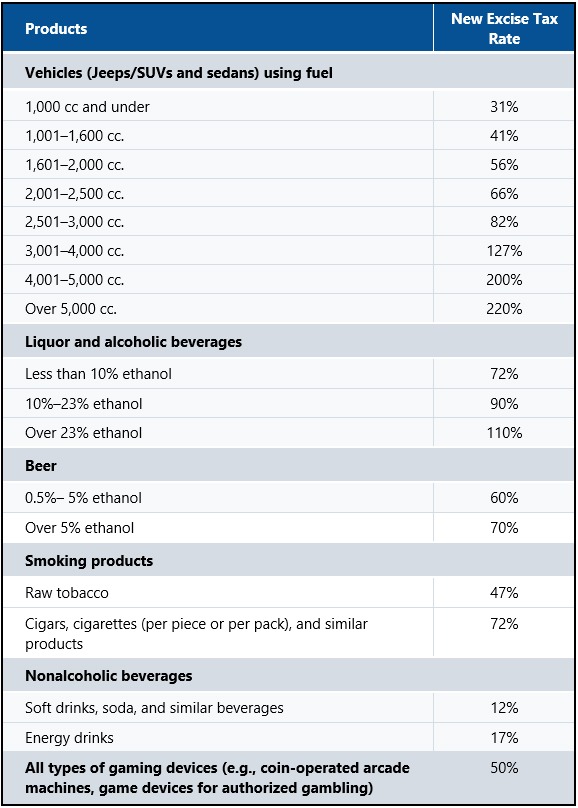
 

This new rate policy is also in line with recent government efforts to encourage avoiding payment in foreign currency to prevent the depletion of foreign currency reserves in Laos. In this regard, commercial banks have already taken action to ration the supply of foreign currency by prioritizing imports of essential goods, such as fuel. The products listed above formalize this impetus to prioritize certain imports and discourage others deemed not essential. In addition, the increased excise tax rates on fuel-powered vehicles show the commitment of the Lao government to move toward electric vehicles, which would also lessen the country’s dependence on fuel imports.

For more information on these excise tax changes, or on any aspect of Laos’ international trade regulations, please contact Tilleke & Gibbins at [email protected].

RELATED INSIGHTS​ 

August 20, 2026
As part of its membership in Lex Mundi, Tilleke & Gibbins has released the latest edition of its Guide to Doing Business in Thailand, providing an overview of the legal, regulatory, and commercial considerations for companies establishing or expanding operations in Thailand. The 2026 edition offers practical insight into the country’s business environment, investment framework, and operational requirements. The guide covers a wide range of topics relevant to foreign and domestic investors, including: Investment incentives and promotion schemes Financial facilities and banking regulations Exchange controls and money transfers Import and export regulations Business structures and incorporation options Requirements for establishing a business Operational and compliance considerations Business cessation and insolvency procedures Employment and labor laws Taxation Immigration and visa requirements Prepared by Tilleke & Gibbins lawyers across multiple practice areas, the publication outlines key aspects of doing business in Thailand, including foreign investment restrictions, regulatory compliance obligations, corporate structures, employment requirements, and recent legal and economic developments affecting investors. The publication forms part of Lex Mundi’s Country Guides series, a global collection of jurisdiction-specific reference materials prepared by member firms around the world. Together, these guides help companies evaluate opportunities, compare regulatory environments, and plan international business activities across multiple markets. The full Guide to Doing Business in Thailand 2026 is available through the button below.
August 13, 2026
On August 6, 2026, the National Bank of Cambodia (NBC) issued a notice calling on business owners that issue electronic money, such as e-wallet accounts and stored-value membership cards, to notify the central bank within 90 days. The notice targets businesses that are not licensed banking or financial institutions or payment service providers, but have been issuing e-money to facilitate payments within their own networks. Failure to notify the NBC may result in legal action. Background and Regulatory Basis The NBC has observed that certain businesses, including cafes, restaurants, transportation companies, entertainment centers, and gas stations, have been issuing e-money through e-wallet accounts in mobile apps or membership cards to facilitate customer payments for products or services within their own networks. Customers create e-wallet accounts and load balances to pay for goods or services at the issuing business. The NBC describes this as “single-purpose e-money.” Under the 1999 Law on Banking and Financial Institutions, providing payment facilities to customers forms part of the operations of banking and financial institutions and requires an NBC license. In addition, article 20 of the 2017 Prakas on the Management of Payment Service Institutions further prohibits legal entities other than banking and financial institutions and payment service institutions from issuing e-money. However, article 20 also provides that issuing e-money in certain limited cases does not require a license, but the NBC must be notified in advance in writing. A business may issue single-purpose e-money without a payment service institution license provided it meets all the following conditions and submits written notice to the NBC: The maximum balance per account is KHR 200,000 (approximately USD 50) or equivalent. The total aggregate balance across all accounts does not exceed KHR 800 million (approximately USD 200,000) or equivalent. The e-money is used to pay for products or
July 27, 2026
Vietnam’s new E-Commerce Law, which took effect on 1 July 2026 along with its implementing Decree No. 248/2026/ND-CP (Decree 248), marks a significant development in the country’s approach to online intellectual property (IP) enforcement, reflecting a clear shift from a reactive model of intermediary liability to one that expects platforms to play a more active role in preventing infringement. From notice-and-takedown to platform responsibility The most significant change introduced by the E-Commerce Law is the transformation of the legal role of e-commerce platforms. The existing safe harbor provisions under the IP Law and the copyright notice-and-takedown regime established by Decree 17/2023/ND-CP (Decree 17) largely required intermediaries to act only after receiving notice of infringement. Once infringing content had been removed, the platform’s legal obligation was generally considered fulfilled. The new legislation adopts a fundamentally different approach. Article 17 of the E-Commerce Law requires intermediary platforms to screen information relating to goods and services before publication in order to prevent listings involving counterfeit or IP-infringing goods, and goods of unknown origin. Rather than relying exclusively on complaints from rights holders, platforms are now expected to implement preventive measures before infringing listings become publicly available. Decree 248 further requires platforms to update keyword filters based on recommendations issued by competent authorities. These filtering mechanisms are intended to prevent prohibited listings from appearing on the platform and represent a further move away from a purely complaint-driven enforcement model. The legislation also introduces Vietnam’s first statutory stay-down obligation. Under the E-Commerce Law and Decree 248, major digital platforms must maintain automated systems capable of reviewing, warning against, and removing unlawful listings while also implementing measures to prevent repeat violations, defined under Decree 248 as conduct that has previously been identified and handled by the platform, but continues to recur. This obligation addresses one
July 21, 2026
On July 6, 2026, Myanmar’s Ministry of Finance and Revenue introduced revised procedures governing the importation and exportation of goods and vehicles, replacing the framework that had been in place since 2017. The revised procedures were introduced in Notification No. 115/2026, which establishes updated compliance requirements and penalties for importers and exporters, covering licensing, declarations, product specifications, prior arrival of goods, and imports or exports made without the required licenses or permits. Scope Unlike its predecessor (Notification No. 6/2017), which focused primarily on import-related noncompliance, the new notification regulates both import and export activities and introduces a separate penalty schedule for export violations. Exporters are now required to ensure that their exports comply with the approvals stated in export licenses and permits, match the information declared in export declarations, and are supported by the required licenses, permits, and accompanying documents. Import Compliance and Penalties The new notification imposes several compliance requirements on importers. Importers must ensure that the country of origin, branding, labeling, and other product information are consistent with the relevant import license or permit, import declaration, and the imported goods. For vehicles and machinery, the model year must match the year approved by the Ministry of Commerce. Importers must also ensure that goods are not imported before the issuance or after the expiry of the import license or permit, and that the imported quantity does not exceed the approved amount. Failure to comply with these requirements may result in regulatory action. As for the notification’s revised penalties for noncompliance with import licensing requirements, imports made without the required import license, permit, or import declaration may be subject to fines ranging from one to three times the assessable value (AV) of the goods, depending on the category of goods involved. Certain vehicles and machinery, as well as specific