
You are using an outdated browser and your browsing experience will not be optimal. Please update to the latest version of Microsoft Edge, Google Chrome or Mozilla Firefox. Install Microsoft Edge

August 25, 2025

The Impact of Recent Franchise Regulation Changes in Indonesia

Indonesia’s current regulations on franchises, as stipulated under Government Regulation No. 35/2024 on Franchising and its implementing regulation, Ministry of Trade (MOT) Regulation No. 71/2019 regarding Implementation of Franchising, highlight fundamental changes in franchise registration. These changes have introduced additional complexities and challenges in the franchise registration procedure, making it more difficult for franchise owners to navigate the process.

New procedure

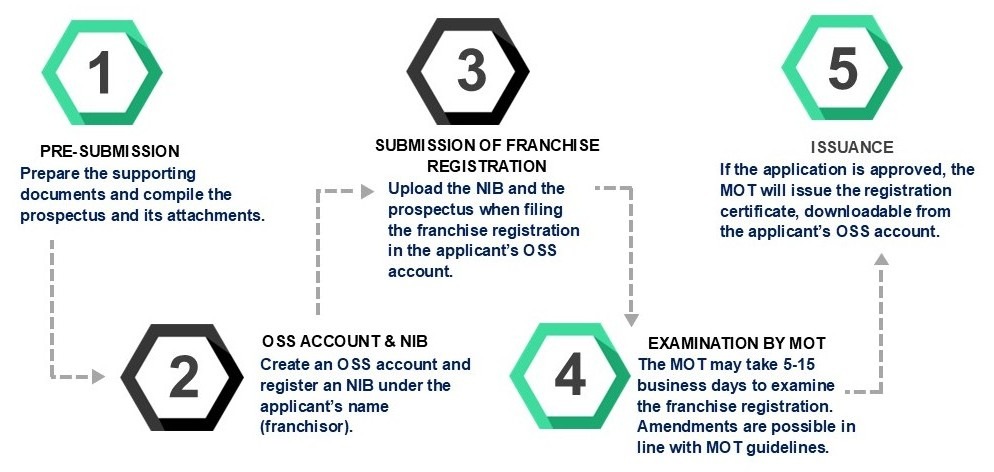
Franchise applications are still submitted through the Online Single Submission (OSS) portal of the Capital Investment Coordinating Board (BKPM). However, the new procedure requires each applicant, including foreign franchisors, to have an OSS account and a business registration number (NIB) issued by BKPM. An application for franchise registration must be submitted under the applicant’s own account—submissions can no longer be made through the account of a consultant.

Once a franchise application is submitted, the authority will distribute the submission to the MOT—the authorized ministry for franchise registration. Any notification or decision upon the registration made by the MOT will be available in the OSS system. Applicants should regularly monitor the status of the franchise application because no notifications will be sent to applicants to alert them of any deficiency.

Here is the summary of the new procedure for franchisors:
Notable Requirements

The disclosure document, or prospectus, is the key focus for the MOT in examining a franchise registration for a franchisor. This document is subject to thorough scrutiny by the MOT to ensure that all mandatory information meets the requirements set in the franchise regulations.

The current regulations specifically require that the mandatory clause “business system” in the prospectus cover operational standards and procedures, which should include human resource management, administration, operational management, standard operating methods, business location selection, business premises design, employee requirements, and marketing strategies.

Other clauses that are equally important to pay attention to are:

  • Identity of the franchisor: The identity should be in line with the IP owner. If not, a license agreement will be required.
  • Business legality of the franchisor: The business license must be attached to the prospectus.
  • Profit statements for the last two years: Audited financial report showing profit and loss.

Impact

The requirement for franchisors and franchisees to have an OSS account introduces additional steps and expenses in the franchise registration process. This requirement can be particularly burdensome for franchise business actors, as franchise registration is often facilitated by third parties, such as consultants. The new regulation mandates that the registration be submitted under the franchisor’s own account, which can be especially challenging for franchisees located overseas.

Ideally, creating an OSS account would be an option rather than a compulsion—this would ease the registration process for franchise business owners. Additionally, the OSS system should be made easier to navigate.

Nonetheless, the requirements stand for now, and business operators should take note of the additional steps that apply to them.


RELATED INSIGHTS​ 

March 22, 2024
Laos has returned its value-added tax rate to 10% from the 7% rate that had been observed for the last two years. The new rate was specified in Ordinance No. 003/PDT, dated March 19, 2024, and announced on the website of the Ministry of Trade and Commerce. Prior to this, the last announcement of an adjustment in the VAT rate came in the last week of December 2021, when the Ministry of Justice published the Law Amending Certain Provisions of the Laws on Tax No. 01/NA, dated August 7, 2021, in the Government Gazette. This law, which entered into force in January 2022, amended the VAT rate from 10% to 7%. Under Lao law, the ordinance is effective from its date of signing by the president of Laos (i.e., March 19, 2024). However, the tax authorities have indicated that the new rate will not be enforced immediately but will be implemented in the near future, such as when it is published in the Lao Official Gazette. This change of the VAT rate to 10% does not come as a surprise. Some international experts and organizations had been recommending that Laos adopt a 10% VAT rate given its current economic challenges, arguing that Laos should prioritize collecting tax and replenishing the state budget. This was, for instance, recommended by the World Bank in the November 2023 Lao PDR Economic Monitor. Tilleke & Gibbins will continue to monitor the situation to determine when the 10% VAT rate will be enforced. For more details on the rate changes, or on any aspect of tax law in Laos, please contact Tilleke & Gibbins at [email protected].
March 22, 2024
Indonesia’s Ministry of Industry (MOI) has issued a new regulation requiring importers of textiles, textile products, bags, and footwear to furnish applicable trademark certificates when applying for an import permit. This means that a letter of appointment to import from the trademark owner or authorized representative is no longer sufficient to obtain an import permit for these goods. The requirement is detailed in MOI Regulation No. 5 of 2024 concerning Procedures for Issuing Technical Considerations for Imports of Textiles, Textile Products, Bags and Footwear, which took effect on March 10, 2024. Affected Products The new regulation applies to the following products: Textiles: Fiber, thread, fabric Textile products: Carpets, other textile floor coverings, clothing, ready-made clothing accessories, other finished textile goods Bags: Suitcases, wallets, school bags, sports bags, handbags, other bags Footwear: Shoes, sandals, moccasins Import Permits In principle, businesses can import textiles, textile products, bags, and footwear as raw materials, auxiliary materials, or consumer goods (for trading) after obtaining the appropriate import permit from the Ministry of Trade (MOT). There are three categories of import permits: General import permits for consumption (API-U), which are required for parties that conduct import activities for the purpose of trading; Import permits for producers (API-P); and Import permits for suppliers of raw or auxiliary materials (PPBB). Applicants for an import permit must submit an application for general importer verification (VIU), the results of which will inform the MOI’s technical consideration process. If the MOI issues a recommendation or approval based on their technical consideration, applicants will be able to proceed with the submission of their import permit to the MOT. The process of applying for and obtaining an API-U import permit has several steps, as shown in the diagram below. New Trademark Certificate Requirement Under the MOI’s March 2024 regulation, when applying for
January 2, 2024
Myanmar’s Ministry of Commerce (MOC) has released updated information regarding the registration fees for online retail businesses. The fees and criteria, which are included in the MOC’s Export/Import Newsletter No. 17/2023 dated December 28, 2023, are laid out below. Registration Fees The official registration fees vary depending on the applicant type: Companies or other commercial organizations: MMK 70,000 (approx. USD 33.5) for registration and renewal; MMK 3,000 (approx. USD 1.5) for each amendment. Small and medium enterprises (SMEs): MMK 50,000 (approx. USD 24) for registration and renewal; MMK 3,000 (approx. USD 1.5) for each amendment. Individual applicants: 30,000 MMK (approx. USD 14.5) for registration and renewal; MMK 3,000 (approx. USD 1.5) for each amendment. Validity Period Registrations approved from January 1, 2024, will be valid for two years from the date of grant. The requirement for online retail businesses to register their operations was announced in July 2023. Based on statements from the MOC, online retail businesses need to complete their registration by late January 2024 to avoid potential enforcement actions. Regarding SMEs, the MOC will also evaluate their SME registration certificate issued by the Agency Office under the Small and Medium Enterprises Development Law 2015. For assistance completing the registration process, or for more details on any aspect of online retail operations in Myanmar, contact Tilleke & Gibbins at [email protected].
December 15, 2023
As part of its membership in Lex Mundi, Tilleke & Gibbins has published an updated edition of its Guide to Doing Business in Thailand for 2023. This guide outlines the key factors for starting and operating a business in the Thai market. Issues covered include: Investment incentives Financial facilities Exchange controls Import and export regulations Structures for doing business Requirements for the Establishment of a Business Operation of the Business Cessation or Termination of the Business Labor legislation, relations, and supply Tax Immigration requirements This publication is part of Lex Mundi’s Country Guides series prepared by member firms in more than 100 jurisdictions worldwide. The guides serve as a useful resource for planning international business strategy and researching new markets. The full Guide to Doing Business in Thailand is available through the button below.