
You are using an outdated browser and your browsing experience will not be optimal. Please update to the latest version of Microsoft Edge, Google Chrome or Mozilla Firefox. Install Microsoft Edge

September 30, 2025

Thailand’s Employee Committees and Their Statutory Protection

Over the past several years, during and after the COVID-19 pandemic, Thai employees and labor unions have faced reductions in benefits and welfare from their employers. Consequently, they have pursued various strategies to enhance their compensation packages. One such approach involves establishing employee committees to negotiate with employers regarding benefits and welfare. Additionally, companies with existing unions typically nominate representatives to serve on these employee committees. Many employers, however, remain unfamiliar with both the committee’s role and the heightened procedural requirements that apply when disciplinary measures are contemplated against committee members. Because any violation of a committee member’s statutory rights can expose the employer—and its directors or authorized representatives—to criminal liability, a clear understanding of the relevant legal framework is essential.

The Labor Relations Act B.E. 2518 (LRA) provides the statutory foundation for establishing employee committees. The purpose of the committee is to promote harmonious industrial relations and create a formal channel through which employees and employers can discuss workplace matters on a regular basis.

Any workplace that employs at least fifty employees must, upon request by employees or the labor union, facilitate the creation of a committee. Members may be elected directly by employees or, where applicable, appointed by the labor union. Each member serves a three-year term. The LRA prescribes minimum committee sizes based on the employer’s headcount, as shown in the table below.
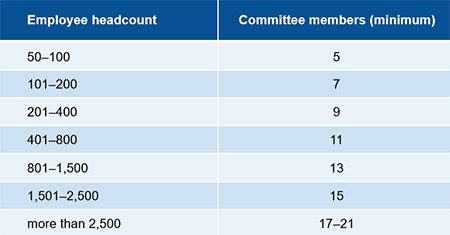
If union members constitute more than 20 percent of the total workforce, the union must appoint at least one more committee member than the number of nonunion members elected by the general workforce. If union membership exceeds 50 percent of the workforce, the union acquires the exclusive right to appoint every committee member. Where multiple unions exist and their combined appointments would exceed the statutory committee size, the employer may lawfully refuse to recognize the excess appointees.

Employees appointed by the union assume office on the date of appointment, even if the election of nonunion members has not yet occurred.

The employer must meet with the committee at least once every three months, or sooner if requested by the union or by more than half of the committee members for reasonable cause, to address:

  • Provision and improvement of employee welfare;
  • Formulation or amendment of work rules;
  • Employee complaints; and
  • Settlement of workplace disputes.

If the committee deems any employer action unfair or unduly burdensome to employees, the committee, an individual employee, or the union may file a petition with the Labor Court for relief.

Special Protections for Committee Members

The LRA prohibits employers from dismissing, reducing the wages of, imposing disciplinary sanctions against, or otherwise obstructing a committee member in the performance of their duties—and from taking any action that would render the member unable to continue working—without first obtaining permission from the Labor Court. Noncompliance constitutes a criminal offense punishable by imprisonment of up to one month, a fine of up to THB 1,000 (approx. USD 30), or both. Supreme Court precedent confirms that these penalties attach immediately upon the unlawful act; a subsequent court order authorizing the dismissal does not cure the prior violation.

The court-approval requirement applies even when the member has breached company work rules. Although the employer may seek the committee member’s dismissal based on such misconduct, the court retains discretion to impose a lesser penalty if it finds termination disproportionate to the offense. Conversely, once the court has authorized termination, the dismissal does not constitute an unfair labor practice, and the employee is barred from filing a complaint with the Labor Relations Committee.

In light of these provisions, employers should proceed with caution when contemplating any disciplinary or obstructive measure against a committee member. Compliance with the LRA’s procedural safeguards is paramount to avoid exposure to criminal liability and ensure lawful continuation of business operations.

RELATED INSIGHTS​ 

May 28, 2025
Tilleke & Gibbins attorneys in Vietnam have contributed the 2025 edition of Doing Business in Vietnam, a comprehensive Q&A-style resource from Thomson Reuters Practical Law that provides essential insights for companies navigating business operations in Vietnam. The guide presents a detailed overview of the country’s legal framework and regulatory environment, reflecting recent updates in Vietnamese legislation and practice. This annually updated guide offers key information on the following areas: Legal system: Structure of the Vietnamese judiciary and the role of codified law. Foreign investment: Conditions for market access, licensing requirements, foreign ownership restrictions, and investment incentives. Business vehicles: Formation and operation of legal entities, including limited liability companies, joint-stock companies, and representative offices. Employment: Employment contracts, social insurance, labor rights, and procedures for hiring foreign nationals. Tax: Overview of corporate income tax, personal income tax, value-added tax, and other tax obligations. Intellectual property: Procedures for protecting and enforcing patents, trademarks, copyrights, and other IP rights. Data protection: Compliance requirements under Vietnam’s data privacy laws, including the Personal Data Protection Decree. Competition law: Antitrust rules and regulatory oversight under the Law on Competition. Anti-bribery and corruption: Legal framework and enforcement practices aimed at curbing corrupt activities. E-commerce and digital business: Regulations governing online platforms, digital content, and cross-border services. Marketing and advertising: Laws and guidelines on advertising standards and consumer protection. Product regulation and liability: Safety requirements, product liability issues, and roles of relevant authorities. Doing Business in Vietnam is part of Practical Law’s global series of legal guides designed to support international practitioners and businesses. To access the most recent edition of the Vietnam guide, visit the Practical Law website and sign up for a free trial.
May 28, 2025
On May 6, 2025, Cambodia’s Ministry of Labor and Vocational Training (MLVT) issued Prakas No. 112/25 on Overtime Work, Work on Paid Holidays, and Suspension of Weekly Days Off, which outlines specific conditions, formalities, and procedures in relation to working overtime, work on paid holidays, and suspension of weekly days off. Overtime Work Employees may be requested to perform overtime work based on the operational needs of the employer, particularly in the following circumstances: When undertaking special assignments related to inventory and balance sheets, liquidation deadlines, and closing of accounting books. In cases of excessive workload arising from exceptional circumstances where alternative measures are not feasible for the employer. However, the overtime work must be conducted voluntarily and must not be enforced through coercion or disciplinary action. Although this new prakas on overtime work does not specify the maximum allowable hours of overtime work, the Labor Law states that overtime must not cause total working hours to exceed 10 hours per day, except in cases of disaster prevention or rectification. Work on Paid Public Holidays Employees are entitled to paid public holidays announced annually by the MLVT. However, when work cannot be suspended, employees may be requested to perform work on paid public holidays on a voluntary basis. Suspension of Weekly Days Off When urgent work is required to prevent imminent accidents or to repair damage to materials, facilities, or buildings, weekly days off may be suspended for up to two nonconsecutive days per month. This applies to both employees of the affected enterprise and those of external entities engaged in the repairs of the affected enterprise. Reduction of Weekly Days Off Due to Weather Certain categories of enterprises are permitted to reduce employees’ weekly days off by up to two nonconsecutive days per month as compensation for working
May 9, 2025
On May 6, 2025, Cambodia’s Ministry of Labour and Vocational Training (MLVT) issued Prakas No. 113/25, introducing new obligations for enterprise owners and directors regarding the use and maintenance of enterprise payroll books. Under this prakas, enterprise owners or directors are required to: Utilize and maintain the enterprise payroll book in accordance with the official template provided by the MLVT. Make the enterprise payroll book available to labor inspectors for annotations related to compliance with labor laws and regulations. Review and adjust (if necessary) internal practices based on any findings, recommendations, and restrictions issued by labor inspectors during inspections. The official enterprise payroll book template can be downloaded via the ministry’s Labor Automated Central Management System (LACMS). Additional requirements include: Retention of supporting documents related to the payroll book at the enterprise’s head office to facilitate inspections. Preservation of completed payroll books for a minimum of three years after their closure. Downloading a new payroll book from the LACMS once the current one is fully used. Labor inspectors are authorized to conduct inspections of the payroll book and related documentation at any time. Noncompliance with the provisions of Prakas No. 113/25 may result in significant monetary penalties, as stipulated in Cambodia’s Labour Law. This prakas also repeals Prakas No. 268, dated October 11, 2001, and any provisions in related regulations that conflict with Prakas No. 113/25. All enterprises are strongly advised to comply with the new requirements and begin using the updated enterprise payroll book template from the LACMS to avoid potential penalties.
May 2, 2025
Attorneys from Tilleke & Gibbins have updated the latest edition of Doing Business in Thailand, a Q&A-style guide from Thomson Reuters Practical Law that offers an overview of key legal considerations for companies operating in jurisdictions worldwide. The contribution outlines the country’s legal and regulatory framework for foreign investment and business operations and reflects the latest legislative developments. The chapter addresses the following core topics: Legal system: Structure of the courts and the codified nature of Thai law. Foreign investment: Business restrictions under the Foreign Business Act, sector-specific regulations, exchange control rules, and investment incentives. Business vehicles: Overview of partnerships, private and public limited companies, and other legal entities. Employment: Labor protections, employment contracts, foreign worker requirements, and termination procedures. Tax: Corporate and personal income tax, indirect taxes, and tax obligations for residents and non-residents. Intellectual property: Registration and enforcement of patents, trademarks, designs, and copyrights. Data protection: Key provisions of the Personal Data Protection Act and related compliance obligations. Competition law: Regulatory framework under the Trade Competition Act. Anti-bribery and corruption: Relevant legislation and enforcement mechanisms. E-commerce and digital business: Legal regime for online transactions and digital platforms. Marketing and advertising: Consumer protection laws and regulations affecting advertising and marketing practices. Product regulation and liability: Safety standards, liability regimes, and roles of enforcement authorities. Practical Law, a legal reference resource from Thomson Reuters, publishes a range of guides for hundreds of jurisdictions and practice areas. The insurance and reinsurance guide is a valuable resource for legal practitioners, covering numerous jurisdictions worldwide. To view the latest version of the guide, please visit the Practical Law website and enroll in the free Practical Law trial to gain full access.