
You are using an outdated browser and your browsing experience will not be optimal. Please update to the latest version of Microsoft Edge, Google Chrome or Mozilla Firefox. Install Microsoft Edge

September 30, 2025

Thailand’s Employee Committees and Their Statutory Protection

Over the past several years, during and after the COVID-19 pandemic, Thai employees and labor unions have faced reductions in benefits and welfare from their employers. Consequently, they have pursued various strategies to enhance their compensation packages. One such approach involves establishing employee committees to negotiate with employers regarding benefits and welfare. Additionally, companies with existing unions typically nominate representatives to serve on these employee committees. Many employers, however, remain unfamiliar with both the committee’s role and the heightened procedural requirements that apply when disciplinary measures are contemplated against committee members. Because any violation of a committee member’s statutory rights can expose the employer—and its directors or authorized representatives—to criminal liability, a clear understanding of the relevant legal framework is essential.

The Labor Relations Act B.E. 2518 (LRA) provides the statutory foundation for establishing employee committees. The purpose of the committee is to promote harmonious industrial relations and create a formal channel through which employees and employers can discuss workplace matters on a regular basis.

Any workplace that employs at least fifty employees must, upon request by employees or the labor union, facilitate the creation of a committee. Members may be elected directly by employees or, where applicable, appointed by the labor union. Each member serves a three-year term. The LRA prescribes minimum committee sizes based on the employer’s headcount, as shown in the table below.
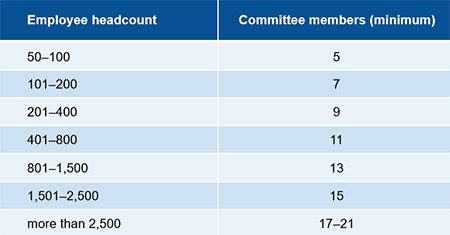
If union members constitute more than 20 percent of the total workforce, the union must appoint at least one more committee member than the number of nonunion members elected by the general workforce. If union membership exceeds 50 percent of the workforce, the union acquires the exclusive right to appoint every committee member. Where multiple unions exist and their combined appointments would exceed the statutory committee size, the employer may lawfully refuse to recognize the excess appointees.

Employees appointed by the union assume office on the date of appointment, even if the election of nonunion members has not yet occurred.

The employer must meet with the committee at least once every three months, or sooner if requested by the union or by more than half of the committee members for reasonable cause, to address:

  • Provision and improvement of employee welfare;
  • Formulation or amendment of work rules;
  • Employee complaints; and
  • Settlement of workplace disputes.

If the committee deems any employer action unfair or unduly burdensome to employees, the committee, an individual employee, or the union may file a petition with the Labor Court for relief.

Special Protections for Committee Members

The LRA prohibits employers from dismissing, reducing the wages of, imposing disciplinary sanctions against, or otherwise obstructing a committee member in the performance of their duties—and from taking any action that would render the member unable to continue working—without first obtaining permission from the Labor Court. Noncompliance constitutes a criminal offense punishable by imprisonment of up to one month, a fine of up to THB 1,000 (approx. USD 30), or both. Supreme Court precedent confirms that these penalties attach immediately upon the unlawful act; a subsequent court order authorizing the dismissal does not cure the prior violation.

The court-approval requirement applies even when the member has breached company work rules. Although the employer may seek the committee member’s dismissal based on such misconduct, the court retains discretion to impose a lesser penalty if it finds termination disproportionate to the offense. Conversely, once the court has authorized termination, the dismissal does not constitute an unfair labor practice, and the employee is barred from filing a complaint with the Labor Relations Committee.

In light of these provisions, employers should proceed with caution when contemplating any disciplinary or obstructive measure against a committee member. Compliance with the LRA’s procedural safeguards is paramount to avoid exposure to criminal liability and ensure lawful continuation of business operations.

RELATED INSIGHTS​ 

April 22, 2025
Thailand’s Immigration Bureau has announced the launch of the Thailand Digital Arrival Card (TDAC) as part of ongoing efforts to improve entry procedures and streamline immigration processing. Effective May 1, 2025, all foreign nationals with any type of visa entering Thailand by any means will be required to complete the TDAC online prior to arrival. This requirement does not apply to individuals transiting or transferring through Thailand without passing through immigration control, or to those entering with a border pass. Foreign nationals planning to enter Thailand must complete and submit their TDAC within the three days prior to their arrival date. The form, which collects passport information, personal details, travel information (e.g., flight number), Thai accommodation information, and a health declaration—can be filled out in English online at https://tdac.immigration.go.th. Once the form is submitted, an acknowledgment will be sent to the email address entered on the form. This acknowledgment must be presented at the immigration checkpoint in Thailand along with travel documents for verification. The Thai government strongly encourages all foreign passport holders to complete the TDAC ahead of their departure to prevent any entry delays or issues at the checkpoint.
April 18, 2025
On March 31, 2025, Cambodia’s Ministry of Labour and Vocational Training (MLVT) issued Notification 009/25, which grants an extension for the renewal of foreign workers’ work permits and employment books in 2025. This extension is to ensure that those who have not yet applied for the renewal of their work permits are provided with sufficient time to complete the application process, as there have been delays in the submission of work permit extension requests. The new deadline for the submission of renewal applications for work permits and employment books is April 30, 2025. Applications and renewals must be processed via the MLVT’s online Foreign Workforce Centralized Management System before the specified deadline. Failure to extend the validity of work permits and employment books for foreign workers before the deadline may result in significant monetary penalties for both employers and foreign nationals. All foreign workers should renew their work permits and employment books within the extended deadline to ensure continued validity for working in Cambodia.
March 13, 2025
The recent freeze on US foreign aid has led to the suspension of billions of dollars in foreign assistance as well as widespread layoffs at contracting organizations around the world. Under this situation, USAID-funded offices in all jurisdictions, including Cambodia, may face the challenge of determining whether they need to lay off their employees. Employers in Cambodia may take different steps in response to this and other instances of sudden financial stress in order to manage their workforce in accordance with Cambodian laws and regulations. Suspension Cambodia’s Labor Law allows employers to suspend employment contracts due to a major economic or material issue or any unexpected difficulty that results in the suspension of operations. To impose this employment contract suspension, the employer must initially submit a suspension request to the Ministry of Labor and Vocational Training (MLVT), detailing the reasons for the requested suspension. If the reasons are deemed valid and the request is approved, the suspension period cannot exceed two months. During the suspension period, the employer must continue providing accommodation for employees if this benefit is already being provided. In some circumstances, the suspension period can be extended if necessary (as happened during the COVID-19 pandemic). However, financial difficulties alone may not be a valid reason for extension. The decision is at the discretion of the MLVT labor inspectors on a case-by-case basis. Therefore, given the uncertain timeline of financial difficulties that may significantly impact the employer’s budget, suspending employment contracts might be ineffective. Mass Layoffs Under Cambodia’s Labor Law, mass layoffs due to a significant reduction in an establishment’s operation or an internal reorganization foreseen by the employer are permissible. The layoff order must be based on professional qualifications, seniority period, and family burdens of the employees. The first employees to be laid off must be
February 25, 2025
On February 4, 2025, Thailand’s Board of Investment (BOI) issued Announcement No. Por. 3/2568, introducing updated qualifications, criteria, and conditions for long-term resident (LTR) visas. The updated requirements took effect immediately upon issuance of the announcement. The LTR program is intended to stimulate the economy and attract high-potential foreign nationals to Thailand, and these latest updates aim to expand access to a wider range of experts, investors, and executives to reinforce Thailand’s foreign talent pool and enhance its competitiveness. The recent updates primarily affect three categories under the LTR visa program: work-from-Thailand professionals, wealthy global citizens, and high-skilled professionals, as detailed below. Work-from-Thailand Professionals The updated LTR visa program includes some changes to the eligibility criteria for visa applicants in the work-from-Thailand professionals category: The revenue requirement for visa applicants’ employers is now USD 50 million over a three-year period, down from USD 150 million previously. Eligible foreign employers now include wholly owned subsidiaries of: companies listed on any stock exchange in any country; or private companies that have been in operation for at least three years and have generated a combined revenue of at least USD 50 million over the past three years. There are no longer work experience requirements. The other requirements remain the same. Wealthy Global Citizens For the wealthy global citizens category, the latest updates remove the requirement to have an annual personal income of USD 80,000, while the other criteria remain. Highly Skilled Professionals For the highly skilled professionals category, the latest updates expand eligibility to include lecturers in vocational or higher education, and remove work experience requirements. Other categories The updated LTR visa program does not introduce any changes for the wealthy pensioners category. However, the announcement does expand the scope of eligible dependents of LTR visa holders to cover parents and a