
You are using an outdated browser and your browsing experience will not be optimal. Please update to the latest version of Microsoft Edge, Google Chrome or Mozilla Firefox. Install Microsoft Edge

September 30, 2025

Thailand’s Employee Committees and Their Statutory Protection

Over the past several years, during and after the COVID-19 pandemic, Thai employees and labor unions have faced reductions in benefits and welfare from their employers. Consequently, they have pursued various strategies to enhance their compensation packages. One such approach involves establishing employee committees to negotiate with employers regarding benefits and welfare. Additionally, companies with existing unions typically nominate representatives to serve on these employee committees. Many employers, however, remain unfamiliar with both the committee’s role and the heightened procedural requirements that apply when disciplinary measures are contemplated against committee members. Because any violation of a committee member’s statutory rights can expose the employer—and its directors or authorized representatives—to criminal liability, a clear understanding of the relevant legal framework is essential.

The Labor Relations Act B.E. 2518 (LRA) provides the statutory foundation for establishing employee committees. The purpose of the committee is to promote harmonious industrial relations and create a formal channel through which employees and employers can discuss workplace matters on a regular basis.

Any workplace that employs at least fifty employees must, upon request by employees or the labor union, facilitate the creation of a committee. Members may be elected directly by employees or, where applicable, appointed by the labor union. Each member serves a three-year term. The LRA prescribes minimum committee sizes based on the employer’s headcount, as shown in the table below.
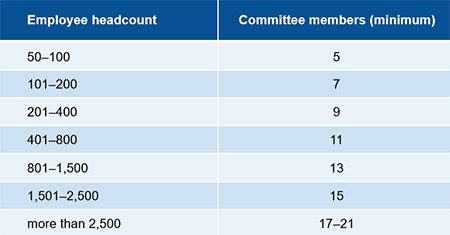
If union members constitute more than 20 percent of the total workforce, the union must appoint at least one more committee member than the number of nonunion members elected by the general workforce. If union membership exceeds 50 percent of the workforce, the union acquires the exclusive right to appoint every committee member. Where multiple unions exist and their combined appointments would exceed the statutory committee size, the employer may lawfully refuse to recognize the excess appointees.

Employees appointed by the union assume office on the date of appointment, even if the election of nonunion members has not yet occurred.

The employer must meet with the committee at least once every three months, or sooner if requested by the union or by more than half of the committee members for reasonable cause, to address:

  • Provision and improvement of employee welfare;
  • Formulation or amendment of work rules;
  • Employee complaints; and
  • Settlement of workplace disputes.

If the committee deems any employer action unfair or unduly burdensome to employees, the committee, an individual employee, or the union may file a petition with the Labor Court for relief.

Special Protections for Committee Members

The LRA prohibits employers from dismissing, reducing the wages of, imposing disciplinary sanctions against, or otherwise obstructing a committee member in the performance of their duties—and from taking any action that would render the member unable to continue working—without first obtaining permission from the Labor Court. Noncompliance constitutes a criminal offense punishable by imprisonment of up to one month, a fine of up to THB 1,000 (approx. USD 30), or both. Supreme Court precedent confirms that these penalties attach immediately upon the unlawful act; a subsequent court order authorizing the dismissal does not cure the prior violation.

The court-approval requirement applies even when the member has breached company work rules. Although the employer may seek the committee member’s dismissal based on such misconduct, the court retains discretion to impose a lesser penalty if it finds termination disproportionate to the offense. Conversely, once the court has authorized termination, the dismissal does not constitute an unfair labor practice, and the employee is barred from filing a complaint with the Labor Relations Committee.

In light of these provisions, employers should proceed with caution when contemplating any disciplinary or obstructive measure against a committee member. Compliance with the LRA’s procedural safeguards is paramount to avoid exposure to criminal liability and ensure lawful continuation of business operations.

RELATED INSIGHTS​ 

July 7, 2025
On June 20, 2025, Cambodia’s Ministry of Economy and Finance issued Instruction No. 19116 to clarify when board members and company directors must receive salaries and pay payroll taxes. Board members and company directors who are not considered employees are subject to a withholding tax. This category consists of people who complete services for a nonresident individual and people who perform independent work for a company in Cambodia. Board members and company directors who are considered employees, including those appointed by a foreign head office to temporarily manage a company in Cambodia, must pay payroll taxes on any salary they receive, regardless of whether they are paid by a local or foreign branch of the company. The above obligations apply regardless of whether the person has a work permit. Board members and company directors are exempt from paying payroll tax if they: Are not present and not performing a regular management role at the company despite being registered on the company’s statutes or patent tax card; Participate only in board meetings and occasional shareholder meetings; and Do not receive a salary from a company in Cambodia. Overall, this instruction provides an important clarification regarding the tax obligations of board members and company directors. Companies should pay attention to the classification of their board members and directors and be mindful of the exemption.   This article was written with the assistance of Tilleke & Gibbins interns Amelia Gemma Erickson and Amrin Keat.
July 7, 2025
On June 27, 2025, Thailand issued the new Ministerial Regulation Prescribing the Criteria and Rates for Receiving Unemployment Benefits (No. 2) B.E. 2568 (2025), which amended a similarly named ministerial regulation by boosting the rate of social security benefits to alleviate hardships for employees who are terminated. The new ministerial regulation took effect the following day. Under this new ministerial regulation, eligible terminated employees are entitled to receive unemployment benefits under the Social Security Fund (SSF) for a maximum of 180 days per year, at the rate of 60% of the employee’s monthly wages at the time of termination, up from 50% previously. However, the maximum wage used as the basis for calculating the benefit remains capped at THB 15,000 per month. Therefore, the maximum unemployment benefit that an employee can receive from the SSF is now THB 9,000 (up from THB 7,500) per month for a period of up to six months. To qualify for the unemployment benefits from the SSF, employees must be registered with the Social Security Office and must have contributed to the SSF for at least six months within the 15 months prior to the start date of the relevant unemployment period. This new ministerial regulation was enacted to increase the amount of financial support provided to insured persons in the case of termination, as part of the government’s objective of alleviating economic hardship under current economic and social conditions in Thailand. For more details on unemployment benefits in Thailand, or on any aspect of employment law in the country, please contact Pimvimol (June) Vipamaneerut at [email protected], Dusita Khanijou at [email protected], Ketnut Pukahuta at [email protected], or Chomanut Arif at [email protected].
July 4, 2025
On July 1, 2025, new minimum daily wage rates for Bangkok and certain business types nationwide were published in the Government Gazette, taking effect on the same day. The daily minimum wage rate for Bangkok has been increased to THB 400 per day, while the minimum wage rates for other provinces remain unchanged from the rates that took effect on January 1, 2025. However, daily minimum wage rates have also been increased to THB 400 nationwide for type 2, type 3, and type 4 hotels under the Hotel Act and for entertainment establishments under the Entertainment Place Act. This THB 400 rate applies to all businesses that meet the criteria, even if the province’s general rate is lower. The new minimum wage rates supersede any lower wages agreed upon in existing employment contracts or conditions of employment that were in force before this announcement came into effect. As a result, these employees must be paid their wages at the newly prescribed rate for work performed from July 1, 2025, onward.
June 30, 2025
On March 4, 2025, Cambodia’s Ministry of Labor and Vocational Training (MLVT) issued Prakas No. 073/25 on Procedures for Resolving Individual Labor Disputes, replacing Prakas No. 318 on the same topic from 2001 and introducing significant changes to how individual labor disputes are filed, processed, and escalated. In addition, Prakas No. 073 outlines the roles and responsibilities of labor inspectors, the process for filing and handling complaints, and the steps for conciliation and further legal recourse, as described below. Filing a Complaint Any party to an individual labor dispute can file a complaint with the Labor Dispute Department of the MLVT or the Department of Labor at the capital or provincial level. Upon receiving a complaint, a labor inspector will review the case and may initiate either conciliation or a labor inspection. Invitation letters will be issued to the disputing parties to provide relevant information and documents. Conciliation Process Prakas No. 073 places strong emphasis on the conciliation process, introducing strict procedural rules and deadlines with clear consequences for noncompliance: If the claimant fails to provide required information within the specified deadline (or within three working days thereafter without reasonable excuse), the complaint is deemed void. If the respondent fails to attend the conciliation meeting within the deadline (or within three working days thereafter without reasonable excuse), the conciliation is considered unsuccessful, and the respondent is deemed guilty as claimed. Once all necessary information is gathered, a labor inspector will invite both parties to a joint conciliation meeting, which must be held within three weeks of the complaint being received. If the claimant fails to attend the meeting or sign the minutes without a reasonable excuse, the complaint is void. If the respondent fails to attend the meeting without a reasonable excuse, the conciliation is unsuccessful, and the respondent