
You are using an outdated browser and your browsing experience will not be optimal. Please update to the latest version of Microsoft Edge, Google Chrome or Mozilla Firefox. Install Microsoft Edge

March 2, 2021

Thailand’s Decriminalization of Cannabis Plants

Informed Counsel

The cannabis plant has fascinated many civilizations, societies, and individuals through the centuries with its unique properties, and many have learned how to benefit from these, finding a variety of therapeutic and industrial uses of the plant that, in turn, enhanced domestic economies worldwide. In Thailand, cannabis plants and their derivatives have been used since ancient times as treatment for many diseases, and the plant forms a key ingredient in many Thai traditional medicinal remedies. However, over the past few decades, cannabis usage was seen to change in a way that became incrementally more abusive, resulting in outright prohibition in almost all countries. Thailand was no exception, and in 1979 the Thai government officially enacted the Narcotics Act forbidding the use of cannabis and listing cannabis plants and their derivatives—most notably marijuana (cannabis with psychoactive properties) and hemp (cannabis with limited or no psychoactive properties)—as category 5 narcotics (i.e., prohibited substances).

Despite these restrictions, many Thais continued to use cannabis illegally, and some urged the government to legalize personal and commercial use of cannabis plants and their derivatives. Eventually, some in the Thai government agreed that it was time to consider steps toward legalization, As a result, the government has been taking action to delist cannabis plants from the list of prohibited narcotics since 2018, when a regulation allowed the cultivation of hemp for industrial and non-commercial purposes, such as household cooking and research and development.

The next significant step came in February 2019, when the Narcotics Act (No. 7) was amended, legalizing medical marijuana within certain limitations. In national elections the following month, the Bhumjaithai political party, whose election campaign included a pledge to decriminalize and legalize cannabis plants, won substantial support in parts of the country and chose to join the coalition government, with the Bhumjaithai party leader assuming control of the Ministry of Public Health (MOPH). Since then, the government, with cooperation from the MOPH and the Food and Drug Administration (FDA), has been working to reclassify cannabis products and to issue new regulatory pathways to accommodate these new “cash crops” to boost the domestic economy. Subsequently, a notification was issued in August 2019 that reclassified certain modern drugs, cosmeceuticals, nutraceuticals, cosmetics, and food containing hemp out of the scope of the Narcotics Act. At the same time, cannabis and hemp legalization were also taking a higher profile in the public sphere. For instance, the issue of cannabis legalization was raised and promoted in the election campaigns of early 2019 by one of the large political parties.

After a long interlude (caused primarily by government focus turning to the COVID-19 pandemic and other emergent priorities), a new MOPH notification was published in the Government Gazette on December 14, 2020, expanding the delisting of cannabis from the Narcotics Act to include nearly all parts of cannabis and hemp plants, as detailed in the table below.
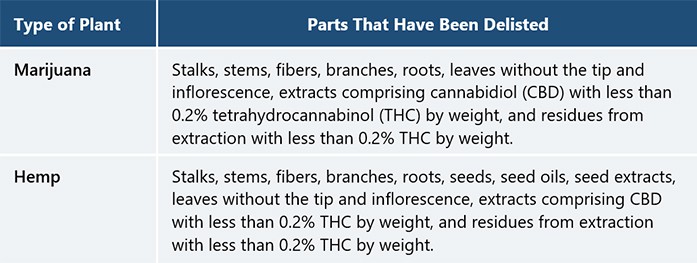
Anyone who wishes to participate in this emerging cannabis industry must be cautious and carefully review the Narcotics Act and its relevant notifications. Although many parts of the cannabis plant were delisted, there some parts remain on the narcotics list (e.g., marijuana seeds, buds, and leaves with cannabis inflorescence or complete cannabis flower head), and the limits on CBD and THC content must be strictly observed.

Importantly, this notification covers only cannabis cultivated in Thailand. Foreign participants are precluded from any participation in an approved cannabis business until a five-year ban on foreign participation—counting from the initial delisting in February 2019—has passed. This means that only the Thai government and its authorized partners have standing to apply for a commercial license until February 20, 2024, which is when foreign parties will be allowed to obtain a commercial cannabis license (subject to any extension or further imposition of restrictions). However, non-commercial licenses (e.g., for research and development) may be issued to Thai applicants.

Despite these limitations, the MOPH notification is another progressive step for driving cannabis research, development, and industry in Thailand. In addition, it delisted other plants that had been classified as category 5 narcotics, including kratom plants (a common plant in Southeast Asia with mild stimulant properties) such as Mitragyna speciosa (Korth.) Havil; opium plants such as Papaver somniferum L. and Papaver bracteatum Lindl.; and fungi of the species Psilocybe cubensis, which contain psilocybin or psilocin. Further notifications on these substances are expected to be issued soon.

The government quickly followed up on the December 14, 2020, notification by publishing another notification on December 30, establishing the criteria for filing applications for licenses to produce, import, export, distribute, and possess hemp (Cannabis sativa) in Thailand. Processing of these applications by the FDA opened on January 29, 2021, for interested Thai citizens and entities under Thai law. Industry operators are now waiting for the Thai FDA’s final promulgation of its own regulations for cannabis licensing to support this development.

Parties interested in entering into this emerging industry should closely monitor the ongoing development of the regulatory regime for cannabis plants in Thailand, as this regime is solidifying rapidly. Those who stay apprised of the situation and remain ready to act when opportunities arise will be able to take full advantage of the new regulatory changes, and in the process will help strengthen a nascent industry in Thailand.

RELATED INSIGHTS​ 

December 2, 2024
Kratom (Mitragyna speciosa) was once listed as a prohibited substance under the Narcotics Act. Kratom was then removed from the narcotics list in 2021 and is now regulated under the Kratom Plant Act B.E. 2565 (2022), which allows the trading, use, import, and export of kratom. Furthermore, the Ministry of Public Health has allowed the use of kratom in food and drink, food supplements, and herbal products. Anyone who wishes to launch kratom food or herbal products must first obtain a product license from the Thai Food and Drug Administration (FDA). On September 4, 2024, the Thai FDA announced guidelines specifically for powdered kratom leaves and kratom leaf extracts (using water or ethanol as solvents) as ingredients in food supplements. These guidelines aim to provide business operators with a clear framework for launching kratom-based food products in Thailand. Key points from these guidelines include: Raw material specifications and standards: Powdered kratom leaves and kratom leaf extracts must contain at least the prescribed amount of mitragynine (one of the primary active compounds in kratom) as a marker of quality. For example, mitragynine must account for at least 1% by mass for powdered kratom leaves. Food supplement specification and standards: Food supplements containing powdered kratom leaves or kratom leaf extracts must not have a dosage of over 0.2 mg/day of mitragynine (including 7-hydroxymitraglynine, which may occur naturally), or 1 mg/day for food supplements containing kratom extracts that use water as a solvent. Addition of 7-hydroxymitraglynine to food supplements is prohibited. Mitragynine content in food supplement products must not exceed the specified dosage limit. Additionally, the food supplement product must be in a ready-to-eat form (e.g., liquid, gel, tablet, or capsule). If powdered kratom leaves or kratom leaf extracts are to be used as ingredients in food categories other than food supplements,
October 1, 2024
The Indonesian food and drug authority, also known as “BPOM,” issued a draft regulation on September 9, 2024, proposing standard labeling disclosing the sugar, salt, and fat content of packaged food products sold in the country. The draft Regulation on Nutritional Value Information on Food Labels to implement Government Regulation No. 28 of 2024 on the Implementation of the Health Law seeks to mandate “Nutri-Level” front-of-pack nutrition labeling to indicate the amount of sugar, salt, and fat at four possible levels, with a modified stoplight-color system: Level “A” (lowest amount) has a dark green background Level “B” has a light green background Level “C” has a yellow background Level “D” (highest amount) has a red background These levels are shown in the following sample image: The requirements for sugar, salt, and fat content for each level are based on amounts per 100 milliliters of ready-to-eat processed food as follows: Further requirements relating to nutrients reflected in the Nutri-Level labeling include: Foods labeled as level A are not allowed to contain natural or artificial sweetening food additives, either through direct addition or carried over from other ingredients. Foods labeled as level B may only contain natural sweetening food additives. Foods labeled as level C or D may use natural and artificial sweetening food additives. “Sugar” includes all monosaccharides and disaccharides, excluding lactose. Processed plain liquid milk and plain milk powder are exempt from the requirement to declare total fat content on the Nutri-Level label. Labeling Implementation The implementation of Nutri-Level labeling must comply with the following requirements: The Nutri-Level label must list all four letters (as shown in the examples below) unless the package meets the criteria for display of a simplified format label. The Nutri-Level of the processed food must be indicated by enlarging the relevant letter, as shown
September 6, 2024
Addressing technical barriers to trade is a key priority for the Association of Southeast Asian Nations (ASEAN) as part of trade facilitation in achieving the single market and production base under the ASEAN Economic Community directive agreed in 2015. The region has been undertaking positive steps toward standard harmonization in ASEAN priority sectors, integrating and bringing about regulatory convergence by taking into account the diversities that exist in the ten ASEAN member states. Health supplements in ASEAN are under the responsibility of the Traditional Medicine and Health Supplement Product Working Group (TMHS PWG). One of the TMHS PWG’s outputs is the ASEAN Agreement on a Regulatory Framework for Health Supplements, which includes various technical requirements for health supplements that participating member states must adopt by adjusting their domestic regulations. The key ingredients of these health supplements are vitamins and minerals. While all ASEAN countries allow the use of vitamins and minerals in health supplements, the amounts allowed for use vary, depending on the nutritional requirements deemed appropriate by each country. Partly in response to these efforts for regional harmonization, there have been important changes to vitamin and mineral limits in certain ASEAN countries that are worth monitoring. Some of these are outlined below. Thailand In January 2024, the Thai Food and Drug Administration (TFDA) updated the Thai Recommended Daily Intake (Thai RDI) guidelines for the Thai population. Subsequently, the TFDA adjusted the vitamin and mineral limits in order to comply with the updated Thai RDI and to follow the ASEAN Agreement on a Regulatory Framework for Health Supplements. The TFDA’s adjustment of vitamin and mineral limits for use in food supplements came in Notification of the Ministry of Public Health (No. 448) B.E. 2566 (2023) Re: Food Supplements (No. 5), which was published in the Government Gazette on January
August 8, 2024
On July 19, 2024, Thailand’s Ministry of Public Health Notification No. 450 B.E.2567 (2024) came into effect after being published in the Government Gazette the day before. The notification introduces significant updates to the labeling requirements for prepackaged foods. This new regulation consolidates and updates Thailand’s rules for food labeling by repealing and replacing several previous notifications. The notification’s key changes and their implications for food businesses are identified below. 1. Clarified “Best Before” Definition The notification aligns the definition of “best before” with Codex standards. It now refers to the date marking the end of the period during which the food maintains its best quality under stated storage conditions. After this date, food quality may change, and the product cannot be marketed. 2. Updated Labeling Exceptions Certain foods are exempt from labeling requirements, with the latest list including: Foods sold directly to consumers by manufacturers who can provide product information. Unprocessed foods. Some fresh foods not sold directly to consumers. Prepackaged foods produced and sold for immediate consumption in food service settings. However, any of these exempt foods that have received food serial numbers must still have labels that comply with the notification. 3. Expiration Date and Best-Before Date Display The notification provides clearer language for displaying the expiration date and best-before date. If specific wording is required by other notifications, it must be followed. English equivalents are now permitted alongside Thai text. 4. Warning Displays Multiple applicable warnings can now be consolidated and displayed together, provided the complete message is included as specified. 5. Claims about Substances or Ingredients New guidelines have been established for making claims about food additives and ingredients. Claims should be factual, not deceptive, and provably not false. 6. Label Placement and Design Labels must be permanently affixed, proportionate to the packaging, and