
You are using an outdated browser and your browsing experience will not be optimal. Please update to the latest version of Microsoft Edge, Google Chrome or Mozilla Firefox. Install Microsoft Edge

October 1, 2024

Indonesia Prepares to Require Nutritional Labeling for Sugar, Salt, and Fat Content

The Indonesian food and drug authority, also known as “BPOM,” issued a draft regulation on September 9, 2024, proposing standard labeling disclosing the sugar, salt, and fat content of packaged food products sold in the country.

The draft Regulation on Nutritional Value Information on Food Labels to implement Government Regulation No. 28 of 2024 on the Implementation of the Health Law seeks to mandate “Nutri-Level” front-of-pack nutrition labeling to indicate the amount of sugar, salt, and fat at four possible levels, with a modified stoplight-color system:

  • Level “A” (lowest amount) has a dark green background
  • Level “B” has a light green background
  • Level “C” has a yellow background
  • Level “D” (highest amount) has a red background

These levels are shown in the following sample image:
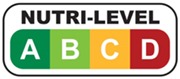
The requirements for sugar, salt, and fat content for each level are based on amounts per 100 milliliters of ready-to-eat processed food as follows:

Further requirements relating to nutrients reflected in the Nutri-Level labeling include:

  • Foods labeled as level A are not allowed to contain natural or artificial sweetening food additives, either through direct addition or carried over from other ingredients.
  • Foods labeled as level B may only contain natural sweetening food additives.
  • Foods labeled as level C or D may use natural and artificial sweetening food additives.
  • “Sugar” includes all monosaccharides and disaccharides, excluding lactose.
  • Processed plain liquid milk and plain milk powder are exempt from the requirement to declare total fat content on the Nutri-Level label.

Labeling Implementation

The implementation of Nutri-Level labeling must comply with the following requirements:

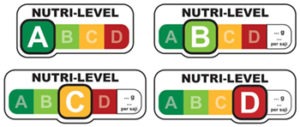
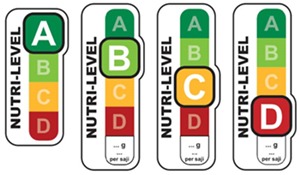
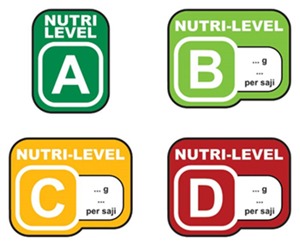
  • The Nutri-Level label must list all four letters (as shown in the examples below) unless the package meets the criteria for display of a simplified format label.
  • The Nutri-Level of the processed food must be indicated by enlarging the relevant letter, as shown in the examples below.
  • Processed foods at levels C and D must include a Nutri-Level label, while processed foods at levels A and B may do so on a voluntary basis.
  • The inclusion of a Nutri-Level label on processed foods at levels C and D must be accompanied by the sugar, salt, and fat content per serving (per saji in Indonesian, as shown in the examples below) or per package.

Nutri-Level Label Format

The draft regulation provides Nutri-Level label examples in both full and simplified formats. The simplified format applies to small packages of 30 square centimeters or less, while the full format must be used on other packages.

Full (horizontal)
Full (vertical)
Simplified
Timeline for Compliance

The draft regulation provides a grace period for existing product registrations:

  • Processed food that has obtained a product registration or for which a product registration application is pending before the regulation comes into effect must be amended within 30 months of the effective date of the regulation.
  • Ready-to-drink beverages, liquid concentrates, and powdered beverages must be amended within 18 months of the effective date of the regulation.

It is anticipated that the draft regulation will be finalized by the end of 2024.

For more details on this draft regulation, or on any aspect of food labeling requirements in Indonesia, please contact Tilleke & Gibbins at [email protected].

RELATED INSIGHTS​ 

July 24, 2026
As food innovation continues to accelerate, manufacturers are increasingly introducing ingredients derived from new sources, produced using novel technologies, or lacking a significant history of human consumption. While these innovations create new opportunities for the food industry, they also raise important questions regarding consumer safety. For this reason, many jurisdictions, including Thailand, the European Union, Australia and New Zealand, Canada, and Singapore, require a premarket safety assessment for novel food ingredients before they can be placed on the market. The objective of this assessment is to ensure that each ingredient is safe for its intended use and level of consumption, does not present toxicological, allergenic, microbiological, or nutritional concerns, and will not mislead consumers. Scientific authorities typically evaluate the ingredient’s identity, manufacturing process, composition, specifications, anticipated dietary exposure, toxicological information, nutritional impact, and history of use before determining whether it can be marketed. Against this background, the Thai Food and Drug Administration (FDA) recently took an important step toward improving regulatory transparency by publishing, for the first time, a consolidated public list of substances that have successfully completed the Thai FDA’s safety assessment process, including substances determined to be novel foods and those determined not to fall within the novel food category. The list identifies the approved substances, the corresponding manufacturers or importers, approval dates, and the approved conditions of use. Although the publication does not change the existing legal framework governing novel food approvals, it provides businesses with greater visibility into the Thai FDA’s regulatory precedents and the types of substances that have previously been accepted through the safety assessment process. The full announcement is available on the Thai FDA’s website. As the list is now publicly available, it also provides useful insight into the types of substances that have successfully completed the Thai FDA’s safety assessment process.
July 24, 2026
For businesses in Thailand’s regulated industries, the problem of “too many licenses” is one of the most familiar hurdles to getting a product to market. Take a simple example: importing the materials necessary to sell teriyaki chicken skewers. To legally do this, a business may need approvals from several different agencies—separate permits for the chicken (Department of Livestock Development), the dipping sauce (Thai FDA), the wooden skewers (Department of Forestry), and other ingredients, each under a different authority. This kind of overlap is often cited to argue for a “regulatory guillotine”—a systematic review to cut outdated or duplicative rules that slow investment and business activity. The Facilitation of Licensing and Public Service Consideration Act B.E. 2569 (2026) (Licensing Facilitation Act 2026) is Thailand’s most significant response yet to that concern. This article looks at the Facilitation Act 2026 through a life sciences and regulatory affairs lens—what it may mean for the manufacturers, importers, and distributors of food, drugs, medical devices, cosmetics, and similar products who routinely deal with several regulators to bring a single product to market. The Super License: One Approval Standing in for Many The reform with the clearest potential for regulated-product businesses is the law’s “super license” mechanism, referred to as a “main license” in the statute. Once a business obtains the main license for a regulated activity, it is automatically deemed to hold all related sublicenses issued by other agencies for that same activity, provided the activity has been designated as eligible in the Government Gazette. The Licensing Facilitation Act 2026 also creates a central application center, allowing applicants to submit a single application and pay all relevant fees at one point of contact, with the center routing the application to each agency through a shared information system. The potential benefits of this for businesses
July 13, 2026
Indonesia’s Halal Product Assurance Agency (BPJPH) has issued new regulations establishing clearer procedures for imposing administrative sanctions on businesses that violate halal product assurance requirements. BPJPH Regulation No. 2 of 2026 on the Imposition of Administrative Sanctions for Violations of Halal Product Assurance Implementation, issued on June 5, 2026, strengthens Indonesia’s halal compliance framework, as mandated under Law No. 33 of 2014 on Halal Product Assurance and Government Regulation No. 42 of 2024 on the Implementation of Halal Product Assurance. BPJPH Regulation No. 2/2026 also supports the upcoming mandatory halal compliance deadline of October 17, 2026, which will apply to a broad range of products and services, including imported food and beverages, slaughtering products and services, natural and quasi-drugs, health supplements, cosmetics, chemical and genetically engineered products, clothing and accessories, household goods, prayer equipment, stationery, and class A medical devices. Scope BPJPH is authorized to impose administrative sanctions for violations of halal product assurance requirements committed by businesses, halal inspection agencies (LPH), halal auditors, halal product process companion institutions (lembaga pendamping PPH), and halal product process companions (pendamping PPH). The head of BPJPH has authority to determine, cancel, or amend the imposition of administrative sanctions, including upon receipt of objections. This authority covers revocation of Halal Certificates (including foreign halal certificate registration numbers), withdrawal of goods from circulation, freezing of LPH operations, freezing of halal product process companion institutions, revocation of PPH companion institution registration numbers, revocation of halal auditor registration numbers, and revocation of LPH accreditation status. Administrative Sanctions Businesses may be subject to any of the following administrative sanctions: Written warning; Administrative fine; Revocation of the halal certificate, including revocation of foreign halal certificate registration numbers; and Withdrawal of goods from circulation. The regulation sets out the types of violations that may trigger these sanctions, with each
July 1, 2026
Obtaining marketing authorization is a fundamental requirement for bringing pharmaceutical products to the Thai market. Companies must navigate the Thai Food and Drug Administration’s registration procedures while also complying with post-approval pharmacovigilance obligations, licensing requirements for manufacturing and importation, data protection rules, and other regulatory requirements. This guide provides an overview of Thailand’s regulatory framework for pharmaceutical marketing authorization, including available registration pathways, review timelines, application fees, postmarketing surveillance obligations, licensing requirements, exemptions, data exclusivity, freedom of information, and parallel import considerations. It is intended as a practical reference for pharmaceutical companies, regulatory affairs professionals, and others involved in bringing medicinal products to the Thai market. Download the guide below for a concise overview of the current requirements and procedures governing pharmaceutical marketing authorization in Thailand.