
You are using an outdated browser and your browsing experience will not be optimal. Please update to the latest version of Microsoft Edge, Google Chrome or Mozilla Firefox. Install Microsoft Edge

November 18, 2024

Thailand Reaffirms Alcoholic Beverage Packaging and Labeling Requirements

A new notification on required labeling and packaging for alcoholic beverages was published in Thailand’s Government Gazette on November 8, 2024, taking full effect the following day.

The notification (Notification of the Alcoholic Beverage Control Committee Re: Criteria, Methods, and Conditions for Packaging of Alcoholic Beverages and Warning Statements of Alcoholic Beverages Both Produced Domestically and Imported into Thailand 2024) essentially reaffirms a mandatory requirement for packaging and warning statements for alcoholic beverages, which echoes existing regulations from 2009 and 2017.

Under the authority of the Alcoholic Beverage Control Act B.E. 2551 (2008) (ABCA), the notification reinforces the Alcoholic Beverage Control Committee’s objective of promoting consumer awareness through standardized warning labels.

The notification addresses the following key aspects:

  • Packaging definitions. The notification defines packing-related terms for the first time under the ABCA. These terms include (1) packaging, (2) containers (also known as primary packaging), and (3) outer packaging (secondary packaging).
  • Packaging requirements. Containers for alcoholic beverages produced or imported for sale in Thailand must be at least 0.175 liters each.
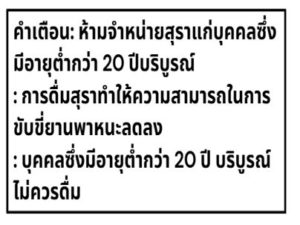
  • Warning statements. Although alcoholic beverages are classified as food under the Food Act B.E. 2522 (1979), the notification exempts alcoholic beverages from general food labeling requirements prescribed in the Food Act. Instead, it mandates that the following warning statements be prominently displayed:
    • Sale of liquor to persons under 20 years old is prohibited;
    • Drinking reduces driving ability; and
    • Not suitable for persons under 20 years old.
  • Format. The notification specifies that these warning statements must be written in Thai, in bold characters, with a minimum type size of five millimeters. The warning must be enclosed in a box that contrasts with the label background and surrounding content.
  • Exemptions. Certain products, such as alcoholic beverages imported as samples or otherwise not intended for commercial sale, are exempt from the warning statement requirements.

The notification consolidates and reinforces Thailand’s alcohol packaging standards, maintaining an emphasis on consumer protection and awareness by ensuring that important information is clearly and consistently displayed on all alcoholic beverage packaging. It formally grants the Alcoholic Beverage Control Committee the authority to oversee and enforce warning statements in alcoholic beverage labeling.

With no major changes to existing regulations, the notification came into effect swiftly, without granting any grace periods.


RELATED INSIGHTS​ 

October 14, 2021
As part of its membership in Lex Mundi, Tilleke & Gibbins has published an updated edition of its Guide to Doing Business in Thailand for 2021. This guide outlines all of the key factors for starting and operating a business in the Thai market. Issues covered include: Investment incentives Financial facilities Exchange controls Import and export regulations Structures for doing business Requirements for the Establishment of a Business Operation of the Business Cessation or Termination of the Business Labor legislation, relations, and supply Tax Immigration requirements This publication is part of Lex Mundi’s Guides to Doing Business series prepared by member firms in more than 100 jurisdictions worldwide. The guides serve as a useful resource when planning an international business strategy or researching a new market.
August 26, 2021
The Ministry of Health of Vietnam recently issued Circular No. 10/2021/TT-BYT dated June 30, 2021, stipulating the list of substances prohibited from use in the production and trading of health supplements (“Circular 10”). Circular 10 will come into effect on September 1, 2021. Accordingly, substances found on the following lists will be prohibited from use in health supplements: The list of drugs and drug materials prohibited from importation and production found in Annex V of Decree No. 54/2017/ND-CP of the Government dated May 8, 2017, guiding the implementation of Law on Pharmacy (Decree 54). Lists promulgated with Decree No. 73/2018/ND-CP of the Government dated May 15, 2018, stipulating the list of narcotic substances and precursors, including: List I: Narcotic substances banned from use in healthcare and daily life, the use of which for analysis, testing, scientific research, and criminal investigation is subject to permission by competent authorities. List II: Narcotic substances restricted from analysis, testing, scientific research, criminal investigation, or healthcare as regulated by competent authorities. List III: Narcotic substances permitted in analysis, testing, scientific research, criminal investigation, healthcare, and veterinary medicine as regulated by competent authorities. List IVA: Essential precursors involved in forming the structure of narcotic substances. The list of narcotic active ingredients found in Annex I of Circular No. 20/2017/TT-BYT of the Ministry of Health, detailing articles of the Law on Pharmacy and Decree 54 related to drugs and drug materials under special control. The list of toxic drugs and toxic drug materials under Circular No. 06/2017/TT-BYT of the Ministry of Health dated May 3, 2017. Lists under Circular No. 42/2017/TT-BYT of the Ministry of Health dated November 13, 2017, stipulating the lists of toxic herbal materials, including: Annex I: List of toxic herbal materials of plant origin. Annex II: List of toxic herbal materials of
August 26, 2021
In April 2021, the Vietnamese government made public a draft decree to amend Decree No. 43/2017/ND-CP of the Government dated April 14, 2017, on goods labeling (“Decree 43”), which is the primary legislation in Vietnam on the labeling requirements for domestically circulating goods and imported goods. Some noteworthy differences between the draft and the current Decree 43 include the following: 1. Original labels for imported products For imported goods, the draft adds a requirement on compulsory information for original labels, which is not mentioned in Decree 43. In particular, the original product label for goods being imported to circulate on the Vietnam market must contain the following compulsory information in a foreign language or in Vietnamese before customs clearance: Product name; Name and address of the entities responsible for the products; Product origin or place where the final production stage to complete the product was conducted. (If this information is not presented on the original product label, it must be included in the import documents accompanying the product.) 2. Vietnamese labels for imported products Under the draft, if it is impossible to determine the product origin under rules/guidance on determining product origin in Vietnam, it is acceptable to instead indicate on the product label the place(s) where the final production stage to complete the product was conducted. 3. Nutritional information for food Instead of being optional information as mentioned in Decree 43, “nutritional value” is compulsory information on labels for some food products under the draft. The Ministry of Health will have a roadmap for carrying out nutritional labeling and will provide appropriate guidance to manufacturers and importers, as well as issue regulations on types of food that are partially or entirely exempt from declaration of nutritional value. The draft has not yet been finalized and is subject to