
You are using an outdated browser and your browsing experience will not be optimal. Please update to the latest version of Microsoft Edge, Google Chrome or Mozilla Firefox. Install Microsoft Edge

November 18, 2024

Thailand Reaffirms Alcoholic Beverage Packaging and Labeling Requirements

A new notification on required labeling and packaging for alcoholic beverages was published in Thailand’s Government Gazette on November 8, 2024, taking full effect the following day.

The notification (Notification of the Alcoholic Beverage Control Committee Re: Criteria, Methods, and Conditions for Packaging of Alcoholic Beverages and Warning Statements of Alcoholic Beverages Both Produced Domestically and Imported into Thailand 2024) essentially reaffirms a mandatory requirement for packaging and warning statements for alcoholic beverages, which echoes existing regulations from 2009 and 2017.

Under the authority of the Alcoholic Beverage Control Act B.E. 2551 (2008) (ABCA), the notification reinforces the Alcoholic Beverage Control Committee’s objective of promoting consumer awareness through standardized warning labels.

The notification addresses the following key aspects:

  • Packaging definitions. The notification defines packing-related terms for the first time under the ABCA. These terms include (1) packaging, (2) containers (also known as primary packaging), and (3) outer packaging (secondary packaging).
  • Packaging requirements. Containers for alcoholic beverages produced or imported for sale in Thailand must be at least 0.175 liters each.
  • Warning statements. Although alcoholic beverages are classified as food under the Food Act B.E. 2522 (1979), the notification exempts alcoholic beverages from general food labeling requirements prescribed in the Food Act. Instead, it mandates that the following warning statements be prominently displayed:
    • Sale of liquor to persons under 20 years old is prohibited;
    • Drinking reduces driving ability; and
    • Not suitable for persons under 20 years old.
  • Format. The notification specifies that these warning statements must be written in Thai, in bold characters, with a minimum type size of five millimeters. The warning must be enclosed in a box that contrasts with the label background and surrounding content.
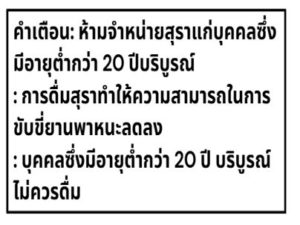
  • Exemptions. Certain products, such as alcoholic beverages imported as samples or otherwise not intended for commercial sale, are exempt from the warning statement requirements.

The notification consolidates and reinforces Thailand’s alcohol packaging standards, maintaining an emphasis on consumer protection and awareness by ensuring that important information is clearly and consistently displayed on all alcoholic beverage packaging. It formally grants the Alcoholic Beverage Control Committee the authority to oversee and enforce warning statements in alcoholic beverage labeling.

With no major changes to existing regulations, the notification came into effect swiftly, without granting any grace periods.


RELATED INSIGHTS​ 

July 26, 2021
Laos’ first law specifically addressing contracts for electronic transactions comes as a relief to operators who had previously been left to interpret laws on contracts generally in a context for which they were not designed.
July 23, 2021
To enforce more rigorous control of cross-border advertising activities, the Vietnamese government issued Decree No. 70/2021/ND-CP dated July 20, 2021 (Decree 70), amending and supplementing provisions of Decree No. 181/2013/ND-CP dated November 14, 2013, elaborating on some articles of the Law on Advertising. Decree 70 will take effect on September 15, 2021. According to the Deputy Director of the Authority of Broadcasting and Electronic Information, Decree 70 will allow better control over cross-border advertisement on platforms such as Facebook or YouTube. To that end, Decree 70 stipulates new obligations for these providers while also consolidating executive authority over cross-border advertising activities under the Ministry of Information and Communications (MIC). Revised Obligations for Cross-Border Advertising Services Significantly, Decree 70 overhauls Article 13, which provides the definitions and obligations for cross-border advertising service providers. Accordingly, cross-border advertising services are explained as the utilization of websites hosted outside Vietnam to provide ads targeted at Vietnamese consumers and obtain revenue in Vietnam. Notably, Article 13 defines such websites as a “single or multi-website system …  providing users with services for storage, provision, use, search, or exchange of information, sound or image sharing, forum creation, or live chat to supply advertising services.” This would effectively encompass many types of online environments, specifically social network sites, such as Facebook. In addition, more entities will be taxed on cross-border advertising revenue under Article 13, including not only service providers but also both domestic and overseas advertisers. Under Decree 70, cross-border advertising services must comply with Vietnam’s cybersecurity and intellectual property laws in addition to the Law on Advertising. Decree 70 requires foreign providers of cross-border advertising services to supply the MIC with direct contact information 15 days before commencing cross-border advertising activities in Vietnam. Domestic advertising service providers that cooperate with foreign entities to provide cross-border