
You are using an outdated browser and your browsing experience will not be optimal. Please update to the latest version of Microsoft Edge, Google Chrome or Mozilla Firefox. Install Microsoft Edge

November 18, 2024

Thailand Reaffirms Alcoholic Beverage Packaging and Labeling Requirements

A new notification on required labeling and packaging for alcoholic beverages was published in Thailand’s Government Gazette on November 8, 2024, taking full effect the following day.

The notification (Notification of the Alcoholic Beverage Control Committee Re: Criteria, Methods, and Conditions for Packaging of Alcoholic Beverages and Warning Statements of Alcoholic Beverages Both Produced Domestically and Imported into Thailand 2024) essentially reaffirms a mandatory requirement for packaging and warning statements for alcoholic beverages, which echoes existing regulations from 2009 and 2017.

Under the authority of the Alcoholic Beverage Control Act B.E. 2551 (2008) (ABCA), the notification reinforces the Alcoholic Beverage Control Committee’s objective of promoting consumer awareness through standardized warning labels.

The notification addresses the following key aspects:

  • Packaging definitions. The notification defines packing-related terms for the first time under the ABCA. These terms include (1) packaging, (2) containers (also known as primary packaging), and (3) outer packaging (secondary packaging).
  • Packaging requirements. Containers for alcoholic beverages produced or imported for sale in Thailand must be at least 0.175 liters each.
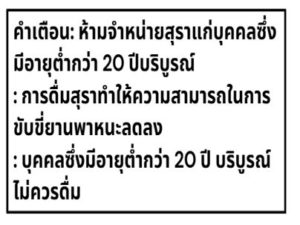
  • Warning statements. Although alcoholic beverages are classified as food under the Food Act B.E. 2522 (1979), the notification exempts alcoholic beverages from general food labeling requirements prescribed in the Food Act. Instead, it mandates that the following warning statements be prominently displayed:
    • Sale of liquor to persons under 20 years old is prohibited;
    • Drinking reduces driving ability; and
    • Not suitable for persons under 20 years old.
  • Format. The notification specifies that these warning statements must be written in Thai, in bold characters, with a minimum type size of five millimeters. The warning must be enclosed in a box that contrasts with the label background and surrounding content.
  • Exemptions. Certain products, such as alcoholic beverages imported as samples or otherwise not intended for commercial sale, are exempt from the warning statement requirements.

The notification consolidates and reinforces Thailand’s alcohol packaging standards, maintaining an emphasis on consumer protection and awareness by ensuring that important information is clearly and consistently displayed on all alcoholic beverage packaging. It formally grants the Alcoholic Beverage Control Committee the authority to oversee and enforce warning statements in alcoholic beverage labeling.

With no major changes to existing regulations, the notification came into effect swiftly, without granting any grace periods.


RELATED INSIGHTS​ 

July 28, 2023
Myanmar’s Ministry of Commerce (MOC) issued three notifications related to e-commerce on July 21, 2023, classifying online retail businesses as essential services, requiring them to register with the relevant authorities, and setting the criteria for their registration. Under Notification No. 49/2023 the MOC authorized the Department of Trade (DOT) to issue notifications, orders, and directives relating to online retail businesses. This was followed by Notification No. 50/2023, which classifies online retail businesses as essential services under the Essential Supplies and Services Law and requires them to register with the DOT within six months of the issuance of the notification (i.e., by January 21, 2024). Failure to register within the specified period will be punishable by imprisonment for six months to three years and a fine of up to MMK 500,000 (approx. USD 238). Finally, under Notification No. 51/2023, the MOC set out the criteria and requirements for the registration of online retail businesses by entities, business institutions, and individuals, as well as the duties and liabilities of sellers and consumers. Pursuant to this notification, registration should be completed via the DOT’s online system, fees must be paid digitally, and electronic registration certificates will be issued. Certificates are initially valid for two years, and can be renewed. The MOC will provide information at a later time on the prescribed forms, certificate format, registration and online fees, and online registration portal. In applying for registration, an entity or business institution established under the Myanmar Companies Law, Special Company Act, Co-operative Society Law, or any other existing Myanmar laws must have a website with its own domain name or an online channel with an exact address that is used for online sales and a registered business address within Myanmar. Individual applicants must be at least 18 years old, reside in Myanmar, and
June 5, 2023
Vietnam’s Law on the Protection of Consumer Rights (“Consumer Protection Law” or “CPL”) was passed in 2010 and has been effective since July 1, 2011, providing a legal framework for protecting the rights of consumers in Vietnam. Over the past 12 years of implementation and application, however, the CPL has revealed its shortcomings and limitations. For example, there are issues related to inconsistency between the CPL and other laws such as the Civil Code, Law on Competition, Enterprise Law, and Cybersecurity Law. The current CPL also has not kept pace with modern consumption practices, especially the rapid changes and emerging trends in e-commerce, cross-border transactions, and services via digital platforms. The government of Vietnam has therefore entrusted the Ministry of Industry and Trade (MOIT) to take the lead in drafting a new amended CPL to replace the old one, to improve the policies and legislation on consumer protection, and protect the vulnerabilities of consumers in transactions with businesses. During the 5th session of the National Assembly at the end of May 2023, the National Assembly discussed and reviewed the latest draft of the CPL (“Draft CPL”), which is expected to be approved on June 21, 2023. The following are some key contents of the Draft CPL: 1. Revised Subjects of Application Unlike the current CPL, which applies only to consumers; traders of goods and services; and agencies, organizations and individuals involved in consumer protection activities within the territory of Vietnam, the Draft CPL adds “the Vietnamese Fatherland Front, socio-political organizations and social organizations participating in protecting consumers’ interests” as new subjects of its application, and clarifies that “agencies, organizations, and individuals” include both domestic and offshore agencies, organizations, and individuals involved in activities of consumer rights protection. The Draft CPL also removes “within the territory of Vietnam” from the
June 2, 2023
Thailand’s labeling requirements have new rules on product label font size and readability following the issuance of Announcement of the Label Committee Re: Characteristics of the Label for Label-Controlled Goods No. 3, which is a bylaw of the Consumer Protection Act (CPA). The announcement takes effect on June 18, 2023, and applies to all “label-controlled goods,” which are described under the CPA and its bylaws as goods either produced by factories in Thailand or imported into Thailand for sale. The labels of these goods must meet current labeling requirements, such as having information about the product name, quantity, intended use, cautions, and expiry date. Label readability—specifically in terms of the size of text on labels—is also a mandatory requirement, and is the focus of this latest announcement. Text size requirements are an important part of ensuring that consumers are fully aware of the details of a product before deciding to purchase the goods. According to the announcement, any statement or text displayed on a label must be easily visible and readable. The size of the text must be proportional to the label area. Specifically, the text height must not be less than 2 millimeters (or 1.5 millimeters for labels with an area of less than 35 square millimeters). The announcement does not clarify exactly how the height of the text will be determined. Some companies have expressed concern that these requirements are too strict and will be challenging to meet, especially for small businesses. The text size requirements may be expensive to implement, as the larger text requires more space on the label, potentially leading to larger labels or packages, higher production costs, or even expensive recalls to affix new labels. In some cases, text size requirements may even make it impossible to fit all the required information on
April 20, 2023
Food safety is one important area of focus as Cambodia continues to improve its regulatory framework surrounding consumer protection. Last year, the new Law on Food Safety set out the main principles to regulate the food sector, providing general rights and obligations of food businesses and requirements for food products traded in Cambodia. Then in the first months of 2023, two implementing regulations were issued to clarify the overarching principles of the Law on Food Safety, as well as its enforcement mechanisms. The adoption of these enforcement-related regulations is once again a clear signal to the market that the Cambodian government is taking the enforcement of consumer protection laws seriously. Food Surveillance, Seizure, and Recalls The first of these implementing regulations was Sub-Decree No. 13 on the Conditions, Formalities and Procedures for Food Surveillance and Seizure, dated January 6, 2023 (SD 13), followed the next month by Prakas No. 080 on the Forms and Procedures to Seize Unsafe Foods or Foods Not Complying with Technical Regulations, dated February 22, 2023 (Prakas 80). These implementing regulations give clarity on how the authorities will monitor and inspect the food sector, and in what cases the authorities may resort to recalls or seizure of foods. Prakas 80 also provides the necessary paperwork for both inspecting officers and companies to use when reporting on unsafe foods to authorities and the public. Lastly, the regulations further clarify the obligations for food businesses and the penalties for noncompliance. The Consumer Protection, Competition, and Fraud Repression Directorate-General (CCF) of the Ministry of Commerce takes a key role as the main enforcement authority under the regulations. The CCF receives reports on unsafe foods, manages voluntary recalls, publishes warnings to the public regarding unsafe foods, seizes unsafe or otherwise noncompliant goods, and applies the administrative fines and penalties