
You are using an outdated browser and your browsing experience will not be optimal. Please update to the latest version of Microsoft Edge, Google Chrome or Mozilla Firefox. Install Microsoft Edge

November 18, 2024

Thailand Reaffirms Alcoholic Beverage Packaging and Labeling Requirements

A new notification on required labeling and packaging for alcoholic beverages was published in Thailand’s Government Gazette on November 8, 2024, taking full effect the following day.

The notification (Notification of the Alcoholic Beverage Control Committee Re: Criteria, Methods, and Conditions for Packaging of Alcoholic Beverages and Warning Statements of Alcoholic Beverages Both Produced Domestically and Imported into Thailand 2024) essentially reaffirms a mandatory requirement for packaging and warning statements for alcoholic beverages, which echoes existing regulations from 2009 and 2017.

Under the authority of the Alcoholic Beverage Control Act B.E. 2551 (2008) (ABCA), the notification reinforces the Alcoholic Beverage Control Committee’s objective of promoting consumer awareness through standardized warning labels.

The notification addresses the following key aspects:

  • Packaging definitions. The notification defines packing-related terms for the first time under the ABCA. These terms include (1) packaging, (2) containers (also known as primary packaging), and (3) outer packaging (secondary packaging).
  • Packaging requirements. Containers for alcoholic beverages produced or imported for sale in Thailand must be at least 0.175 liters each.
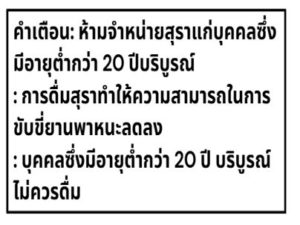
  • Warning statements. Although alcoholic beverages are classified as food under the Food Act B.E. 2522 (1979), the notification exempts alcoholic beverages from general food labeling requirements prescribed in the Food Act. Instead, it mandates that the following warning statements be prominently displayed:
    • Sale of liquor to persons under 20 years old is prohibited;
    • Drinking reduces driving ability; and
    • Not suitable for persons under 20 years old.
  • Format. The notification specifies that these warning statements must be written in Thai, in bold characters, with a minimum type size of five millimeters. The warning must be enclosed in a box that contrasts with the label background and surrounding content.
  • Exemptions. Certain products, such as alcoholic beverages imported as samples or otherwise not intended for commercial sale, are exempt from the warning statement requirements.

The notification consolidates and reinforces Thailand’s alcohol packaging standards, maintaining an emphasis on consumer protection and awareness by ensuring that important information is clearly and consistently displayed on all alcoholic beverage packaging. It formally grants the Alcoholic Beverage Control Committee the authority to oversee and enforce warning statements in alcoholic beverage labeling.

With no major changes to existing regulations, the notification came into effect swiftly, without granting any grace periods.


RELATED INSIGHTS​ 

October 26, 2021
Parallel imports—branded goods imported into a domestic market and sold there without the consent of the intellectual property (IP) owner—pose a unique challenge for IP owners. In contrast to counterfeit goods, parallel imported goods are manufactured by or under the license of the IP owner and formulated or packaged for a particular jurisdiction and then imported into a different jurisdiction without the authorization of the IP owner. Intellectual property laws and perspectives on parallel import vary throughout Southeast Asia. The distinct legal landscape in each nation should be carefully navigated in consultation with legal experts to ensure brand protection to the fullest degree. This guide provides insight into the legal frameworks relating to parallel imports in Cambodia, Indonesia, Laos, Myanmar, Thailand, and Vietnam. Each section examines the relevant laws and regulations that pertain to parallel imports and explores the remedies available to IP owners in each country. Finally, the guide presents some strategies to combat parallel importation and maximize IP protection in Southeast Asia. The full guide can be downloaded through the button below.   This guide was prepared with the assistance of Tilleke & Gibbins interns Christian Pederson and Keoni Williams.
October 26, 2021
Attorneys from Tilleke & Gibbins in Vietnam have written the Vietnam chapter of the newly released Fashion Law 2021, a guide to law surrounding the business of fashion in jurisdictions around the world. The guide covers 18 key jurisdictions for the global fashion industry, offering insights into local legal frameworks surrounding vital issues such as brand enforcement and protection, e-commerce and marketing, and sustainability considerations. The Vietnam chapter of Fashion Law 2021 provides detailed information on the following topics: Trademarks, designs, copyright, and other intellectual property types such as patents and trade secrets. Strategic local contractual arrangements for manufacturing, distributing, and advertising fashion products. Overview and application of online marketing regulations and consumer protection regulations in Vietnam. The most relevant unfair competition rules for fashion businesses, and local courts’ interpretation and enforcement of the rules. ESG (environmental, social, and governance) concerns and sustainability issues for the fashion industry. Customs monitoring and local import and export guards against counterfeit products. The full Vietnam chapter is available for free on the Global Legal Post website, or it can be downloaded as a PDF through the button below. Tilleke & Gibbins also contributed the Thailand chapter to the guide.
October 26, 2021
Attorneys from Tilleke & Gibbins’ Bangkok office have written the Thailand chapter of the newly released Fashion Law 2021, a guide to law surrounding the business of fashion in jurisdictions around the world. The guide covers 18 key jurisdictions for the global fashion industry, offering insights into local legal frameworks surrounding vital issues such as brand enforcement and protection, e-commerce and marketing, and sustainability considerations. The Thailand chapter of Fashion Law 2021 provides detailed information on the following topics: Trademarks, designs, copyright, and other intellectual property types, as well as the main intellectual property legal tools available to protect fashion products in Thailand. Strategic local contractual arrangements for manufacturing, distributing, and advertising fashion products. Overview and application of online marketing regulations and consumer protection regulations in Thailand. The most relevant unfair competition rules for fashion businesses and local courts’ interpretation and enforcement of the rules. ESG (environmental, social, and governance) concerns and sustainability issues for the fashion industry. Customs monitoring and local import and export guards against counterfeit products. Frequently asked questions and common concerns regarding fashion business operations in Thailand. The full Thailand chapter is available for free on the Global Legal Post website, or it can be downloaded as a PDF through the button below. Tilleke & Gibbins also contributed the Vietnam chapter to the guide.
October 25, 2021
Michael Ramirez, a counsel in Tilleke & Gibbins’ dispute resolution group in Bangkok, has updated the firm’s contribution to the Global Attorney-Client Privilege Guide, published by Lex Mundi. The newly expanded guide provides information on what constitutes attorney-client privilege in over 70 countries around the world. The Thailand section of the guide contains in-depth information on the function and applications of attorney-client privilege in Thailand (or, as explained in the guide, an equivalent concept enshrined in Thai law), including coverage of the following topics: Privilege in corporations Common interest doctrine Litigation funding Crime-fraud exception Work product doctrine/litigation privilege Other privileges including mediation, accountant-client and settlement negotiation The interactive guide features expert contributions by Lex Mundi member firms from jurisdictions worldwide. Readers can browse the contributions, generate country-specific reports, and compare attorney-client privilege in multiple jurisdictions. For more information, please visit the Lex Mundi website.