
You are using an outdated browser and your browsing experience will not be optimal. Please update to the latest version of Microsoft Edge, Google Chrome or Mozilla Firefox. Install Microsoft Edge

May 15, 2024

Thailand Issues Draft Cybersecurity Standards for Cloud Services

On May 1, 2024, Thailand’s National Cyber Security Committee (NCSC) published the draft NCSC Notification Re: Cloud Cybersecurity Standards for a public hearing period, which was open until May 14, 2024. These standards have been drafted to drive the country’s cloud-first policy with the aim of minimizing risks from cyber threats to cloud services utilized by government agencies, supervising or regulating organizations, and critical information infrastructure (CII) organizations.

The key points of the draft Cloud Cybersecurity Standards are below.

Scope

  • The standards apply to government agencies, supervising or regulating organizations, and CII organizations under the Cybersecurity Act B.E. 2562 (2019), as well as cloud service providers (defined below).
  • The standards prescribe cloud system cybersecurity measures for cloud service customers (defined below) and providers only to the extent that the service is provided to the in-scope organizations outlined above.

Definitions

  • Cloud service customers (CSCs): In-scope organizations that have a formal contractual agreement to use cloud services provided by a cloud service provider.
  • Cloud service providers (CSPs): Persons who enable cloud services to be used by a cloud service customer, responsible for maintaining infrastructure, platforms, and software that enable provision of the cloud services and for managing these resources to ensure their accessibility, security, and scalability for their cloud service customers.

Application

  • In-scope organizations that will use or have been using cloud services must comply with the Cloud Cybersecurity Standards by taking into account their data or technology information systems’ level of impact, as specified in the previously issued Notification of the NCSC Re: Standards for Defining the Security Category for Data and Information Systems B.E. 2566 (2023).
  • The impact level related to personal data is to be rated as being at least at the medium level, and the minimum standards for that level specified in the draft Cloud Cybersecurity Standards must be adopted.
  • In-scope organizations must report their implementation of the Cloud Cybersecurity Standards to the National Cyber Security Agency (NCSA) within 30 days of completing the implementation.
  • The draft Cloud Cybersecurity Standards will come into force one year from their publication in the Government Gazette.

Structure

The requirements in the Cloud Cybersecurity Standards are divided into two areas, (1) cloud security governance and (2) cloud infrastructure and operations:

Requirement Area 1: Cloud Security Governance

  • Information security policies
  • Organization of information security
  • External supplier relationships
  • Compliance

Requirement Area 2: Cloud Infrastructure Security and Operations  

  • Human resource security
  • Asset management
  • Access control
  • Cryptography
  • Physical and environmental security
  • Operational security
  • Communication security
  • System acquisition, development, and maintenance
  • External supplier relationships
  • Information security incident management

Impact Levels and Requirements

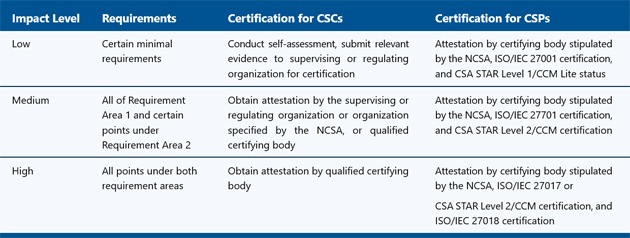
The stipulations of the Cloud Cybersecurity Standards vary depending on the data or information systems’ level of impact. The requirements for each level are summarized in the table below.
For more information on the draft Cloud Cybersecurity Standards, or on any aspect of cybersecurity and cloud-related laws in Thailand, please contact Athistha (Nop) Chitranukroh at [email protected] and Thammapas Chanpanich at [email protected].

RELATED INSIGHTS​ 

July 10, 2023
One of the more positive outcomes of the COVID-19 pandemic is that telemedicine has become remarkably important as an interactive system between patients and healthcare professionals. Thailand, which ranks near the top as a world medical hub, is a highly favored destination in Asia for expat workers. Currently, the Thai market has both Thai-based and foreign-based platforms with information about healthcare providers and telemedicine readily available. “Doctor Locator,” “Weed Map,” and “Find a Teeth Aligner Dentist” are examples of online platforms connecting patients with medical and telemedicine services. These digital platforms provide information about the location of specialized clinics, cannabis dispensaries, pharmacy stores, and orthodontic practitioners in Thailand. These platforms act as intermediaries between medical care businesses and consumers. As actual medical services are not offered or provided, these digital platforms do not have to be regulated under the Medical Facility Act of Thailand. However, healthcare digital platform services that act as an intermediary or conduit managing information used to connect medical clinics or cannabis dispensaries with patients or customers via a computer network are now regulated under the soon-to-be-implemented Royal Decree on Digital Platforms, regardless of whether payment is actually made via the platform. The regulatory authority for this is the Electronic Transactions Development Agency (ETDA). Under this royal decree, digital platform providers that intend to operate a digital platform service must notify the ETDA prior to initiating operations. The extent of the details to be included in the notification to the ETDA will be more comprehensive if the digital platform: has annual revenue (before expenses) for digital platform services within Thailand exceeding THB 1.8 million (approx. USD 51,200) for an individual operator or THB 50 million (approx. USD 1.42 million) for a corporate or entity operator; or has more than 5,000 users (on average) per month. Apart
June 26, 2023
Vietnam’s Ministry of Information and Communications (MIC) organized a workshop with industry representatives on June 19, 2023, to discuss its future policy direction for over-the-top (OTT) telecom services and internet data center (IDC) and cloud computing services. OTT telecom services, in the MIC’s interpretation, are communication services such as text messages or voice calls provided over the internet—for example, the services of Zalo, WhatsApp, WeChat, etc. The workshop, the first in an expected series, focused only on the discussion of policy on how to regulate these services. Light-Touch Management Approach A very positive signal of the MIC in the workshop was its clear intention to apply a “light-touch” approach to management. For cross-border provision of OTT telecom services and IDC/cloud computing services, the MIC intends to require notification and a post-check mechanism, instead of a heavy licensing or commercial arrangement regime like the one applicable to traditional telecom services. In addition, there is no limitation on foreign investment if foreigners would like to provide these services in Vietnam. With regard to domestic service providers, the MIC proposes a registration regime with a similar post-check mechanism. The MIC’s reason for registration instead of notification is because the provision of these services by domestic companies may involve setting up data center/cloud systems which require consideration of various issues including location, electricity sources, and connection with telecom infrastructure such as marine cable. However, the MIC is also hoping to make the registration process as light as possible for enterprises (for example, using online registration) to provide a favorable environment and conditions to facilitate development of the industry without obstacles or cumbersome administrative procedures for companies’ operations. For providers of these services, the MIC is also considering an exemption from the responsibility to pay fees for telecommunications activities rights, and from payment to
June 8, 2023
At a conference organized by Vietnam’s Ministry of Public Security (MPS) on June 7, 2023, government officials provided more guidance on the recently issued Personal Data Protection Decree (PDPD), which is set to take effect on July 1, 2023. Key takeaways included the following: A national portal on personal data protection for online submission of notifications and registrations will be launched before July 1, 2023. The MPS also plans to issue templates for data processing impact assessments (DPIAs) and transfer impact assessments (TIAs) in the near future. The PDPD requires data controllers, data processors, and data controller-processors to prepare a DPIA at the start of personal data processing. The MPS clarified that the DPIA is expected to be prepared and submitted once. Only changes to its content would require submission of an updated DPIA. Both DPIAs and TIAs (which are for cross-border data transfers) must be prepared in Vietnamese. Since the sale and purchase of personal data is strictly prohibited unless explicitly permitted by law, the MPS has handled approximately 14 cases involving unlawful trading of personal data, including sensitive data. Under the PDPD, sensitive data has a broader definition than under the GDPR (the European Union’s General Data Protection Regulation), and also includes location data, creditworthiness, and personal financial data. Consent is not a legal basis for the trading of personal data, including sensitive data. The 72-hour timeline for responding to a data subject’s request does not mean 72 working or business hours. Rather, it means 72 actual consecutive hours. Any organization transferring the personal data of Vietnamese citizens outside of Vietnam must comply with the PDPD, regardless of the organization’s location. For organizations incorporated overseas that must comply with the PDPD, there is no requirement to appoint a local representative (unlike the GDPR)—but appointment of a data
June 2, 2023
In Southeast Asia, artificial intelligence (AI) products and services are being leveraged across industries such as finance, healthcare, retail, agriculture, and manufacturing. Governments across the region are recognizing the benefits of harnessing AI and the positive impact of AI technology on economic development. As the rise in AI deployment creates opportunities for economic growth in Southeast Asia, regulatory and digital governance efforts should focus on ethical, inclusivity, and cybersecurity concerns to help ensure that the widespread use of AI technology in the region is sustainable. Two jurisdictions in the region that have already made significant strides in developing initiatives surrounding AI are Singapore and Thailand. Singapore Due to its more advanced technological infrastructure, Singapore was one of the first countries in the region to address AI-related issues. Singapore has been aligning its data protection policies and regulations with the changing digital landscape since 2012—the year Singapore passed its Personal Data Protection Act. In 2019, Singapore unveiled its National AI Strategy to increase the use of AI technologies and deploy “scalable, impactful AI solutions in key verticals by 2030.” The goal is to align talent, regulation, and business growth to ensure AI applications serve society. Singapore’s approach is to facilitate innovation while safeguarding consumer interests, as it strives to become one of the regional leaders in the field of AI. In terms of Singapore’s regulatory landscape, Singapore’s Personal Data Protection Commission (PDPC) oversees data and AI, including AI developers and AI-using companies, which consist of backroom operations, front-end usage companies, and distributors of equipment with AI features. The Singapore Academy of Law (SAL) oversees all laws applicable to AI systems and decides on issues that impact the AI industry. Singapore has joined various bilateral and regional trade arrangements to facilitate research, development, and collaboration in support of its growing digital
