
You are using an outdated browser and your browsing experience will not be optimal. Please update to the latest version of Microsoft Edge, Google Chrome or Mozilla Firefox. Install Microsoft Edge

May 15, 2024

Thailand Issues Draft Cybersecurity Standards for Cloud Services

On May 1, 2024, Thailand’s National Cyber Security Committee (NCSC) published the draft NCSC Notification Re: Cloud Cybersecurity Standards for a public hearing period, which was open until May 14, 2024. These standards have been drafted to drive the country’s cloud-first policy with the aim of minimizing risks from cyber threats to cloud services utilized by government agencies, supervising or regulating organizations, and critical information infrastructure (CII) organizations.

The key points of the draft Cloud Cybersecurity Standards are below.

Scope

  • The standards apply to government agencies, supervising or regulating organizations, and CII organizations under the Cybersecurity Act B.E. 2562 (2019), as well as cloud service providers (defined below).
  • The standards prescribe cloud system cybersecurity measures for cloud service customers (defined below) and providers only to the extent that the service is provided to the in-scope organizations outlined above.

Definitions

  • Cloud service customers (CSCs): In-scope organizations that have a formal contractual agreement to use cloud services provided by a cloud service provider.
  • Cloud service providers (CSPs): Persons who enable cloud services to be used by a cloud service customer, responsible for maintaining infrastructure, platforms, and software that enable provision of the cloud services and for managing these resources to ensure their accessibility, security, and scalability for their cloud service customers.

Application

  • In-scope organizations that will use or have been using cloud services must comply with the Cloud Cybersecurity Standards by taking into account their data or technology information systems’ level of impact, as specified in the previously issued Notification of the NCSC Re: Standards for Defining the Security Category for Data and Information Systems B.E. 2566 (2023).
  • The impact level related to personal data is to be rated as being at least at the medium level, and the minimum standards for that level specified in the draft Cloud Cybersecurity Standards must be adopted.
  • In-scope organizations must report their implementation of the Cloud Cybersecurity Standards to the National Cyber Security Agency (NCSA) within 30 days of completing the implementation.
  • The draft Cloud Cybersecurity Standards will come into force one year from their publication in the Government Gazette.

Structure

The requirements in the Cloud Cybersecurity Standards are divided into two areas, (1) cloud security governance and (2) cloud infrastructure and operations:

Requirement Area 1: Cloud Security Governance

  • Information security policies
  • Organization of information security
  • External supplier relationships
  • Compliance

Requirement Area 2: Cloud Infrastructure Security and Operations  

  • Human resource security
  • Asset management
  • Access control
  • Cryptography
  • Physical and environmental security
  • Operational security
  • Communication security
  • System acquisition, development, and maintenance
  • External supplier relationships
  • Information security incident management

Impact Levels and Requirements

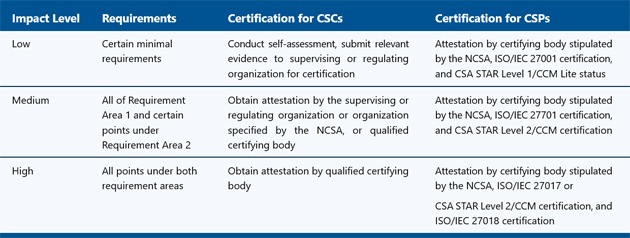
The stipulations of the Cloud Cybersecurity Standards vary depending on the data or information systems’ level of impact. The requirements for each level are summarized in the table below.
For more information on the draft Cloud Cybersecurity Standards, or on any aspect of cybersecurity and cloud-related laws in Thailand, please contact Athistha (Nop) Chitranukroh at [email protected] and Thammapas Chanpanich at [email protected].

RELATED INSIGHTS​ 

May 24, 2023
The draft Royal Decree on Artificial Intelligence System Service Business, which was introduced by the Office of the National Digital Economy and Society Commission earlier for public comment in October last year, focuses on potential risks from artificial intelligence (AI) systems to public health, safety, and freedoms. The framework emphasizes the importance of risk assessment, reporting requirements, and the establishment of specific measures and criteria deemed necessary to minimize AI risks. AI Systems Defined by the Decree Under the draft royal decree, an AI system is defined as a machine-based system that can make predictions, recommendations, or decisions that affect real or virtual environments pursuant to the objectives set by humans. The definition clarifies that artificial intelligence systems are designed to operate at different levels of autonomy, including: machine learning AI; logic-based and knowledge-based AI; statistical AI; Bayesian estimation AI; and search and optimization AI. Risk-based Approach The draft AI royal decree takes a risk-based approach to regulation and specifically identifies prohibited or high-risk AI services that could cause harm or engage in unethical practices to ensure that AI systems do not pose major risks to public health, safety, or freedoms. The extent of regulatory scrutiny applied to an AI system corresponds to the level of risk presented by the AI system. For example, AI systems that pose unacceptable risks are generally prohibited, AI systems considered to be high-risk are subject to a conformity assessment, and AI systems considered to be limited-risk are subject to transparency requirements. Compliance with specified criteria and procedures to minimize potential risks of each AI service would be further outlined in subregulations. Prohibited AI Systems The draft AI royal decree prohibits AI systems that: employ subliminal techniques to covertly influence human behavior (below the threshold of conscious awareness); utilize social scoring; access sensitive personal
May 17, 2023
In Myanmar, a Union Tax Law is enacted each year to announce the rates of tax set out in the Income Tax Law 1974, the Commercial Tax Law 1990, and the Special Goods Tax Law 2016. The Union Tax Law 2023 (UTL 2023) came into force on April 1, 2023. It sets the rates of special goods tax (SGT), income tax (IT), and commercial tax (CT) for the period of April 1, 2023, to March 31, 2024, and exempts certain goods and services from these taxes. The key changes implemented by the UTL 2023 are summarized below. Special Goods Tax The UTL 2023 exempts battery electric vehicles (BEVs) from SGT. At the same time, it increases the rate of SGT on imported liquor. Previously, the rate of SGT ranged from 190 MMK per liter to 60 percent of the per-liter price of imported liquor in the previous fiscal year. The UTL 2023 raises the minimum rate to 209 MMK per liter while leaving the upper rate unchanged. Commercial Tax and Customs Tariffs BEVs imported into Myanmar were made exempt from CT under the Law Amending the Union Tax Law 2022. The UTL 2023 extends the exemption until the end of the 2023–24 fiscal year, along with two- and three-wheeler BEVs, BEV batteries, and related parts for specific use in BEVs. The CT exemption for battery charging services for BEVs, also introduced in 2022, has similarly been extended. Following enactment of the UTL 2023, the Ministry of Planning and Finance (MOPF) issued Notification No. 31/2023, reducing to zero the customs tariffs on imported BEVs, including those imported completely built up (CBU), completely knocked down (CKD), or semi-knocked down (SKD). The tariffs on spare parts and materials for BEVs have also been reduced to zero. In addition to exempting BEVs from
May 15, 2023
Southeast Asia’s remarkable growth as a destination for foreign investment—including a 42 percent increase in 2021, according to a joint ASEAN-UNCTAD report—has brought with it innovation as well as the desire to protect that innovation. Investors are increasingly seeking to patent the proprietary technology that is a crucial component of so many businesses today, and a burning question for patent applicants is whether artificial intelligence (AI) technology and software are patentable in Southeast Asia. The short answer is that it depends, as the patent laws in Southeast Asia are not uniform. Is it Patentable? While AI tools tend to be newer, the older and more familiar question is whether computer software is patentable, and many jurisdictions do have specific rules on this issue. Pure software, or software characterized only by source code, may not be patentable, but it can be protected under copyright laws. AI-related software may involve complex algorithms, datasets, and training methodologies that can be challenging to disclose in a manner that satisfies the enablement requirement in practice. Algorithms, mathematical methods, and abstract ideas are often considered non-patentable subject matter in many jurisdictions. While software implementing AI may involve innovative algorithms, securing patents for algorithms alone can be challenging in some jurisdictions. Also, the patent laws of Indonesia, Myanmar, Thailand, and Vietnam specifically list computer programs as unpatentable subject matter. However, a possible workaround would be to describe the software as connected to a tangible medium. This method could overcome an unpatentable subject matter rejection during substantive examination. Furthermore, in Indonesia, a computer program can be patentable if its characteristics (i.e., instructions) have a technical effect and function to solve a tangible or intangible problem. The most liberal of Southeast Asia’s patent regimes—Singapore’s—even addresses AI innovations. The country has a special fast-track scheme for examining AI patent
May 9, 2023
The significance of artificial intelligence (AI) is rapidly increasing worldwide, and Southeast Asia is no exception, as it plays a leading role in the technological development of many industries. AI has already proven its importance for driving business growth in areas such as e-commerce, finance, and healthcare, but its remarkable potential also raises concerns around privacy. As AI systems are designed to collect and process large amounts of data to improve their operation, it is necessary to balance the development of technology with the protection of individuals’ privacy. Current Frameworks in Southeast Asia This concern has been on regional policymakers’ agendas for many years. The ASEAN Framework on Personal Data Protection, which was adopted in 2016, is not legally binding and has no enforcement mechanism, but it serves as a guide for ASEAN member states in developing their own data protection laws and regulations. Domestic data privacy laws are currently in force in five ASEAN member countries—Indonesia, Malaysia, the Philippines, Thailand, and Singapore—while Vietnam’s Personal Data Protection Decree is scheduled to take effect on July 1, 2023. This presents a challenge for ASEAN members, as adopting AI-related technology can further complicate data protection efforts due to the amount of personal data AI systems collect, as well as the complexity of the data used to train the AI algorithm. Some ASEAN members have also made progress in regulating AI. For instance, Singapore released the Model AI Governance Framework in 2019 and launched the AI Governance Testing Framework and Toolkit in 2022—the world’s first such framework. Similarly, Thailand issued the Artificial Intelligence Ethics Guideline in 2019 to help government agencies in the development, promotion, and use of AI, and in 2023 adopted the Thailand Artificial Intelligence Guidelines to help the private sector develop AI-related work. These guidelines primarily focus on principles
