You are using an outdated browser and your browsing experience will not be optimal. Please update to the latest version of Microsoft Edge, Google Chrome or Mozilla Firefox. Install Microsoft Edge

December 8, 2023

Thailand Extends Payment Deadline for 2024 Land and Building Tax

Thailand’s Ministry of Interior has extended the deadlines for payment of the 2024 land and building tax and related procedures by two months. The announcement was published in the Government Gazette on November 30, 2023.

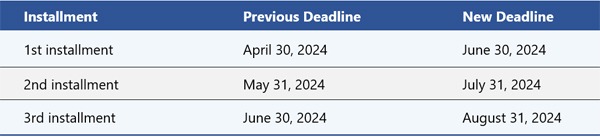
According to the new timeline in the ministry’s announcement, the official land and building tax assessment forms will be sent to taxpayers by the end of April 2024 (extended from February 2024) while the deadline for payment of land and building tax has been extended to June 30, 2024 (from April 30, 2024).

For payments made in installments, the announcement also extended the deadline for each installment as follows:
For more details on these measures, or any aspect of Thailand’s land and building tax, please contact Chaiwat Keratisuthisathorn at [email protected] or Supranee Arjjit at [email protected].

RELATED INSIGHTS​ 

October 14, 2016
Thailand is one of the world’s most popular travel destinations. A vast amount of tourists visit the country every year. And almost all of them have at least one thing in common—they need somewhere to stay.As tourists continue to pour into Thailand, savvy business operators have sought to capitalize on this wave of opportunity by providing various forms of accommodation. Small hotels and short-term accommodation rental service have become a particularly prevalent means to do business.
August 18, 2016
Franchising Global Guide, published by Practical Law Company, provides an overview of franchising law and regulations in 17 jurisdictions around the world. The Thailand chapter of the guide, written by Alan Adcock, a partner and deputy director of the intellectual property and regulatory affairs group at Tilleke & Gibbins, covers the following subjects in detail:
June 3, 2016
In 2011, when Myanmar embarked on a series of political and economic reforms, there was a surge in demand for real estate. Demand quickly outpaced supply, resulting in an undersupply of quality office space and housing. By 2014, rental prices in Yangon’s prime areas had climbed to as high as USD 100 per square meter, rivaling those found in lower Manhattan and over three times those in prime areas of Bangkok.