You are using an outdated browser and your browsing experience will not be optimal. Please update to the latest version of Microsoft Edge, Google Chrome or Mozilla Firefox. Install Microsoft Edge

December 8, 2023

Thailand Extends Payment Deadline for 2024 Land and Building Tax

Thailand’s Ministry of Interior has extended the deadlines for payment of the 2024 land and building tax and related procedures by two months. The announcement was published in the Government Gazette on November 30, 2023.

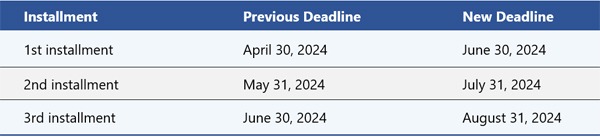
According to the new timeline in the ministry’s announcement, the official land and building tax assessment forms will be sent to taxpayers by the end of April 2024 (extended from February 2024) while the deadline for payment of land and building tax has been extended to June 30, 2024 (from April 30, 2024).

For payments made in installments, the announcement also extended the deadline for each installment as follows:

For more details on these measures, or any aspect of Thailand’s land and building tax, please contact Chaiwat Keratisuthisathorn at [email protected] or Supranee Arjjit at [email protected].

RELATED INSIGHTS​ 

March 13, 2025
Vietnam’s Ministry of Finance has released a draft Decree on Tax Administration for E-Commerce and Digital Platforms (“Draft Decree”), introducing significant tax compliance obligations that could reshape how digital platforms, and individuals and business households conducting business through the platforms, manage their tax responsibilities. Aimed at strengthening tax enforcement, the Draft Decree requires e-commerce and digital platforms to actively track and withhold taxes from business households and individual sellers, and remit payments to tax authorities. While it has not yet been promulgated, the Draft Decree is expected to take effect on April 1, 2025, leaving platforms with a limited window to prepare for compliance. Who Is Affected by the New Tax Rules? The Draft Decree significantly broadens the tax administration scope beyond traditional e-commerce platforms to cover a wide range of digital economy participants. Specifically, the Draft Decree places direct tax-related responsibilities on two major categories (collectively, “Regulated Operators”): E-commerce and digital platforms with payment functions (e.g., platforms that process buyer payments via e-wallets, bank transfers, cards, or cash-on-delivery); and Other digital-economy players that enable e-commerce transactions, including (i) intermediary service platforms connecting service providers with consumers, (ii) digital content platforms, (iii) online advertising providers, (iv) cloud computing and data storage providers, (v) social media platforms engaged in business activities (e.g., live-stream, in-app transactions), (vi) online education, gaming, and digital entertainment platforms generating revenue from digital transactions, (vii) Vietnam-based partners of foreign digital service providers facilitating local payments for overseas platforms, and (viii) intermediary payment service providers handling financial transactions for e-commerce activities. Under the Draft Decree, Regulated Operators will be required to track, report, and enforce tax compliance for both resident and nonresident individuals and households conducting business through their platforms (“Sellers”). What New Tax Obligations Do Platforms Face? Onshore platforms For the first time, Regulated Operators will
March 12, 2025
In November 2024, Thai Prime Minister Paethongtarn Shinawatra unveiled ambitious plans to enhance tax incentives for foreign film productions during a networking reception in Los Angeles, coinciding with her visit to the APEC Economic Leaders’ Meeting in Lima, Peru. This event, attended by Motion Picture Association executives and leaders from top US film companies, marked a significant commitment to boosting foreign investment in Thailand’s film industry. Thailand’s Department of Tourism (DOT) prioritized the initiative by updating the Announcement on Guidelines, Procedures, and Conditions for Applying for Benefits Under the Incentive Measures for Foreign Film Production in Thailand in December 2024 to further position Thailand as a destination for large-scale international film and television productions. Key Amendments to Film Incentives under the 2024 Announcement The 2024 announcement introduced major changes, including (1) removal of the rebate cap, previously set at THB 150 million (approx. USD 4.5 million) per project, enabling rebates based on total qualified spending, and (2) an increase in cash rebate rates. The maximum allowable cash rebate rate was increased to 30 percent from the previous cap of 20 percent. The base rate of 15 percent remains unchanged. The primary incentive available under the 2024 announcement is a 15 percent cash rebate on qualified spending in Thailand of at least THB 50 million (approx. USD 1.5 million). On top of this primary incentive, additional incentives are available; however, the total possible cash rebate is capped at 30 percent, and the additional incentives can only amount to an added 15 percent. Also, the total rebate (including both primary and additional incentives) for films with a budget of less than THB 100 million (approx. USD 3 million) is capped at 25%. To obtain a higher rebate rate, productions may apply for the following additional incentives: Compliance Requirements Foreign production companies
March 6, 2025
On February 18, 2025, the Thai Senate approved an amendment to the Act on the Establishment of and Procedures for the Tax Court. This follows the July 2024 approval by the Thai cabinet and subsequent preparation of supporting secondary legislation. This important amendment to procedural law, once it takes effect, will extend the exclusive jurisdictional powers of the Tax Court to all criminal tax, customs, and excise tax claims in addition to the court’s existing jurisdiction over all such civil claims. The amendment, while now formally approved by the legislature, is awaiting the king’s signature and will take effect 180 days after its publication in the Government Gazette. Based upon its projected publication date, the amendment will likely take effect by the end of the third quarter of this year. This development is set to offer a more sophisticated Tax Court litigation process for highly specialized and often complex criminal tax and customs claims, something with which Thailand’s traditional criminal courts have struggled. It also ensures that all tax and customs matters are adjudicated before the same court, saving time, party costs, and judicial resources. This appears likely to result in more consistent adjudication of criminal tax and customs disputes, a benefit for the Thai government and party litigants alike. Any ongoing criminal tax and customs claims already commenced with the respective criminal courts on the date on which the amendment becomes effective will remain under the exclusive jurisdiction of those criminal courts. The Tax Court will have exclusive jurisdiction over all other claims. This important legislative change offers those managing or otherwise facing civil and/or criminal Thai tax or customs disputes the opportunity to more effectively plan and execute a uniform defense strategy before a single, qualified forum.
March 4, 2025
On February 20, 2025, the National Assembly of Vietnam made public the executed Resolution 170/2024/QH15, which outlines special mechanisms and policies to address difficulties and obstacles related to notable real estate projects and land issues in Da Nang, Ho Chi Minh City, and Khanh Hoa Province. This resolution, with an effective date of April 1, 2025, aims to resolve issues identified in inspection conclusions, audits, and court judgments, including 1,313 cases of land-use term violations in Da Nang. Solutions Resolution 170 provides a variety of mechanisms and policies to clear the way for projects to proceed with implementation. These may include, depending on the specific location, the following solutions. For issued Land Use Rights Certificates (LURC) that violate the land-use term for business production land in Da Nang: For projects that have already been invested in and utilized, the land-use terms in the LURC may be adjusted to 50 years from the date of the decision on land allocation, land lease, conversion of land use purpose, or actual land handover. For continued use of land, determining land prices, and calculating land use fees and land rental fees applicable to a list of projects in Da Nang, Ho Chi Minh City, and Khanh Hoa Province: The city/provincial People’s Committees will review and complete, within their authority, the procedures related to land, investment, construction, environment, and forestry of such projects in accordance with the current laws. Projects that meet legal and regulatory requirements after thorough review and compliance checks will be allowed to continue, provided they are aligned with urban planning, environmental standards, and national security requirements. In addition, investors must fulfill applicable financial obligations, including land use fees and land rental payments, which will be reassessed and collected based on the land price tables applicable in Da Nang, Ho Chi