
You are using an outdated browser and your browsing experience will not be optimal. Please update to the latest version of Microsoft Edge, Google Chrome or Mozilla Firefox. Install Microsoft Edge

March 13, 2025

Vietnam’s Expected E-Commerce Tax Rules: What Do Platforms Need to Know?

Vietnam’s Ministry of Finance has released a draft Decree on Tax Administration for E-Commerce and Digital Platforms (“Draft Decree”), introducing significant tax compliance obligations that could reshape how digital platforms, and individuals and business households conducting business through the platforms, manage their tax responsibilities. Aimed at strengthening tax enforcement, the Draft Decree requires e-commerce and digital platforms to actively track and withhold taxes from business households and individual sellers, and remit payments to tax authorities.

While it has not yet been promulgated, the Draft Decree is expected to take effect on April 1, 2025, leaving platforms with a limited window to prepare for compliance.

Who Is Affected by the New Tax Rules?

The Draft Decree significantly broadens the tax administration scope beyond traditional e-commerce platforms to cover a wide range of digital economy participants. Specifically, the Draft Decree places direct tax-related responsibilities on two major categories (collectively, “Regulated Operators”):

  • E-commerce and digital platforms with payment functions (e.g., platforms that process buyer payments via e-wallets, bank transfers, cards, or cash-on-delivery); and
  • Other digital-economy players that enable e-commerce transactions, including (i) intermediary service platforms connecting service providers with consumers, (ii) digital content platforms, (iii) online advertising providers, (iv) cloud computing and data storage providers, (v) social media platforms engaged in business activities (e.g., live-stream, in-app transactions), (vi) online education, gaming, and digital entertainment platforms generating revenue from digital transactions, (vii) Vietnam-based partners of foreign digital service providers facilitating local payments for overseas platforms, and (viii) intermediary payment service providers handling financial transactions for e-commerce activities.

Under the Draft Decree, Regulated Operators will be required to track, report, and enforce tax compliance for both resident and nonresident individuals and households conducting business through their platforms (“Sellers”).

What New Tax Obligations Do Platforms Face?

Onshore platforms

For the first time, Regulated Operators will bear direct tax enforcement responsibilities. This represents a significant shift from the current system, where Sellers bear the primary tax responsibility. Specifically, Regulated Operators must comply with the following key tax obligations:

  • Ensure that every Seller provides a valid tax identification number (TIN) before being allowed to conduct transactions on the platform.
  • Withhold VAT and personal income tax (PIT) from Sellers’ revenues before transferring proceeds, following the tax rates discussed in the section below.
  • Issue e-commerce tax withholding certificates to Sellers annually and submit data to tax authorities. The tax withholding certificate must contain detailed transaction information, including the Sellers’ details, revenue, and withheld tax amounts, and the platform’s digital signature.

These requirements are designed to prevent tax evasion by anonymous Sellers operating on digital platforms. Notably, platforms that comply with their tax withholding obligations are exempt from additional transaction reporting requirements under Decree 91/2022/ND-CP. Nonetheless, it appears that Regulated Operators still need to report Seller information upon request by tax authorities.

The Draft Decree, however, leaves several aspects unclear, including:

  • Liability of noncompliant Sellers: It remains uncertain whether Sellers who fail to provide TINs will be subject to higher withholding tax rates, restricted from conducting business, or potentially suspended from platform operations based on the severity of noncompliance.
  • Liability of platforms: The Draft Decree does not specify whether Regulated Operators will face penalties for failing to collect TINs from Sellers. In addition, in a transaction involving multiple platforms, it would be difficult to identify which platform is directly liable for the tax withholding and payment.
  • Implementation timeline: No clear guidance is provided regarding how long Regulated Operators will have to collect TINs from existing Sellers before enforcement begins.

Further clarification from regulators is expected to ensure a smooth transition and avoid disruptions for both platforms and Sellers.

Offshore platforms

Offshore platforms must comply with Vietnam’s foreign tax registration requirements under Circular 80/2021/TT-BTC, which requires, among other things, (i) electronic tax registration via the General Department of Taxation’s online portal and (ii) direct tax declaration and payment, or appointment of a Vietnam-based tax agent to handle tax obligations.

How Will Tax Withholding Be Calculated?

Under the Draft Decree, tax withholding must occur before Regulated Operators transfer payments from buyers to Sellers. Particularly, Regulated Operators are required to withhold VAT and PIT for each transaction, calculated as a fixed percentage of gross revenue based on the type of transaction.

The taxable revenue per transaction is defined as the total amount received from the buyer, collected by Regulated Operators on behalf of the Sellers.

The tax withholding rates are set out in the table below:
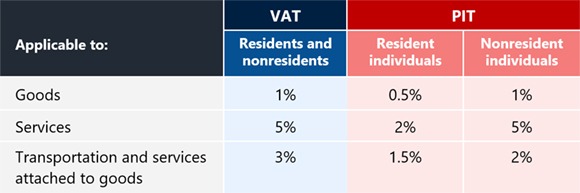
Notably, if a Regulated Operator cannot classify a transaction as goods or services, it must apply the highest withholding tax rates (5% for VAT and 5% for PIT). The withheld taxes must be declared and remitted monthly.

Outlook

With the decree set to take effect on April 1, 2025, the digital economy in Vietnam is on the brink of a major regulatory shift. While industry stakeholders are advocating for a postponement of the effective date, businesses should proactively prepare to mitigate regulatory risks and avoid operational disruptions. Successfully adapting to these changes will require Regulated Operators to focus on three key areas: tax compliance, data management, and Seller engagement.

To ensure a smooth transition, platforms may consider the following:

  • Mapping out Seller categories (resident vs. nonresident) and evaluating potential tax liabilities based on the categories, transaction types, and revenue models (goods, services, or transportation).
  • Developing education initiatives (FAQs, tutorials, chatbot assistance, etc.) to help Sellers understand their TIN registration, tax compliance, and data obligations.
  • Implementing automated TIN collection and verification to ensure compliance before enabling Seller transactions.
  • Implementing secure data storage systems to retain Seller transaction records in compliance with Vietnam’s tax administration laws.


RELATED INSIGHTS​ 

August 25, 2026
Vietnam has enacted a new decree establishing administrative penalties for violations in the fields of cybersecurity and personal data protection. Decree No. 330/2026/NĐ-CP (Decree 330), issued and effective from August 19, 2026, provides a detailed sanctions framework for noncompliance with the Law on Personal Data Protection (including its implementing regulations under Decree 356/2025/ND-CP) and the Law on Cybersecurity, together with their guiding decrees. The issuance of Decree 330 signals that the practical grace period previously perceived by many businesses may be drawing to a close, with active regulatory enforcement in these areas expected to commence in earnest. Scope and Key Provisions Decree 330 has extraterritorial effect and applies to both onshore and offshore companies. For offshore companies, it applies to those that (1) provide telecommunications, internet, online-content, information-technology, cybersecurity, or cross-border services and (2) are involved in or related to the processing of personal data of Vietnamese citizens and certain other people of Vietnamese origin. Decree 330’s key provisions cover the following areas: Administrative penalties for violations relating to the protection of national security and public order in cyberspace, including the dissemination of unlawful, false, or unverified information. Sanctions for cyberattacks, unauthorized access, introduction of harmful code or programs, and failure to cooperate with specialized cybersecurity forces. Sanctions for personal data protection violations, such as consent, cross-border data transfers, impact assessments, breach notification, and data-subject rights, among others—with maximum fines of up to 5% of an organization’s preceding-year revenue for cross-border transfer violations, or up to VND 3 billion for other data-protection breaches. Personal Data Protection Penalties The key sanctions for personal data protection violations are as follows: Consent violations: Fines of up to VND 70 million (approx. USD 2,642), plus potential additional sanctions and remedial measures including irreversible deletion of personal data collected without consent and confiscation of
August 25, 2026
Thailand’s Electronic Transactions Development Agency (ETDA) is studying potential new regulatory measures for digital platform services that could significantly expand the country’s digital platform governance framework. The ETDA has already conducted one public consultation session on the proposed measures and will hold additional sessions on August 25 and September 2, 2026, covering five types of platform services under the Royal Decree on Digital Platform Services B.E. 2565 (2022). The measures under study are preliminary and may be changed based on consultation outcomes. Foundational Measures Applicable to All Platform Types Seven baseline obligations would apply across all digital platform categories: Transparency reports. Platforms must prepare and publish statistical reports on platform governance activities, including the number of content items removed or restricted and appeal outcomes, in a comparable format. Notice and action mechanism. Platforms must establish minimum standards for channels to report potentially illegal content or goods, conduct case-by-case review, provide explanations when content is removed or restricted, and maintain an internal appeals channel. Rights over automated decision-making. Users significantly affected by automated decisions are granted rights to request an explanation, request human review, and contest the decision. Service level agreements (SLAs). Platforms must publish minimum standards for response times, processing timelines, progress notifications, and remedies for incidents on the platform. Labeling of AI-generated content. Content generated or modified by AI must carry visible labels and machine-readable metadata, with exceptions for creative works that disclose AI use in a nonmisleading manner. Prohibition of dark patterns. User interface designs that deceive, coerce, or distort user decision-making are prohibited, including hiding critical information, creating false urgency, or making service cancellation unreasonably difficult. Business user fairness. Platforms must meet minimum standards for the treatment of sellers, workers, and content creators, including advance notice of term changes, explanation of account suspensions or visibility reductions,
August 20, 2026
Thailand has established a new cross-ministerial committee to oversee data center operations nationwide. On August 5, 2026, the Thai cabinet approved the Prime Minister’s Office Regulation on the Data Center Business Policy Committee, which was published in the Government Gazette on August 13, 2026, and is now in effect. The regulation reflects the government’s policy to elevate Thailand’s digital economy and promote investment in digital infrastructure and AI. The key features of the new committee are outlined below. Definition of “Data Center” Under the regulation, “data center” is defined as a building, premises, or structure that uses electronic equipment to provide services related to the collection, storage, processing, hosting, or transmission of data by electronic means to third parties that are not affiliates, as further determined by the Data Center Business Policy Committee. Committee Composition The committee will be chaired by a deputy prime minister designated by the prime minister, and will have three vice-chairs comprising the ministers of digital economy and society, interior, and energy. The committee also includes 12 ex-officio members: the permanent secretaries of finance, agriculture, natural resources, energy, interior, digital economy, industry, and commerce; the secretaries-general of the Board of Investment (BOI), Energy Regulatory Commission, National Broadcasting and Telecommunications Commission (NBTC), and National Water Resources Office; and the director of the Energy Policy and Planning Office. Up to three expert members may be appointed by the prime minister for two-year terms, renewable once. The secretary-general of the National Economic and Social Development Council (NESDC) serves as member and secretary, with up to two NESDC officials serving as assistant secretaries. Powers and Duties The committee is empowered to: Propose policies, standards, and operational frameworks for government agencies in approving, licensing, issuing investment promotion certificates, or providing services to data center operators in Thailand; Study, analyze, and
August 14, 2026
Thailand’s Office of the Insurance Commission (OIC) has issued guidelines clarifying the boundaries between permissible and prohibited activities for unlicensed individuals—including influencers, bloggers, and content creators—when communicating about insurance products on social media. The Good Practice Guidelines for Persons Not Licensed as Insurance Agents or Brokers Regarding the Dissemination of Insurance Content Through Digital Media B.E. 2569 (2026) took effect on July 24, 2026. Activities Requiring a License The guidelines reserve the following activities for licensed agents and brokers: Soliciting or facilitating insurance contracts. Providing personalized advice on product suitability. Recommending policy cancellation to purchase promoted products. Creating links that facilitate contract formation. Receiving performance-based compensation tied to policies or premiums generated. Importantly, boilerplate disclaimers such as “this is not a recommendation to buy insurance” will not shield individuals from liability if the OIC views the content as personalized advice or solicitation. Permitted Activities Unlicensed persons may present general educational content about insurance—such as explaining terminology, sharing industry statistics, reporting news, or sharing personal experiences—provided the content does not target specific individuals to purchase from specific companies. The guidelines also set out best practices for communication, including presenting information in a fair and balanced manner that covers both benefits and limitations, encouraging consumers to read policy terms and consult licensed professionals, verifying information from credible sources before dissemination, and exercising special care when the audience may include vulnerable groups such as persons aged 60 and older. Prohibited Practices Prohibited practices include fear-based marketing, creating artificial urgency, omitting material limitations, making exaggerated claims, falsely claiming professional credentials, using fake engagement mechanisms, and sharing false or misleading content. The guidelines also reinforce the prohibitions under section 83 of the Life Insurance Act B.E. 2535 and section 78 of the Non-Life Insurance Act B.E. 2535 against soliciting insurance contracts with foreign operators