
You are using an outdated browser and your browsing experience will not be optimal. Please update to the latest version of Microsoft Edge, Google Chrome or Mozilla Firefox. Install Microsoft Edge

March 12, 2025

Updates on Thailand’s Film Incentive Measures

In November 2024, Thai Prime Minister Paethongtarn Shinawatra unveiled ambitious plans to enhance tax incentives for foreign film productions during a networking reception in Los Angeles, coinciding with her visit to the APEC Economic Leaders’ Meeting in Lima, Peru. This event, attended by Motion Picture Association executives and leaders from top US film companies, marked a significant commitment to boosting foreign investment in Thailand’s film industry.

Thailand’s Department of Tourism (DOT) prioritized the initiative by updating the Announcement on Guidelines, Procedures, and Conditions for Applying for Benefits Under the Incentive Measures for Foreign Film Production in Thailand in December 2024 to further position Thailand as a destination for large-scale international film and television productions.

Key Amendments to Film Incentives under the 2024 Announcement

The 2024 announcement introduced major changes, including (1) removal of the rebate cap, previously set at THB 150 million (approx. USD 4.5 million) per project, enabling rebates based on total qualified spending, and (2) an increase in cash rebate rates. The maximum allowable cash rebate rate was increased to 30 percent from the previous cap of 20 percent. The base rate of 15 percent remains unchanged.

The primary incentive available under the 2024 announcement is a 15 percent cash rebate on qualified spending in Thailand of at least THB 50 million (approx. USD 1.5 million).

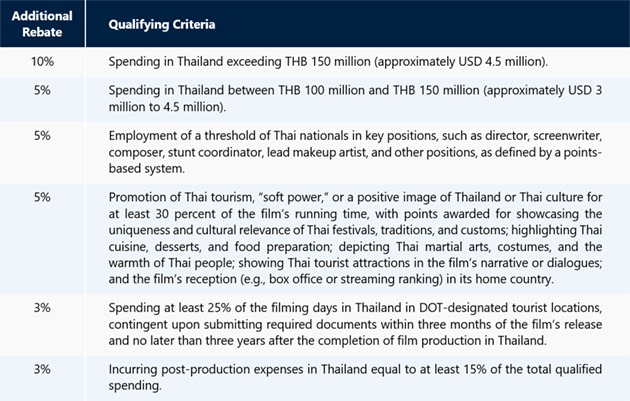
On top of this primary incentive, additional incentives are available; however, the total possible cash rebate is capped at 30 percent, and the additional incentives can only amount to an added 15 percent. Also, the total rebate (including both primary and additional incentives) for films with a budget of less than THB 100 million (approx. USD 3 million) is capped at 25%.

To obtain a higher rebate rate, productions may apply for the following additional incentives:
Compliance Requirements

Foreign production companies seeking to benefit from Thailand’s enhanced film incentives must navigate a structured application and compliance process. The 2024 announcement establishes different processing periods for applications based on spending thresholds. Noncompliance with these procedural requirements could jeopardize eligibility for the rebates, regardless of the actual amount spent in the country.

One of the key criteria for receiving the incentives is that the filming must not cause or result in environmental damage or harm to natural resources; otherwise, the approved incentives will be revoked.

The timing of this policy is noteworthy, given the recent decision regarding an environmental dispute in which Thailand’s Ministry of Natural Resources and Environment sued a major production company for over THB 100 million (approx. USD 3 million), alleging ecological damage caused during filming. The lawsuit claimed that alterations to a bay landscape and failure to comply with legal requirements and agreements established with the authorities resulted in extensive environmental harm, including deforestation and coral reef destruction. After 20 years of legal proceedings, the Thai Supreme Court ruled in 2022 that the production company must pay THB 10 million (approx. USD 300,000), or 10% of the original claim. This case underscores the risk of noncompliance with legal requirements, which can result in negative publicity, financial liability, and the loss of eligibility for incentives.

Tax Implications and Documentation Requirements

The rebate mechanism interacts with several Thai tax considerations that foreign production companies should carefully evaluate. The 2024 announcement specifies that the rebate itself is subject to 1% withholding tax under the Thai Revenue Code. Additionally, service and rental expenses paid to Thai providers typically attract withholding tax rates of 3% and 5%, respectively, while most goods and services in Thailand are subject to 7% VAT (value-added tax), significantly impacting overall production budgeting. The rebate application process also requires comprehensive financial documentation as specified in the requisition form, with all expenses requiring proper verification according to Thai Revenue Department standards.

Understanding which preproduction, production, and postproduction expenses qualify (particularly the requirement that physical production expenses in Thailand must be at least 50% of total qualified spending) requires careful planning. Professional tax and legal advice can help companies optimize their structure to maximize eligible expenses while ensuring regulatory compliance.

Final Remarks

Thailand’s revised film incentives under the DOT’s 2024 announcement provide lucrative opportunities for foreign film and television productions. By enhancing financial incentives, Thailand aims to attract more international projects, thereby stimulating economic growth and promoting cultural exchange. As the global film industry continues to evolve, Thailand’s proactive approach positions it as a competitive and attractive destination for filmmakers worldwide. Productions planning to capitalize on these incentives are advised to consult local experts to navigate the regulatory landscape effectively.


RELATED INSIGHTS​ 

September 7, 2026
Indonesia’s Constitutional Court (Mahkamah Konstitusi) has reinstated a key provision limiting pharmaceutical patent protection, signaling a renewed commitment to balancing patent rights with public access to medicines. In its ruling to Case No. 255/PUU-XXIII/2025, the court partially granted a petition for judicial review of Law No. 65 of 2024, which had amended the country’s Patent Law, and ordered the restoration of a provision that had excluded certain pharmaceutical inventions from patentability. The decision took effect immediately upon its pronouncement at the court’s plenary session on August 28, 2026. Background The petition challenged the removal of article 4(f) from Law No. 13 of 2016 concerning Patents (Patent Law), as amended by Law No. 65 of 2024. Article 4(f) had excluded from patentability certain inventions relating to new uses of known substances. The petitioners argued that removing this provision would open the door to patent protection for second medical use inventions and facilitate patent evergreening—practices that can extend exclusivity periods, delay generic market entry, and reduce public access to affordable medicines. The petitioners included several patient advocacy and public-interest organizations: the Indonesian Dialysis Patients Community Association, the Indonesian Association of Drug Abuse Victims (PKNI), the Indonesian Pulmonary Hypertension Foundation (YHPI), the Rekat Peduli Indonesia Foundation, and the Indonesian Positive Women’s Association (IPPI), along with the Indonesia for Global Justice Association and four individual petitioners. The petitioners also challenged the constitutionality of the phrase “interested party” in article 70(1) of the Patent Law, arguing that it should be construed expressly to clarify who has standing to appeal a decision to grant a patent before the Board of Patent Appeal, and to allow a broader range of parties—such as patent holders, licensees, consumer organizations, prosecutors, aggrieved third parties, and others who may suffer direct or indirect harm from the grant of a patent—to
September 2, 2026
Thailand and China have a longstanding and significant trade relationship, which increasingly extends to e-commerce and digitally enabled supply chains. While these channels create new opportunities for businesses to reach consumers across borders, their growth also brings greater exposure to intellectual property (IP) infringement across jurisdictions and online platforms. Effective cooperation between the two countries’ enforcement authorities has therefore become increasingly important. To strengthen cooperation in this area, Thailand and China signed a memorandum of understanding (MOU) on IP enforcement in Beijing on July 20, 2026, during the Thai prime minister’s official visit to China. Officially titled “Memorandum of Understanding Between the State Administration for Market Regulation of the People’s Republic of China and the Ministry of Commerce of the Kingdom of Thailand on Cooperation in the Field of Intellectual Property Enforcement,” the MOU forms part of a broader bilateral agenda covering industrial and supply chains, participation by micro, small, and medium-sized enterprises (MSMEs), cooperation associated with the ASEAN–China Free Trade Area 3.0, and progress on the registration of Thai geographical indications in China. The MOU establishes a bilateral framework for cooperation and coordination in five broad areas: Strengthening dialogue in IP enforcement; Enhancing information sharing; Facilitating the enforcement of IP rights in cases arising in the parties’ domestic markets and on online platforms, in accordance with their respective domestic laws; Promoting cooperation in IP enforcement training and human resource development; and Undertaking other cooperation activities agreed upon by both sides. The Department of Intellectual Property (DIP) will serve as the principal coordinating agency for Thailand, while the Bureau of Law Enforcement and Inspection in China’s State Administration for Market Regulation (SAMR) will serve in that role for China. The framework is particularly relevant to the growth of e-commerce, as it covers infringement in the domestic markets and on
August 28, 2026
When considering a franchise, many people first think of a restaurant, retail chain, or service outlet. From a legal perspective, however, the foundation of every franchise lies in the right to use a brand, which is typically granted through a trademark license. Trademarks are often the most valuable assets in a franchise system. Through a trademark license, a franchisor authorizes a franchisee to use its trademarks, logos, and branding while maintaining control over how the brand is presented to customers. The Role of Trademarks in Franchise Businesses Under the Trademark Law 2019, a mark is defined as a sign that is capable of distinguishing the goods or services of one undertaking from those of others in the course of trade. This distinguishing function is particularly important in a franchise arrangement, where the franchisee’s use of the franchisor’s trademark allows consumers to recognize the source, quality, and reputation of the business. In this way, trademarks help preserve brand identity, strengthen market recognition, and protect the commercial value of the franchise system. Legal Foundation for Franchise Brand Protection Myanmar presently does not have a specific statutory framework governing franchise arrangements. As a result, franchise agreements are generally regulated under the broader applicable legal framework, including the Contract Act 1872, the Trademark Law 2019, the Competition Law 2015, the Consumer Protection Law 2019, and the relevant implementing rules and regulations. The licensing of trademarks within a franchise arrangement is particularly governed by the Trademark Law 2019. Franchisors should ensure that the trademarks intended to be licensed to franchisees in Myanmar are registered under the Trademark Law 2019 and that the relevant trademark license is properly recorded with the Intellectual Property Department (IPD). Trademark License Recordal Under the Trademark Law 2019, the owner of a registered trademark may grant a license to another
August 27, 2026
It is generally understood that patents are granted for new designs that have not been widely known or used in Thailand and not been disclosed anywhere prior to the date of the patent application. It is trite law that design law protects the distinctive appearance or products. Under Section 3 of the Thai Patent Act B.E. 2522, as amended by the Patent Act (No. 2) B.E. 2535 and the Patent Act (No. 3) B.E. 2542, a design is defined as “any form or composition of lines or colors that gives a product a special appearance and can serve as a pattern for an industrial or handicraft product.” This raises an important question. Can a patent be issued for a product design that contains text, numerals, trademarks, or symbols that do not fall under the definition of a design? This issue commonly arises when attempting to register packaging, labels, and graphical user interfaces (GUIs). Until a few years ago, applicants could file design applications with the Thai Patent Office for designs that contained such elements, provided that an appropriate disclaimer was included. This practice was generally accepted by Thai design examiners at that time, but the Patent Office has since implemented a change in its practice that could have a significant impact on applicants for design patents. Where design representations are submitted as line drawings or computer-aided design (CAD) drawings, the examiner may now issue an office action requiring their removal. This practice, however, appears to be applied inconsistently, as some examiners still exercise their own discretion in determining whether drawings containing these elements are acceptable. Below are examples of a GUI design, a CAD drawing design, and a photographic design representation that illustrates issues relating to the presence of nonallowable elements. GUI design For this GUI design, the submitted