You are using an outdated browser and your browsing experience will not be optimal. Please update to the latest version of Microsoft Edge, Google Chrome or Mozilla Firefox. Install Microsoft Edge

August 23, 2021

Thailand Deploys Relief Measures to Help Insured Persons under the Social Security Act

Since July 13, 2021, the Thai government has issued a series of resolutions offering relief measures for persons insured under sections 33 (regular employees), 39 (former employees still paying contributions to the SSO) and 40 (freelancers) of the Social Security Act B.E. 2533 (1990) (the SSA) who have been affected by the COVID-19 prevention measures under the Emergency Decree on Public Administration in Emergency Situations B.E. 2548 (2005), including the business closures required in some provinces.

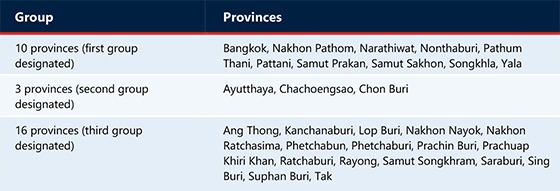
The latest cabinet resolution extends relief measures to SSA-insured persons in 29 provinces designated as maximum control areas (or “dark red” provinces). The provinces are grouped into three categories based on when they received that designation (which, in turn, impacts the duration of the relief which they receive):
Two types of relief measures have been announced—one for parties under section 33 of the SSA, and one for parties under sections 39 and 40.


Section 33 (Regular Employees)

Monetary assistance is available for Thai nationals insured under section 33 of the SSA (and their employers) engaged in the following business activities:

  • Administrative and support activities
  • Arts, entertainment, and recreation
  • Automotive repair
  • Construction
  • Food and accommodation
  • Information and communication activities
  • Professional activities in science and academia
  • Services
  • Transportation and storage
  • Wholesale/retail

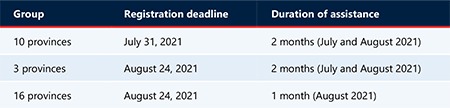
Employers must submit an application to the Social Security Office (SSO) through the online portal (www.sso.go.th/eservices) in order for them and their employees to receive the assistance payments. Each qualifying employee receives THB 2,500 per month if they are registered with the SSO within the deadline, while registered employers receive THB 3,000 per qualifying employee, up to a maximum of 200 employees (i.e., THB 600,000), as summarized in the table below.
 

Section 39 (Former Employees Still Paying SSO Contributions) and Section 40 (Freelancers)

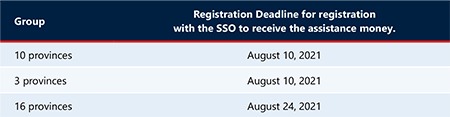
THB 5,000 assistance payments are available for Thai employees insured under sections 39 and 40 of the SSA. Government officers and those who receive a government pension are not eligible to receive the payments. Although the payments are classified as monthly, the current regulations authorize only one month of payments for qualifying insured persons who register with the SSO by the deadlines below.
Both of the relief measures described above are likely to be renewed on a monthly basis if the pandemic remains severe. However, as of August 19, no resolution has yet been issued to approve an extension for September.

Tilleke & Gibbins will continue to monitor the situation for developments. Questions on Thailand’s COVID-19 relief measures for employers and employees can be directed to Chusert Supasitthumrong at [email protected] or Piyawat Vitooraporn at [email protected].

RELATED INSIGHTS​ 

March 31, 2026
On December 10, 2025, the National Assembly of Vietnam adopted Law on Vocational Education No. 124/2025/QH15, which took effect on January 1, 2026, replacing Law on Vocational Education No. 74/2014/QH13 of 2014. The new law broadens the categories of institutions eligible to deliver vocational training, introduces vocational upper secondary schools, and shifts governance structures for private institutions from ownership-representative boards of management to stakeholder-based school councils. These reforms aim to diversify training providers, align programs with labor market needs, and create a more flexible, open vocational education ecosystem, offering expanded opportunities for foreign and domestic investors, universities, and enterprises. Some highlights of the new Law on Vocational Education are presented below. Expansion of Vocational Training Levels and Programs In addition to elementary, intermediate, and college—the three levels of vocational training program set out under the 2014 Law on Vocational Education—the new law expands the structure by introducing two new levels: Vocational high school training programs are placed between elementary and intermediate levels, and are aimed at combining upper secondary education with vocational training, expanding options for learners after graduating from the lower secondary level. Other vocational training programs are not specified in detail under the new law, but aim to equip learners with the capability to perform and handle one or several simple tasks of an occupation. Expansion of Vocational Education Providers The new law reclassifies and extends vocational education providers by classifying them into two distinct categories: Vocational education institutions, which include colleges, intermediate schools, and vocational high schools. Establishments participating in vocational education activities, which include vocational education centers, vocational-continuing education centers, continuing education centers, other centers with vocational education functions, enterprises, cooperatives, and higher education institutions. Vocational education providers may provide one vocational training level only, or several/all levels, depending on the type of provider. The
January 16, 2026
Employment law specialists from Tilleke & Gibbins in Vietnam have contributed the Vietnam chapter to the Guide to Restructuring a Cross-Border Workforce from International Employment Lawyer. This comprehensive global guide, covering 50 jurisdictions worldwide, addresses the complex issue of workplace restructurings, with a particular focus on the needs of multinational companies. The Vietnam chapter was authored by partner Kien Trung Trinh, counsel Sarah Galeski, and associates Dung Thi Phuong Le and Nguyen Thi Huong Nguyen. The Q&A-style chapter provides in-depth analysis of key areas related to workplace restructuring, including: Reduction in workforce; Restructuring or reorganization of the business; Changing terms and conditions; and Areas to watch. A PDF of the Vietnam chapter can be downloaded through the button below. Tilleke & Gibbins also contributed the Cambodia, Laos, Myanmar, and Thailand chapters to the Guide to Restructuring a Cross-Border Workforce 2026. To browse the full guide for all 45 jurisdictions, please visit the International Employment Lawyer website.
January 16, 2026
Employment law specialists from Tilleke & Gibbins’ office in Bangkok have contributed the Thailand chapter to the Guide to Restructuring a Cross-Border Workforce from International Employment Lawyer. This comprehensive global guide, covering 50 jurisdictions worldwide, addresses the complex issue of workplace restructurings, with a particular focus on the needs of multinational companies. The Thailand chapter was authored by Pimvimol (June) Vipamaneerut, Chusert Supasitthumrong, Dusita Khanijou, and Chomanut Arif. The Q&A-style chapter provides in-depth analysis of key areas related to workplace restructuring, including: Reduction in workforce; Restructuring or reorganization of the business; Changing terms and conditions; and Areas to watch. A PDF of the Thailand chapter can be downloaded through the button below. Tilleke & Gibbins also contributed the Cambodia, Laos, Myanmar, and Vietnam chapters to the Guide to Restructuring a Cross-Border Workforce 2026. To browse the full guide for all 45 jurisdictions, please visit the International Employment Lawyer website.
January 16, 2026
Tilleke & Gibbins’ office in Yangon has contributed the Myanmar chapter to the Guide to Restructuring a Cross-Border Workforce from International Employment Lawyer. This comprehensive global guide, covering 50 jurisdictions worldwide, addresses the complex issue of workplace restructurings, with a particular focus on the needs of multinational companies. The Myanmar chapter was prepared by Kyaw Min Tun, an associate in the firm’s Myanmar office. The Q&A-style chapter provides in-depth analysis of key areas related to workplace restructuring, including: Reduction in workforce; Restructuring or reorganization of the business; Changing terms and conditions; and Areas to watch. A PDF of the Myanmar chapter can be downloaded through the button below. Tilleke & Gibbins also contributed the Cambodia, Laos, Thailand, and Vietnam chapters to the Guide to Restructuring a Cross-Border Workforce 2026. To browse the full guide for all 45 jurisdictions, please visit the International Employment Lawyer website.