You are using an outdated browser and your browsing experience will not be optimal. Please update to the latest version of Microsoft Edge, Google Chrome or Mozilla Firefox. Install Microsoft Edge

August 23, 2021

Thailand Deploys Relief Measures to Help Insured Persons under the Social Security Act

Since July 13, 2021, the Thai government has issued a series of resolutions offering relief measures for persons insured under sections 33 (regular employees), 39 (former employees still paying contributions to the SSO) and 40 (freelancers) of the Social Security Act B.E. 2533 (1990) (the SSA) who have been affected by the COVID-19 prevention measures under the Emergency Decree on Public Administration in Emergency Situations B.E. 2548 (2005), including the business closures required in some provinces.

The latest cabinet resolution extends relief measures to SSA-insured persons in 29 provinces designated as maximum control areas (or “dark red” provinces). The provinces are grouped into three categories based on when they received that designation (which, in turn, impacts the duration of the relief which they receive):
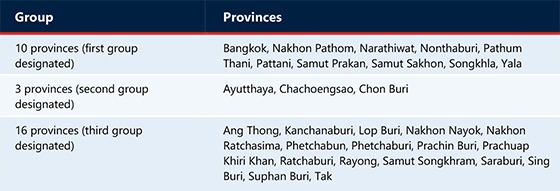
Two types of relief measures have been announced—one for parties under section 33 of the SSA, and one for parties under sections 39 and 40.


Section 33 (Regular Employees)

Monetary assistance is available for Thai nationals insured under section 33 of the SSA (and their employers) engaged in the following business activities:

  • Administrative and support activities
  • Arts, entertainment, and recreation
  • Automotive repair
  • Construction
  • Food and accommodation
  • Information and communication activities
  • Professional activities in science and academia
  • Services
  • Transportation and storage
  • Wholesale/retail

Employers must submit an application to the Social Security Office (SSO) through the online portal (www.sso.go.th/eservices) in order for them and their employees to receive the assistance payments. Each qualifying employee receives THB 2,500 per month if they are registered with the SSO within the deadline, while registered employers receive THB 3,000 per qualifying employee, up to a maximum of 200 employees (i.e., THB 600,000), as summarized in the table below.
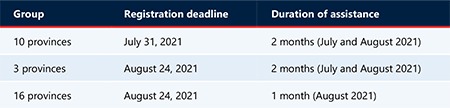
 

Section 39 (Former Employees Still Paying SSO Contributions) and Section 40 (Freelancers)

THB 5,000 assistance payments are available for Thai employees insured under sections 39 and 40 of the SSA. Government officers and those who receive a government pension are not eligible to receive the payments. Although the payments are classified as monthly, the current regulations authorize only one month of payments for qualifying insured persons who register with the SSO by the deadlines below.
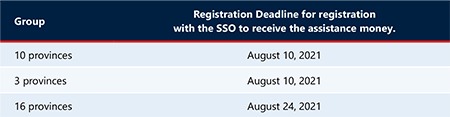
Both of the relief measures described above are likely to be renewed on a monthly basis if the pandemic remains severe. However, as of August 19, no resolution has yet been issued to approve an extension for September.

Tilleke & Gibbins will continue to monitor the situation for developments. Questions on Thailand’s COVID-19 relief measures for employers and employees can be directed to Chusert Supasitthumrong at [email protected] or Piyawat Vitooraporn at [email protected].

RELATED INSIGHTS​ 

January 16, 2026
Employment law specialists from Tilleke & Gibbins’ office in Vientiane have contributed the Laos chapter to the Guide to Restructuring a Cross-Border Workforce from International Employment Lawyer. This comprehensive global guide, covering 50 jurisdictions worldwide, addresses the complex issue of workplace restructurings, with a particular focus on the needs of multinational companies. The Laos chapter was prepared by associates Naiyane Xaechao and Sayphin Singsouvong. The Q&A-style chapter provides in-depth analysis of key areas related to workplace restructuring, including: Reduction in workforce; Restructuring or reorganization of the business; Changing terms and conditions; and Areas to watch. A PDF of the Laos chapter can be downloaded through the button below. Tilleke & Gibbins also contributed the Cambodia, Myanmar, Thailand, and Vietnam chapters to the Guide to Restructuring a Cross-Border Workforce 2026. To browse the full guide for all 45 jurisdictions, please visit the International Employment Lawyer website.
January 16, 2026
Employment law specialists from Tilleke & Gibbins’ office in Phnom Penh have contributed the Cambodia chapter to the Guide to Restructuring a Cross-Border Workforce from International Employment Lawyer. This comprehensive global guide, covering 50 jurisdictions worldwide, addresses the complex issue of workplace restructurings, with a particular focus on the needs of multinational companies. The Cambodia chapter was authored by Jay Cohen, partner and director of Tilleke & Gibbins’ Phnom Penh office, and Chanvisal Lok, associate. The Q&A-style chapter provides in-depth analysis of key areas related to workplace restructuring, including: Reduction in workforce; Restructuring or reorganization of the business; Changing terms and conditions; and Areas to watch. A PDF of the Cambodia chapter can be downloaded through the button below. Tilleke & Gibbins also contributed the Laos, Myanmar, Thailand, and Vietnam chapters to the Guide to Restructuring a Cross-Border Workforce 2026. To browse the full guide for all 45 jurisdictions, please visit the International Employment Lawyer website.
January 14, 2026
Employers operating in Thailand can enforce post-employment noncompete covenants, but success depends on precise drafting and strong evidentiary support. Thai courts will uphold restraints that protect legitimate employer interests and are fair and reasonable in duration, geographic reach, and substantive scope. Overbroad covenants, however, draw judicial skepticism and may fail unless they are drafted in severable, defensible components tied to the employee’s actual role. This article synthesizes recent trends in Thai case practice, explains how Thai courts assess reasonableness in employment restraints, and provides a practical litigation-focused framework for drafting enforceable covenants, preparing evidence, and pursuing relief through the Labor Court. The Legal Framework and Its Practical Implications Thai courts evaluate noncompete covenants under general principles of contract enforceability and public policy, with particular focus on whether a restraint is necessary to protect a legitimate employer interest and proportionate to that objective. In employment matters, this analysis is shaped by the employee-protective tenor of Thai labor law and by the Labor Court’s equitable discretion in determining appropriate remedies. The practical takeaway is that standardized or broadly drafted covenants rarely survive scrutiny. Courts look for a demonstrable nexus between the employee’s actual exposure to confidential information, trade secrets, or customer relationships and the scope of the restraint. Where that nexus is weak or the restraint operates as a blanket prohibition, courts are inclined to decline enforcement or limit relief to a narrowly tailored prohibition. The employer interests most commonly recognized as legitimate in Thai practice include the protection of trade secrets, confidential business information, and goodwill tied to identifiable customer segments or territories. Courts are more likely to enforce restraints where employers can clearly document what information is at risk, why particular customer relationships matter, and how the employee was involved with those assets. Judges also look closely at the
December 19, 2025
On December 12, 2025, Thailand’s Ministry of Labor published a ministerial regulation prescribing the minimum and maximum wages used as a base for calculating social security contributions. The regulation, which takes effect on January 1, 2026, sets a flat minimum base wage of THB 1,650 per month and a phased increase of the maximum base wage over the following six years, as outlined in the table below. Impact on Social Security Benefits Not only will monthly contributions increase as a result of the adjustment to the maximum wages used as a base for calculating social security contributions, but the maximum benefits available to insured persons will also be enhanced, as shown in the next table. Employer Obligations From January 1, 2026, employers must correctly withhold wages and remit social security contributions for both the employer’s and employees’ portions in compliance with the revised thresholds. Failure to comply may expose employers to penalties under the Social Security Act B.E. 2533 (1990). Employers should ensure that payroll systems are updated as necessary to reflect these changes to the wage ceiling used for social security contribution calculations.