You are using an outdated browser and your browsing experience will not be optimal. Please update to the latest version of Microsoft Edge, Google Chrome or Mozilla Firefox. Install Microsoft Edge

August 23, 2021

Thailand Deploys Relief Measures to Help Insured Persons under the Social Security Act

Since July 13, 2021, the Thai government has issued a series of resolutions offering relief measures for persons insured under sections 33 (regular employees), 39 (former employees still paying contributions to the SSO) and 40 (freelancers) of the Social Security Act B.E. 2533 (1990) (the SSA) who have been affected by the COVID-19 prevention measures under the Emergency Decree on Public Administration in Emergency Situations B.E. 2548 (2005), including the business closures required in some provinces.

The latest cabinet resolution extends relief measures to SSA-insured persons in 29 provinces designated as maximum control areas (or “dark red” provinces). The provinces are grouped into three categories based on when they received that designation (which, in turn, impacts the duration of the relief which they receive):
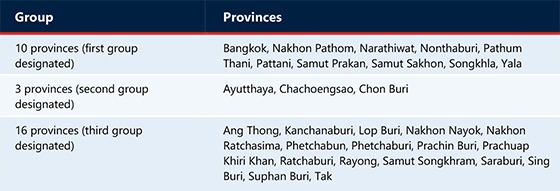
Two types of relief measures have been announced—one for parties under section 33 of the SSA, and one for parties under sections 39 and 40.


Section 33 (Regular Employees)

Monetary assistance is available for Thai nationals insured under section 33 of the SSA (and their employers) engaged in the following business activities:

  • Administrative and support activities
  • Arts, entertainment, and recreation
  • Automotive repair
  • Construction
  • Food and accommodation
  • Information and communication activities
  • Professional activities in science and academia
  • Services
  • Transportation and storage
  • Wholesale/retail

Employers must submit an application to the Social Security Office (SSO) through the online portal (www.sso.go.th/eservices) in order for them and their employees to receive the assistance payments. Each qualifying employee receives THB 2,500 per month if they are registered with the SSO within the deadline, while registered employers receive THB 3,000 per qualifying employee, up to a maximum of 200 employees (i.e., THB 600,000), as summarized in the table below.
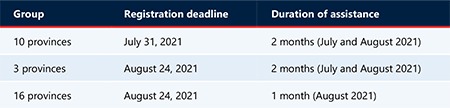
 

Section 39 (Former Employees Still Paying SSO Contributions) and Section 40 (Freelancers)

THB 5,000 assistance payments are available for Thai employees insured under sections 39 and 40 of the SSA. Government officers and those who receive a government pension are not eligible to receive the payments. Although the payments are classified as monthly, the current regulations authorize only one month of payments for qualifying insured persons who register with the SSO by the deadlines below.
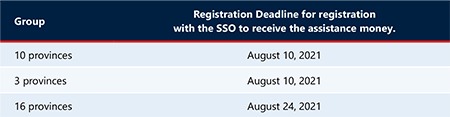
Both of the relief measures described above are likely to be renewed on a monthly basis if the pandemic remains severe. However, as of August 19, no resolution has yet been issued to approve an extension for September.

Tilleke & Gibbins will continue to monitor the situation for developments. Questions on Thailand’s COVID-19 relief measures for employers and employees can be directed to Chusert Supasitthumrong at [email protected] or Piyawat Vitooraporn at [email protected].

RELATED INSIGHTS​ 

March 27, 2024
Cambodia’s Ministry of Labor and Vocational Training issued the Notification on the Compensation for Terminating an Employment Contract on March 21, 2024, clarifying the compensation due to employees upon the termination of their employment contracts. The notification outlines different requirements depending on the nature of the termination and the type of employment contract, as laid out below. Termination without Valid Reason and in Absence of Serious Misconduct If an employment contract has been terminated by an employer without a valid reason and the employee did not commit any serious misconduct as defined under the relevant article of the Labor Law, the employer must compensate the employee as follows: Fixed-Duration Contract: Wages that have not yet been paid; Unused and unpaid annual leave through the termination date; Severance payment equal to at least 5% of the wages paid to the employee during the length of the contract; and Damages for being laid off before the expiration date of the fixed-duration contract, at least equal to the wages the employee would have received had he or she completed the original contracted term of employment. Unspecified-Duration Contract: Wages that have not yet been paid; Unused and unpaid annual leave through the termination date; Compensation in lieu of notice if the employer did not give prior notice in accordance with the Labor Law; Seniority indemnity for the semester that the employee is terminated and total seniority back payments that have not been paid; and Damages for being laid off, in an amount equal to the seniority payment received during the employment contract. Termination in Cases of Serious Misconduct Employees who commit any serious misconduct as defined under the Labor Law (regardless of whether they are under a fixed-duration or unspecified-duration contract) are entitled only to the following compensation: Wages that have not yet
March 18, 2024
Lawyers from Tilleke & Gibbins’ labor and employment team have contributed a new Vietnam chapter to Thomson Reuters Practical Law’s Employment and Employee Benefits Global Guide. The guide provides a high-level comparative overview of employment laws and regulations across various jurisdictions around the world. Tilleke & Gibbins also contributed the Myanmar chapter of the guide. The Vietnam chapter covers a wide range of typical employment matters, such as limitations on working hours, paid leave requirements, minimum wage, and health and safety obligations. In addition, the guide provides insight on a number of topics of special interest to foreign investors doing business in Vietnam, including the following: Mandatory contents of a labor contract; Visas and permits required for expatriate employees; Employers’ obligations for protecting employees’ privacy and personal data; Procedural requirements for the dismissal of an employee; Employer and parent company liability. To view the latest version of Employment and Employee Benefits, please visit the Practical Law website and enroll in the free Practical Law trial to gain full access.
February 28, 2024
The Myanmar Investment Commission (MIC) has announced the opening of the trial period for MIC-permitted or MIC-endorsed companies to reenter investment data for using the Myanmar Investment Online (MyInO) system. The trial period is open until June 30, 2024. The MyInO system allows for the submission and recordal of applications for investment under the Myanmar Investment Law. With the implementation of phase 2 from September 1, 2023, applications for the appointment or resignation of foreign experts and employees within MIC-permitted or MIC-endorsed companies can now be submitted manually or through the Investment Monitoring System available on MyInO. To initiate the application process in MyInO, applicants are required to create an account on the platform. Subsequently, companies holding an MIC permit or endorsement must reenter all investment-related data since the obtaining of the relevant permits/endorsements, in compliance with the announcement. Following this data update, applications can be filed through MyInO. After this trial period, the submission of applications for appointments will be available online. The benefit of using MyInO to submit a foreign expert or employee appointment or resignation application is that the application can be submitted within 30 days of the foreign expert’s arrival in Myanmar. In contrast, hard copy applications must be submitted within seven working days of arrival. According to the Myanmar Investment Law, a foreign expert is one who qualifies as a senior manager, technical or operational expert, or advisor in permitted or endorsed companies within Myanmar. For assistance with completing the investment data reentry process or filing applications for appointment or resignation of foreign experts or employees, or for further details on any aspect of the Investment Monitoring System under MyInO, please contact Tilleke & Gibbins at [email protected].
February 9, 2024
Tilleke & Gibbins employment specialists in Myanmar have contributed an updated Employment and Employee Benefits in Myanmar overview for Thomson Reuters Practical Law, an online publication that provides an overview of employment and employee benefits in jurisdictions worldwide. The Myanmar overview was written by members of Tilleke & Gibbins’ Yangon office, including Yuwadee Thean-ngarm, director; Nwe Oo, senior associate; and Kyaw Min Tun, associate. The chapter covers a wide range of key employment topics, including employment status, background checks, regulation of the employment relationship, minimum wage, working hours and holidays, illness and injury of employees, discrimination and harassment, termination of employment, resolution of employer-employee disputes, redundancy/layoffs, employee representation and consultation, business transfer and insolvency, employee relocation, health and safety obligations, taxation of employment income, intellectual property issues, and more. Practical Law, one of the many legal reference resources from Thomson Reuters, publishes a wide range of guides for hundreds of jurisdictions and practice areas. The Employment and Employee Benefits Global Guide covers 44 jurisdictions around the world, with Tilleke & Gibbins also providing the Vietnam chapter of the guide. To view the latest version of the Employment and Employee Benefits in Myanmar overview, please visit the Practical Law website and enroll in the free Practical Law trial to gain full access.