You are using an outdated browser and your browsing experience will not be optimal. Please update to the latest version of Microsoft Edge, Google Chrome or Mozilla Firefox. Install Microsoft Edge

August 23, 2021

Thailand Deploys Relief Measures to Help Insured Persons under the Social Security Act

Since July 13, 2021, the Thai government has issued a series of resolutions offering relief measures for persons insured under sections 33 (regular employees), 39 (former employees still paying contributions to the SSO) and 40 (freelancers) of the Social Security Act B.E. 2533 (1990) (the SSA) who have been affected by the COVID-19 prevention measures under the Emergency Decree on Public Administration in Emergency Situations B.E. 2548 (2005), including the business closures required in some provinces.

The latest cabinet resolution extends relief measures to SSA-insured persons in 29 provinces designated as maximum control areas (or “dark red” provinces). The provinces are grouped into three categories based on when they received that designation (which, in turn, impacts the duration of the relief which they receive):
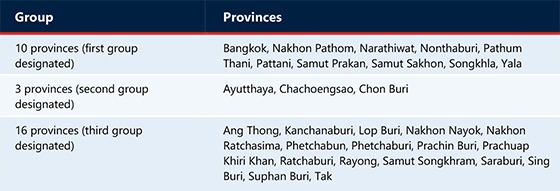
Two types of relief measures have been announced—one for parties under section 33 of the SSA, and one for parties under sections 39 and 40.


Section 33 (Regular Employees)

Monetary assistance is available for Thai nationals insured under section 33 of the SSA (and their employers) engaged in the following business activities:

  • Administrative and support activities
  • Arts, entertainment, and recreation
  • Automotive repair
  • Construction
  • Food and accommodation
  • Information and communication activities
  • Professional activities in science and academia
  • Services
  • Transportation and storage
  • Wholesale/retail

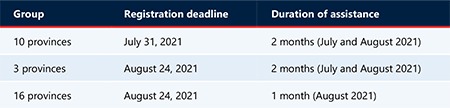
Employers must submit an application to the Social Security Office (SSO) through the online portal (www.sso.go.th/eservices) in order for them and their employees to receive the assistance payments. Each qualifying employee receives THB 2,500 per month if they are registered with the SSO within the deadline, while registered employers receive THB 3,000 per qualifying employee, up to a maximum of 200 employees (i.e., THB 600,000), as summarized in the table below.
 

Section 39 (Former Employees Still Paying SSO Contributions) and Section 40 (Freelancers)

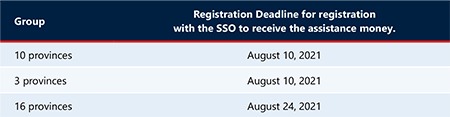
THB 5,000 assistance payments are available for Thai employees insured under sections 39 and 40 of the SSA. Government officers and those who receive a government pension are not eligible to receive the payments. Although the payments are classified as monthly, the current regulations authorize only one month of payments for qualifying insured persons who register with the SSO by the deadlines below.
Both of the relief measures described above are likely to be renewed on a monthly basis if the pandemic remains severe. However, as of August 19, no resolution has yet been issued to approve an extension for September.

Tilleke & Gibbins will continue to monitor the situation for developments. Questions on Thailand’s COVID-19 relief measures for employers and employees can be directed to Chusert Supasitthumrong at [email protected] or Piyawat Vitooraporn at [email protected].

RELATED INSIGHTS​ 

January 12, 2024
On December 28, 2023, Cambodia’s Ministry of Labor and Vocational Training (MLVT) issued Notification No. 110/23 on the issuance of work permits for foreign employees, in accordance with the country’s Labor Law and Prakas 195 dated August 20, 2014, on work permits and employment cards for foreign employees. This is a more comprehensive notification than existed previously, as it specifically clarifies the parties that are required to apply for work permits and employment cards. Notification No. 110/23 specifies that the following types of foreign individuals must hold a valid foreign work permit and/or employment card in order to work in Cambodia: A foreign employer whose name is stated in an enterprise’s patent tax certificate must hold a foreign work permit. A foreign employee whose name is stated in an enterprise’s patent tax certificate must hold a foreign work permit and an employment card. Self-employed individuals must hold a foreign work permit and an employment card. Applications for work permits and employment cards can be submitted through the MLVT’s online portal, accompanied by the following required documents: Valid passport; Latest patent tax certificate; Physical examination form; and Photo (4×6 cm) However, foreign shareholders and members of the board of directors as defined in the company’s articles of incorporation who do not have a Cambodian resident visa are not required to obtain a work permit or employment card. For more information on regulations and requirements for foreign employees in Cambodia, please contact Tilleke & Gibbins at [email protected].
December 15, 2023
Tilleke & Gibbins’ office in Yangon provided the Myanmar chapter to the Guide to Restructuring a Cross-Border Workforce from International Employment Lawyer. This global guide, which covers 45 jurisdictions worldwide, examines the issue of workplace restructurings, particularly in relation to the needs of multinational companies. The Myanmar chapter was written by Kyaw Min Tun, an associate in the firm’s Myanmar office. The Q&A-style chapter focuses on key areas related to workplace restructuring, covering each of the following topics in detail: Reduction in workforce; Restructuring or reorganization of the business; Changing terms and conditions; and Areas to watch. A PDF of the Myanmar chapter can be downloaded through the button below. Tilleke & Gibbins also provided the Cambodia, Laos, Thailand, and Vietnam chapters to the Guide to Restructuring a Cross-Border Workforce 2024. To browse the full guide for all 45 jurisdictions, please visit the International Employment Lawyer website.
December 15, 2023
Employment law specialists from Tilleke & Gibbins’ office in Vientiane have provided the Laos chapter to the Guide to Restructuring a Cross-Border Workforce from International Employment Lawyer. This global guide, which covers 45 jurisdictions worldwide, examines the issue of workplace restructurings, particularly in relation to the needs of multinational companies. The Laos chapter was written by associates Naiyane Xaechao and Sayphin Singsouvong. The Q&A-style chapter focuses on key areas related to workplace restructuring, covering each of the following topics in detail: Reduction in workforce; Restructuring or reorganization of the business; Changing terms and conditions; and Areas to watch. A PDF of the Laos chapter can be downloaded through the button below. Tilleke & Gibbins also provided the Cambodia, Myanmar, Thailand, and Vietnam chapters to the Guide to Restructuring a Cross-Border Workforce 2024. To browse the full guide for all 45 jurisdictions, please visit the International Employment Lawyer website.
December 15, 2023
Employment law specialists from Tilleke & Gibbins’ office in Phnom Penh have provided the Cambodia chapter to the Guide to Restructuring a Cross-Border Workforce from International Employment Lawyer. This global guide, which covers 45 jurisdictions worldwide, examines the issue of workplace restructurings, particularly in relation to the needs of multinational companies. The Cambodia chapter was written by Jay Cohen, partner and director of Tilleke & Gibbins’ Phnom Penh office, and Chanvisal Lok, associate. The Q&A-style chapter focuses on key areas related to workplace restructuring, covering each of the following topics in detail: Reduction in workforce; Restructuring or reorganization of the business; Changing terms and conditions; and Areas to watch. A PDF of the Cambodia chapter can be downloaded through the button below. Tilleke & Gibbins also provided the Laos, Myanmar, Thailand, and Vietnam chapters to the Guide to Restructuring a Cross-Border Workforce 2024. To browse the full guide for all 45 jurisdictions, please visit the International Employment Lawyer website.