
You are using an outdated browser and your browsing experience will not be optimal. Please update to the latest version of Microsoft Edge, Google Chrome or Mozilla Firefox. Install Microsoft Edge

January 12, 2021

Thailand Announces Social Security Assistance for Second Wave of COVID-19

Due to the resurgence of the COVID-19 pandemic in Thailand since December, 2020, Thailand’s Ministry of Labor recently published two regulations under the Social Security Act (SSA) in the Government Gazette:

  • The Regulation on Entitlement to Compensatory Benefits in the Event of Unemployment Due to Force Majeure from the Pandemic of Dangerous Communicable Disease Under Relevant Law Relating to Communicable Diseases B.E. 2563 (2020) (the Force Majeure Regulation); and
  • The Regulation on Determination of the Amount of Contributions to the Social Security Funds B.E. 2563 (2020) (the SSF Contribution Regulation).

Details of the two regulations are provided below.

The Force Majeure Regulation

This regulation is similar to a previous regulation from April, 2020, during the first wave of the pandemic, stating that the definition of force majeure under the Social Security Act B.E. 2533 (1990) (the SSA) includes hazards from pandemics of dangerous communicable diseases (including COVID-19). This definition therefore affords protection to insured persons (i.e., employees) in the event that the COVID-19 pandemic results in their being unable to work, or their employers being unable to operate their business normally.

This regulation allows the Social Security Office (SSO) to pay compensation to employees who:

  • are insured persons who qualify to receive compensatory benefit in case of unemployment in accordance with the SSA;
  • have to cease working temporarily during the period from December 19, 2020 onwards; and
  • do not receive wages from their employer during the temporary cessation.

This applies only if the circumstances above result from the following force majeure events related to hazards from COVID-19 (or other pandemics of dangerous communicable diseases that affect the public under the Communicable Diseases Act B.E. 2558 (2015)):

  • The employee cannot work, or the employer does not allow the employee to work, because of quarantine or to comply with a COVID-19 preventative measure; or,
  • The employee cannot work because the employer temporarily ceases operations, wholly or partially, due to a government order to close the premises temporarily under the Communicable Diseases Act preventing the business from operating as normal.

The affected employee will be entitled to compensation at a rate of 50% of their daily wages during the quarantine period, period of compliance with a COVID-19 preventative measure, or period of temporary premises closure, for not more than 90 days. The payment will be calculated based on daily wages in accordance with section 57 paragraph 1 of the SSA, but will be paid monthly.

The SSO will cease payment of the compensation if the employee resigns or is terminated by an employer, or the employment contract expires. In addition, the employer is obligated to issue a certificate letter to request compensation in the event of unemployment resulting from force majeure. The certificate must be in accordance with a form letter prescribed in the regulation, can be made and sent electronically, and must be retained by the employer as evidence.

The SSF Contribution Regulation

This regulation reduces the rate of mandatory Social Security Fund contributions under section 33 of the SSA effective from January 1, 2021 to March 31, 2021. Contribution rates are calculated as a percentage of each employees’ monthly wages, based on a minimum monthly wage of THB 1,650 and a maximum monthly wage of THB 15,000. The reduced rates are as follows:
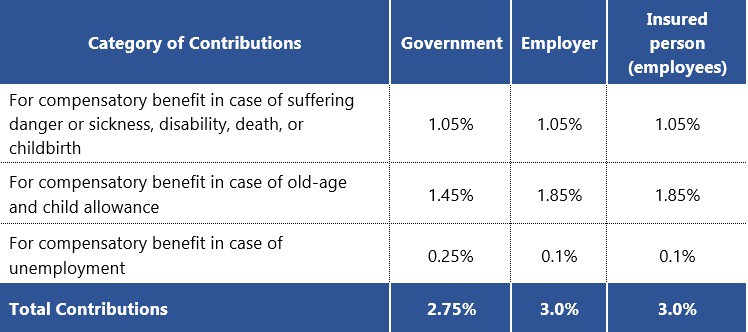
The rates of mandatory Social Security Fund contributions under section 33 of the SSA effective from April 1, 2021 onward, are as follows:
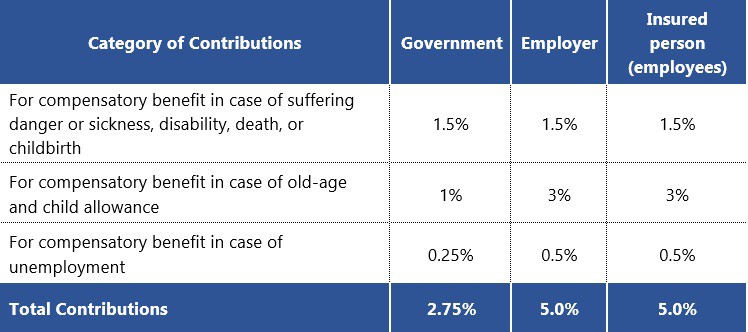
Therefore, based on the minimum and maximum wages allowed for calculation, from January 1 to March 31, 2021, the contributions would range from THB 49.5 to THB 450 per month for both the employer and the employees. From April 1, 2021 onwards, this will increase to THB 82.5 to THB 750.

RELATED INSIGHTS​ 

July 7, 2025
On June 27, 2025, Thailand issued the new Ministerial Regulation Prescribing the Criteria and Rates for Receiving Unemployment Benefits (No. 2) B.E. 2568 (2025), which amended a similarly named ministerial regulation by boosting the rate of social security benefits to alleviate hardships for employees who are terminated. The new ministerial regulation took effect the following day. Under this new ministerial regulation, eligible terminated employees are entitled to receive unemployment benefits under the Social Security Fund (SSF) for a maximum of 180 days per year, at the rate of 60% of the employee’s monthly wages at the time of termination, up from 50% previously. However, the maximum wage used as the basis for calculating the benefit remains capped at THB 15,000 per month. Therefore, the maximum unemployment benefit that an employee can receive from the SSF is now THB 9,000 (up from THB 7,500) per month for a period of up to six months. To qualify for the unemployment benefits from the SSF, employees must be registered with the Social Security Office and must have contributed to the SSF for at least six months within the 15 months prior to the start date of the relevant unemployment period. This new ministerial regulation was enacted to increase the amount of financial support provided to insured persons in the case of termination, as part of the government’s objective of alleviating economic hardship under current economic and social conditions in Thailand. For more details on unemployment benefits in Thailand, or on any aspect of employment law in the country, please contact Pimvimol (June) Vipamaneerut at [email protected], Dusita Khanijou at [email protected], Ketnut Pukahuta at [email protected], or Chomanut Arif at [email protected].
July 4, 2025
On July 1, 2025, new minimum daily wage rates for Bangkok and certain business types nationwide were published in the Government Gazette, taking effect on the same day. The daily minimum wage rate for Bangkok has been increased to THB 400 per day, while the minimum wage rates for other provinces remain unchanged from the rates that took effect on January 1, 2025. However, daily minimum wage rates have also been increased to THB 400 nationwide for type 2, type 3, and type 4 hotels under the Hotel Act and for entertainment establishments under the Entertainment Place Act. This THB 400 rate applies to all businesses that meet the criteria, even if the province’s general rate is lower. The new minimum wage rates supersede any lower wages agreed upon in existing employment contracts or conditions of employment that were in force before this announcement came into effect. As a result, these employees must be paid their wages at the newly prescribed rate for work performed from July 1, 2025, onward.
June 30, 2025
On March 4, 2025, Cambodia’s Ministry of Labor and Vocational Training (MLVT) issued Prakas No. 073/25 on Procedures for Resolving Individual Labor Disputes, replacing Prakas No. 318 on the same topic from 2001 and introducing significant changes to how individual labor disputes are filed, processed, and escalated. In addition, Prakas No. 073 outlines the roles and responsibilities of labor inspectors, the process for filing and handling complaints, and the steps for conciliation and further legal recourse, as described below. Filing a Complaint Any party to an individual labor dispute can file a complaint with the Labor Dispute Department of the MLVT or the Department of Labor at the capital or provincial level. Upon receiving a complaint, a labor inspector will review the case and may initiate either conciliation or a labor inspection. Invitation letters will be issued to the disputing parties to provide relevant information and documents. Conciliation Process Prakas No. 073 places strong emphasis on the conciliation process, introducing strict procedural rules and deadlines with clear consequences for noncompliance: If the claimant fails to provide required information within the specified deadline (or within three working days thereafter without reasonable excuse), the complaint is deemed void. If the respondent fails to attend the conciliation meeting within the deadline (or within three working days thereafter without reasonable excuse), the conciliation is considered unsuccessful, and the respondent is deemed guilty as claimed. Once all necessary information is gathered, a labor inspector will invite both parties to a joint conciliation meeting, which must be held within three weeks of the complaint being received. If the claimant fails to attend the meeting or sign the minutes without a reasonable excuse, the complaint is void. If the respondent fails to attend the meeting without a reasonable excuse, the conciliation is unsuccessful, and the respondent
May 28, 2025
Tilleke & Gibbins attorneys in Vietnam have contributed the 2025 edition of Doing Business in Vietnam, a comprehensive Q&A-style resource from Thomson Reuters Practical Law that provides essential insights for companies navigating business operations in Vietnam. The guide presents a detailed overview of the country’s legal framework and regulatory environment, reflecting recent updates in Vietnamese legislation and practice. This annually updated guide offers key information on the following areas: Legal system: Structure of the Vietnamese judiciary and the role of codified law. Foreign investment: Conditions for market access, licensing requirements, foreign ownership restrictions, and investment incentives. Business vehicles: Formation and operation of legal entities, including limited liability companies, joint-stock companies, and representative offices. Employment: Employment contracts, social insurance, labor rights, and procedures for hiring foreign nationals. Tax: Overview of corporate income tax, personal income tax, value-added tax, and other tax obligations. Intellectual property: Procedures for protecting and enforcing patents, trademarks, copyrights, and other IP rights. Data protection: Compliance requirements under Vietnam’s data privacy laws, including the Personal Data Protection Decree. Competition law: Antitrust rules and regulatory oversight under the Law on Competition. Anti-bribery and corruption: Legal framework and enforcement practices aimed at curbing corrupt activities. E-commerce and digital business: Regulations governing online platforms, digital content, and cross-border services. Marketing and advertising: Laws and guidelines on advertising standards and consumer protection. Product regulation and liability: Safety requirements, product liability issues, and roles of relevant authorities. Doing Business in Vietnam is part of Practical Law’s global series of legal guides designed to support international practitioners and businesses. To access the most recent edition of the Vietnam guide, visit the Practical Law website and sign up for a free trial.