
You are using an outdated browser and your browsing experience will not be optimal. Please update to the latest version of Microsoft Edge, Google Chrome or Mozilla Firefox. Install Microsoft Edge

January 12, 2021

Thailand Announces Social Security Assistance for Second Wave of COVID-19

Due to the resurgence of the COVID-19 pandemic in Thailand since December, 2020, Thailand’s Ministry of Labor recently published two regulations under the Social Security Act (SSA) in the Government Gazette:

  • The Regulation on Entitlement to Compensatory Benefits in the Event of Unemployment Due to Force Majeure from the Pandemic of Dangerous Communicable Disease Under Relevant Law Relating to Communicable Diseases B.E. 2563 (2020) (the Force Majeure Regulation); and
  • The Regulation on Determination of the Amount of Contributions to the Social Security Funds B.E. 2563 (2020) (the SSF Contribution Regulation).

Details of the two regulations are provided below.

The Force Majeure Regulation

This regulation is similar to a previous regulation from April, 2020, during the first wave of the pandemic, stating that the definition of force majeure under the Social Security Act B.E. 2533 (1990) (the SSA) includes hazards from pandemics of dangerous communicable diseases (including COVID-19). This definition therefore affords protection to insured persons (i.e., employees) in the event that the COVID-19 pandemic results in their being unable to work, or their employers being unable to operate their business normally.

This regulation allows the Social Security Office (SSO) to pay compensation to employees who:

  • are insured persons who qualify to receive compensatory benefit in case of unemployment in accordance with the SSA;
  • have to cease working temporarily during the period from December 19, 2020 onwards; and
  • do not receive wages from their employer during the temporary cessation.

This applies only if the circumstances above result from the following force majeure events related to hazards from COVID-19 (or other pandemics of dangerous communicable diseases that affect the public under the Communicable Diseases Act B.E. 2558 (2015)):

  • The employee cannot work, or the employer does not allow the employee to work, because of quarantine or to comply with a COVID-19 preventative measure; or,
  • The employee cannot work because the employer temporarily ceases operations, wholly or partially, due to a government order to close the premises temporarily under the Communicable Diseases Act preventing the business from operating as normal.

The affected employee will be entitled to compensation at a rate of 50% of their daily wages during the quarantine period, period of compliance with a COVID-19 preventative measure, or period of temporary premises closure, for not more than 90 days. The payment will be calculated based on daily wages in accordance with section 57 paragraph 1 of the SSA, but will be paid monthly.

The SSO will cease payment of the compensation if the employee resigns or is terminated by an employer, or the employment contract expires. In addition, the employer is obligated to issue a certificate letter to request compensation in the event of unemployment resulting from force majeure. The certificate must be in accordance with a form letter prescribed in the regulation, can be made and sent electronically, and must be retained by the employer as evidence.

The SSF Contribution Regulation

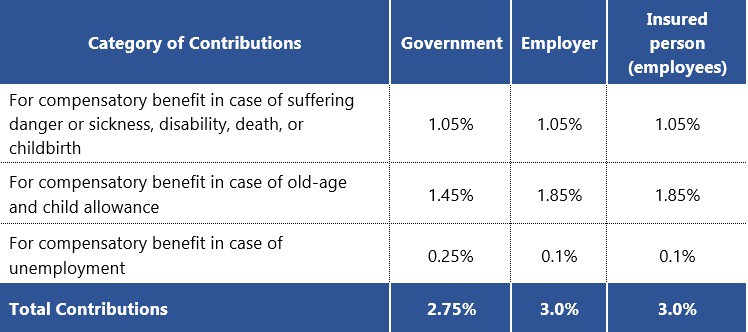
This regulation reduces the rate of mandatory Social Security Fund contributions under section 33 of the SSA effective from January 1, 2021 to March 31, 2021. Contribution rates are calculated as a percentage of each employees’ monthly wages, based on a minimum monthly wage of THB 1,650 and a maximum monthly wage of THB 15,000. The reduced rates are as follows:
The rates of mandatory Social Security Fund contributions under section 33 of the SSA effective from April 1, 2021 onward, are as follows:
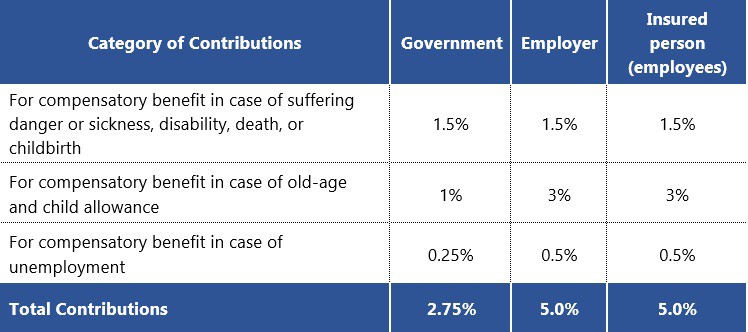
Therefore, based on the minimum and maximum wages allowed for calculation, from January 1 to March 31, 2021, the contributions would range from THB 49.5 to THB 450 per month for both the employer and the employees. From April 1, 2021 onwards, this will increase to THB 82.5 to THB 750.

RELATED INSIGHTS​ 

May 28, 2025
On May 6, 2025, Cambodia’s Ministry of Labor and Vocational Training (MLVT) issued Prakas No. 112/25 on Overtime Work, Work on Paid Holidays, and Suspension of Weekly Days Off, which outlines specific conditions, formalities, and procedures in relation to working overtime, work on paid holidays, and suspension of weekly days off. Overtime Work Employees may be requested to perform overtime work based on the operational needs of the employer, particularly in the following circumstances: When undertaking special assignments related to inventory and balance sheets, liquidation deadlines, and closing of accounting books. In cases of excessive workload arising from exceptional circumstances where alternative measures are not feasible for the employer. However, the overtime work must be conducted voluntarily and must not be enforced through coercion or disciplinary action. Although this new prakas on overtime work does not specify the maximum allowable hours of overtime work, the Labor Law states that overtime must not cause total working hours to exceed 10 hours per day, except in cases of disaster prevention or rectification. Work on Paid Public Holidays Employees are entitled to paid public holidays announced annually by the MLVT. However, when work cannot be suspended, employees may be requested to perform work on paid public holidays on a voluntary basis. Suspension of Weekly Days Off When urgent work is required to prevent imminent accidents or to repair damage to materials, facilities, or buildings, weekly days off may be suspended for up to two nonconsecutive days per month. This applies to both employees of the affected enterprise and those of external entities engaged in the repairs of the affected enterprise. Reduction of Weekly Days Off Due to Weather Certain categories of enterprises are permitted to reduce employees’ weekly days off by up to two nonconsecutive days per month as compensation for working
May 9, 2025
On May 6, 2025, Cambodia’s Ministry of Labour and Vocational Training (MLVT) issued Prakas No. 113/25, introducing new obligations for enterprise owners and directors regarding the use and maintenance of enterprise payroll books. Under this prakas, enterprise owners or directors are required to: Utilize and maintain the enterprise payroll book in accordance with the official template provided by the MLVT. Make the enterprise payroll book available to labor inspectors for annotations related to compliance with labor laws and regulations. Review and adjust (if necessary) internal practices based on any findings, recommendations, and restrictions issued by labor inspectors during inspections. The official enterprise payroll book template can be downloaded via the ministry’s Labor Automated Central Management System (LACMS). Additional requirements include: Retention of supporting documents related to the payroll book at the enterprise’s head office to facilitate inspections. Preservation of completed payroll books for a minimum of three years after their closure. Downloading a new payroll book from the LACMS once the current one is fully used. Labor inspectors are authorized to conduct inspections of the payroll book and related documentation at any time. Noncompliance with the provisions of Prakas No. 113/25 may result in significant monetary penalties, as stipulated in Cambodia’s Labour Law. This prakas also repeals Prakas No. 268, dated October 11, 2001, and any provisions in related regulations that conflict with Prakas No. 113/25. All enterprises are strongly advised to comply with the new requirements and begin using the updated enterprise payroll book template from the LACMS to avoid potential penalties.
May 2, 2025
Attorneys from Tilleke & Gibbins have updated the latest edition of Doing Business in Thailand, a Q&A-style guide from Thomson Reuters Practical Law that offers an overview of key legal considerations for companies operating in jurisdictions worldwide. The contribution outlines the country’s legal and regulatory framework for foreign investment and business operations and reflects the latest legislative developments. The chapter addresses the following core topics: Legal system: Structure of the courts and the codified nature of Thai law. Foreign investment: Business restrictions under the Foreign Business Act, sector-specific regulations, exchange control rules, and investment incentives. Business vehicles: Overview of partnerships, private and public limited companies, and other legal entities. Employment: Labor protections, employment contracts, foreign worker requirements, and termination procedures. Tax: Corporate and personal income tax, indirect taxes, and tax obligations for residents and non-residents. Intellectual property: Registration and enforcement of patents, trademarks, designs, and copyrights. Data protection: Key provisions of the Personal Data Protection Act and related compliance obligations. Competition law: Regulatory framework under the Trade Competition Act. Anti-bribery and corruption: Relevant legislation and enforcement mechanisms. E-commerce and digital business: Legal regime for online transactions and digital platforms. Marketing and advertising: Consumer protection laws and regulations affecting advertising and marketing practices. Product regulation and liability: Safety standards, liability regimes, and roles of enforcement authorities. Practical Law, a legal reference resource from Thomson Reuters, publishes a range of guides for hundreds of jurisdictions and practice areas. The insurance and reinsurance guide is a valuable resource for legal practitioners, covering numerous jurisdictions worldwide. To view the latest version of the guide, please visit the Practical Law website and enroll in the free Practical Law trial to gain full access.
April 22, 2025
Thailand’s Immigration Bureau has announced the launch of the Thailand Digital Arrival Card (TDAC) as part of ongoing efforts to improve entry procedures and streamline immigration processing. Effective May 1, 2025, all foreign nationals with any type of visa entering Thailand by any means will be required to complete the TDAC online prior to arrival. This requirement does not apply to individuals transiting or transferring through Thailand without passing through immigration control, or to those entering with a border pass. Foreign nationals planning to enter Thailand must complete and submit their TDAC within the three days prior to their arrival date. The form, which collects passport information, personal details, travel information (e.g., flight number), Thai accommodation information, and a health declaration—can be filled out in English online at https://tdac.immigration.go.th. Once the form is submitted, an acknowledgment will be sent to the email address entered on the form. This acknowledgment must be presented at the immigration checkpoint in Thailand along with travel documents for verification. The Thai government strongly encourages all foreign passport holders to complete the TDAC ahead of their departure to prevent any entry delays or issues at the checkpoint.