Maintaining positive employee relations is a top concern for virtually all companies. Many companies in Thailand—especially those located in the country’s industrial estates—have labor unions, while others rely on other non-union pathways for attending to the concerns of employees. In all of these cases, the union or collective group of employees also chooses members of the “employee committee” that is charged with fostering good relations and open communications with the employer through regular meetings dedicated to discussion of workplace matters.
Companies with a workforce of 50 or more employees need to understand the roles of the employee committee and the specific rights accorded to the committee members, which are different from the rights of the other employees. Besides the obvious benefits that this understanding has for relations with their employees, it is also important if an employer takes disciplinary action against employee committee members, as violation of a committee member’s rights could result in the employer facing criminal penalties.
The legal basis for these employee committees is the Labor Relations Act B.E. 2518 (LRA), which stipulates that in any workplace with at least 50 employees, the employees or their labor union of the business establishment is entitled to establish an employee committee. Members are elected (or, in the case of a labor union, appointed) to three-year terms on the committee, with the total number of committee members depending on the size of the workforce, as shown in the table.
Membership Requirements
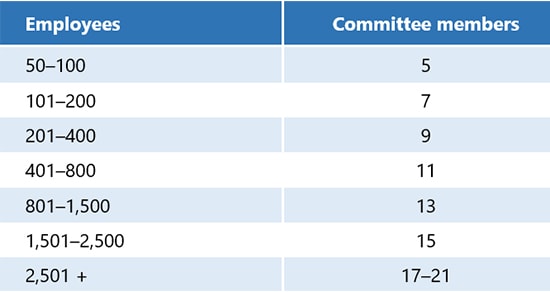
Among partially unionized workforces, labor unions are generally given precedence when it comes to control of the committee. If a labor union whose members account for more than 20% of the total employees in a workplace, the union gets to appoint the majority of the employee committee members (e.g., four out of a seven-person committee, five of a nine-person committee, etc.). Moreover, if a union’s membership accounts for more than 50% of the employees, it is entitled to appoint all employee committee members. Any labor union appointees would have their term begin on the date of their appointment, regardless of when an election is held for the non-union members of the employment committee.
In a situation where a workplace has multiple labor unions that have appointed separate employee committees, exceeding the number of the employee committee members stated by the LRA, the employer is entitled to refuse to recognize the employee committees.
Employers must meet with their employee committee at least once every three months, or whenever the labor union or more than 50% of employee committee members request it. The topics to be discussed include employee welfare, new work rules, employee complaints, and disputes and compromises in the workplace.
If an employee committee considers that an employer has acted unfairly against or caused excessive trouble for employees, the committee (or the relevant employee or the labor union) may lodge a petition with the Labor Court.
Protection of the employee committee
The LRA requires employers to first obtain permission from the Labor Court before terminating the employment of committee members, reducing their wages, taking disciplinary actions against them, otherwise obstructing them from carrying out their duties, or performing any act resulting in a committee member being unable to continue working. If an employer breaches the LRA by doing one of these things without permission from the court, the employer (including directors or authorized persons who act on behalf of the juristic person) risks facing criminal penalties, such as imprisonment for up to one month, a fine of up to THB 1,000, or both. These penalties will remain even if the employer later succeeds in obtaining permission from the Labor Court to terminate the employee—a position upheld by the Supreme Court because the offense was committed before the court issued an order, thus constituting a violation of the LRA.
This court order requirement extends to any scenario wherein an employee committee member violates company work rules, and the disciplinary action ultimately taken against that employee depends on both the employer’s work rules and the consideration of the court. This means that even if the work rules state that an offence can be punished by termination, the court may still opt to punish the offender less severely than what the rules would otherwise prescribe, particularly if it considers that the offence is not grievous enough to warrant outright termination. (This position is again supported by Supreme Court precedent.) If, on the other hand, the court does issue an order permitting the termination of an employee, any subsequent termination would not be considered an unfair labor practice, and the employee would not be entitled to submit a complaint to the Labor Relations Committee.
Some employers may also be surprised to learn that even if they close down their business permanently and terminate all employees, they must ask the Labor Court for permission to terminate the employee committee as well. Otherwise, the employer may face the criminal penalties described above.
Consequently, an employer should be aware of the potential risks before considering any type of disciplinary or other action against a member of an employee committee, as it can be construed as a violation of the LRA and punished with criminal penalties accordingly. Some might find this difficult to remember when involved in the thick of a labor dispute, a situation of employee wrongdoing, or simply the day-to-day challenges of running a business with a large workforce, but staying in control and acting prudently—with foresight into legal requirements and consequences—can help employers stay on the right side of the law.