
You are using an outdated browser and your browsing experience will not be optimal. Please update to the latest version of Microsoft Edge, Google Chrome or Mozilla Firefox. Install Microsoft Edge

March 2, 2021

Thai Employment Law: The Employee Committee and the Special Rights of Its Members

Informed Counsel

Maintaining positive employee relations is a top concern for virtually all companies. Many companies in Thailand—especially those located in the country’s industrial estates—have labor unions, while others rely on other non-union pathways for attending to the concerns of employees. In all of these cases, the union or collective group of employees also chooses members of the “employee committee” that is charged with fostering good relations and open communications with the employer through regular meetings dedicated to discussion of workplace matters.

Companies with a workforce of 50 or more employees need to understand the roles of the employee committee and the specific rights accorded to the committee members, which are different from the rights of the other employees. Besides the obvious benefits that this understanding has for relations with their employees, it is also important if an employer takes disciplinary action against employee committee members, as violation of a committee member’s rights could result in the employer facing criminal penalties.

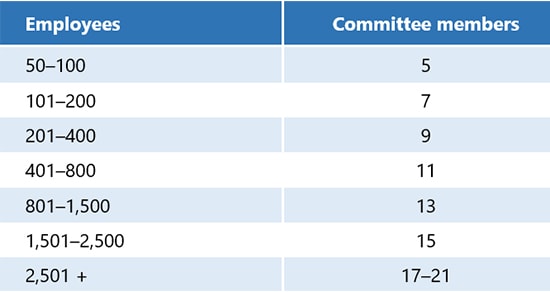
The legal basis for these employee committees is the Labor Relations Act B.E. 2518 (LRA), which stipulates that in any workplace with at least 50 employees, the employees or their labor union of the business establishment is entitled to establish an employee committee. Members are elected (or, in the case of a labor union, appointed) to three-year terms on the committee, with the total number of committee members depending on the size of the workforce, as shown in the table.

Membership Requirements
Among partially unionized workforces, labor unions are generally given precedence when it comes to control of the committee. If a labor union whose members account for more than 20% of the total employees in a workplace, the union gets to appoint the majority of the employee committee members (e.g., four out of a seven-person committee, five of a nine-person committee, etc.). Moreover, if a union’s membership accounts for more than 50% of the employees, it is entitled to appoint all employee committee members. Any labor union appointees would have their term begin on the date of their appointment, regardless of when an election is held for the non-union members of the employment committee.

In a situation where a workplace has multiple labor unions that have appointed separate employee committees, exceeding the number of the employee committee members stated by the LRA, the employer is entitled to refuse to recognize the employee committees.

Employers must meet with their employee committee at least once every three months, or whenever the labor union or more than 50% of employee committee members request it. The topics to be discussed include employee welfare, new work rules, employee complaints, and disputes and compromises in the workplace.

If an employee committee considers that an employer has acted unfairly against or caused excessive trouble for employees, the committee (or the relevant employee or the labor union) may lodge a petition with the Labor Court.

Protection of the employee committee

The LRA requires employers to first obtain permission from the Labor Court before terminating the employment of committee members, reducing their wages, taking disciplinary actions against them, otherwise obstructing them from carrying out their duties, or performing any act resulting in a committee member being unable to continue working.  If an employer breaches the LRA by doing one of these things without permission from the court, the employer (including directors or authorized persons who act on behalf of the juristic person) risks facing criminal penalties, such as imprisonment for up to one month, a fine of up to THB 1,000, or both. These penalties will remain even if the employer later succeeds in obtaining permission from the Labor Court to terminate the employee—a position upheld by the Supreme Court because the offense was committed before the court issued an order, thus constituting a violation of the LRA.

This court order requirement extends to any scenario wherein an employee committee member violates company work rules, and the disciplinary action ultimately taken against that employee depends on both the employer’s work rules and the consideration of the court. This means that even if the work rules state that an offence can be punished by termination, the court may still opt to punish the offender less severely than what the rules would otherwise prescribe, particularly if it considers that the offence is not grievous enough to warrant outright termination. (This position is again supported by Supreme Court precedent.) If, on the other hand, the court does issue an order permitting the termination of an employee, any subsequent termination would not be considered an unfair labor practice, and the employee would not be entitled to submit a complaint to the Labor Relations Committee.

Some employers may also be surprised to learn that even if they close down their business permanently and terminate all employees, they must ask the Labor Court for permission to terminate the employee committee as well. Otherwise, the employer may face the criminal penalties described above.

Consequently, an employer should be aware of the potential risks before considering any type of disciplinary or other action against a member of an employee committee, as it can be construed as a violation of the LRA and punished with criminal penalties accordingly. Some might find this difficult to remember when involved in the thick of a labor dispute, a situation of employee wrongdoing, or simply the day-to-day challenges of running a business with a large workforce, but staying in control and acting prudently—with foresight into legal requirements and consequences—can help employers stay on the right side of the law.

RELATED INSIGHTS​ 

September 13, 2021
With COVID-19 cases continuing to pose a significant threat throughout Thailand, many employers have ordered their employees to work exclusively from home in order to minimize their chances of contracting the virus. However, this luxury is not afforded to all employees—some are unable to work from home due to the nature of their work, and consequently they are placed in the precarious position of being exposed to possible infection. Thailand’s Social Security Office (SSO) understood these risks early in the pandemic and, in March 2020, issued guidelines through the Workmen’s Compensation Fund Office on employees’ entitlement to claim benefits from the workers’ compensation fund (WCF) if they contract the virus as a result of their work. The WCF provides medical-related assistance and compensation to employees who directly suffer from a work-related injury or sickness (subject to certain conditions). Falling ill with COVID-19 during the performance of work duties may constitute suffering work-related sickness, thereby allowing employees to claim compensation from the WCF by submitting the Kor Thor 16 form, a medical certificate, treatment records, records of the employee’s working hours, and other relevant documentation. Upon receiving a claim, the SSO will investigate by collecting facts and evidence from the employer, the infected employee and his or her colleagues, and any witnesses. The official will examine the employee’s duties and working conditions in detail, taking into consideration any relevant information, such as evidence regarding the employee’s travel or movements prior to falling sick. Once all the facts and evidence are gathered, the matter will be submitted to a medical subcommittee responsible for determining whether the employee’s onset of COVID-19 is due to his or her work. If the subcommittee finds that the employee’s contraction of the virus did indeed result from the performance of his or her work duties, the
August 26, 2021
Around the world, COVID-19 is continuing to threaten the health of millions, interrupt daily life, and throttle business activity. In Thailand, the latest wave of infections has been more intense than any since the beginning of the pandemic, and many businesses have been forced to close down once again. There are reasons for hope though—chief among them the increasing pace of vaccinations. Not only are the vaccines effective at preventing serious health issues, they are helping keep both employees and customers safe in business settings so that commerce, trade, and tourism can resume once again. Many in Thailand have already been vaccinated, and struggling employers are looking ahead to safely resuming full business activities, from reopening offices for employees who have been working from home, to welcoming customers and clients back to an environment that minimizes the risk of COVID-19 exposure. In anticipation of such a return to business at full capacity, many Thai employers are taking note of companies and organizations overseas boosting COVID-19 safety in workplaces by mandating vaccines and other measures, and asking whether such mandates could be imposed here in Thailand. The main legal concept to consider here is the provision in the Labor Protection Act B.E. 2541 (1998), which authorizes employers to issue “lawful and just” orders to employees. For an order to be “lawful and just,” it must be proportionate to the circumstance. In the current context of the COVID-19 pandemic, employers can refer to the Communicable Diseases Act B.E. 2558 (2015), as well as other local regulations, to provide grounds when asserting that their risk-mitigation orders are proportionate, lawful, and just. It is doubtful that a Thai court would rule that the circumstances we find ourselves in now would justify an employer requiring employees to be vaccinated, but this legal standard can
August 25, 2021
Multilaw has published the latest edition of How to Hire and Fire, a guide to the rules and regulations governing employment relationships in over 90 jurisdictions around the world. Lawyers at Tilleke & Gibbins prepared the Cambodia, Myanmar, Thailand, and Vietnam chapters of the guide, which covers the following main topics: General principles: Forums for adjudicating employment disputes, main sources of employment law, employees working for foreign companies in Cambodia or abroad for domestic companies, and data privacy. Hiring the employee: Legal requirements for employment agreements, types of agreement, secrecy and confidentiality, ownership of inventions and other IP rights, pre-employment considerations, hiring of non-nationals, hiring specified categories of individuals, and outsourcing and sub-contracting. Maintaining the employment relationship: Changes to the contract, changes in business ownership, social security, accidents at work, discipline and grievances, harassment, discrimination, equal pay, compulsory training obligations, offsetting earnings, maternity and disability leave, insurance, absence for military or public service duties, trade unions, employee strikes, and employers’ liability for actions of employees. Firing the employee: Procedures for terminating employment agreements, instant dismissal, employee resignation, termination on notice, age-related termination, force majeure automatic termination, collective dismissals, termination by agreement, directors and senior officers, rules for companies facing financial difficulties, restriction of future activities, whistleblowers, garden leave, severance payments and tax considerations, allowances, and time limits for post-termination claims. General: Specific matters unique or important to each jurisdiction. Multilaw is a global network of carefully selected, independent law firms consisting of over 10,000 commercial lawyers in more than 100 countries, able to provide expert legal advice in complex environments around the globe. The full guide is available for free on the Multilaw website.