
You are using an outdated browser and your browsing experience will not be optimal. Please update to the latest version of Microsoft Edge, Google Chrome or Mozilla Firefox. Install Microsoft Edge

March 2, 2021

Thai Employment Law: The Employee Committee and the Special Rights of Its Members

Informed Counsel

Maintaining positive employee relations is a top concern for virtually all companies. Many companies in Thailand—especially those located in the country’s industrial estates—have labor unions, while others rely on other non-union pathways for attending to the concerns of employees. In all of these cases, the union or collective group of employees also chooses members of the “employee committee” that is charged with fostering good relations and open communications with the employer through regular meetings dedicated to discussion of workplace matters.

Companies with a workforce of 50 or more employees need to understand the roles of the employee committee and the specific rights accorded to the committee members, which are different from the rights of the other employees. Besides the obvious benefits that this understanding has for relations with their employees, it is also important if an employer takes disciplinary action against employee committee members, as violation of a committee member’s rights could result in the employer facing criminal penalties.

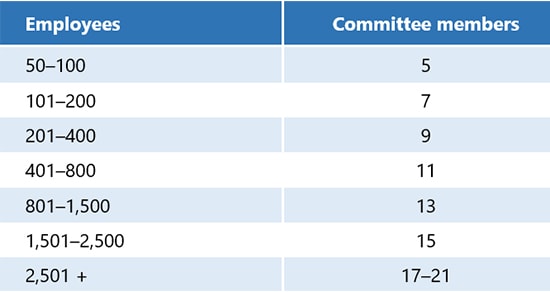
The legal basis for these employee committees is the Labor Relations Act B.E. 2518 (LRA), which stipulates that in any workplace with at least 50 employees, the employees or their labor union of the business establishment is entitled to establish an employee committee. Members are elected (or, in the case of a labor union, appointed) to three-year terms on the committee, with the total number of committee members depending on the size of the workforce, as shown in the table.

Membership Requirements
Among partially unionized workforces, labor unions are generally given precedence when it comes to control of the committee. If a labor union whose members account for more than 20% of the total employees in a workplace, the union gets to appoint the majority of the employee committee members (e.g., four out of a seven-person committee, five of a nine-person committee, etc.). Moreover, if a union’s membership accounts for more than 50% of the employees, it is entitled to appoint all employee committee members. Any labor union appointees would have their term begin on the date of their appointment, regardless of when an election is held for the non-union members of the employment committee.

In a situation where a workplace has multiple labor unions that have appointed separate employee committees, exceeding the number of the employee committee members stated by the LRA, the employer is entitled to refuse to recognize the employee committees.

Employers must meet with their employee committee at least once every three months, or whenever the labor union or more than 50% of employee committee members request it. The topics to be discussed include employee welfare, new work rules, employee complaints, and disputes and compromises in the workplace.

If an employee committee considers that an employer has acted unfairly against or caused excessive trouble for employees, the committee (or the relevant employee or the labor union) may lodge a petition with the Labor Court.

Protection of the employee committee

The LRA requires employers to first obtain permission from the Labor Court before terminating the employment of committee members, reducing their wages, taking disciplinary actions against them, otherwise obstructing them from carrying out their duties, or performing any act resulting in a committee member being unable to continue working.  If an employer breaches the LRA by doing one of these things without permission from the court, the employer (including directors or authorized persons who act on behalf of the juristic person) risks facing criminal penalties, such as imprisonment for up to one month, a fine of up to THB 1,000, or both. These penalties will remain even if the employer later succeeds in obtaining permission from the Labor Court to terminate the employee—a position upheld by the Supreme Court because the offense was committed before the court issued an order, thus constituting a violation of the LRA.

This court order requirement extends to any scenario wherein an employee committee member violates company work rules, and the disciplinary action ultimately taken against that employee depends on both the employer’s work rules and the consideration of the court. This means that even if the work rules state that an offence can be punished by termination, the court may still opt to punish the offender less severely than what the rules would otherwise prescribe, particularly if it considers that the offence is not grievous enough to warrant outright termination. (This position is again supported by Supreme Court precedent.) If, on the other hand, the court does issue an order permitting the termination of an employee, any subsequent termination would not be considered an unfair labor practice, and the employee would not be entitled to submit a complaint to the Labor Relations Committee.

Some employers may also be surprised to learn that even if they close down their business permanently and terminate all employees, they must ask the Labor Court for permission to terminate the employee committee as well. Otherwise, the employer may face the criminal penalties described above.

Consequently, an employer should be aware of the potential risks before considering any type of disciplinary or other action against a member of an employee committee, as it can be construed as a violation of the LRA and punished with criminal penalties accordingly. Some might find this difficult to remember when involved in the thick of a labor dispute, a situation of employee wrongdoing, or simply the day-to-day challenges of running a business with a large workforce, but staying in control and acting prudently—with foresight into legal requirements and consequences—can help employers stay on the right side of the law.

RELATED INSIGHTS​ 

August 12, 2024
With the growing prominence of ESG (Environmental, Social, and Governance) factors, businesses in Vietnam are increasingly recognizing their importance in driving global demand, societal impact, and economic value. A comprehensive acknowledgment of ESG-related legal requirements is critical for investors and companies operating in Vietnam to meet stakeholder expectations and ensure compliance. Our guide provides a basic overview of the rapidly evolving ESG landscape in Vietnam, covering a range of key issues for companies doing business in the country: What is ESG, and what does the ESG legal framework look like in Vietnam? Who needs to follow ESG regulations in Vietnam? What are the benefits of ESG compliance? How can enterprises enhance ESG best practices in Vietnam? Please click on the link below to view the full article.
August 2, 2024
On July 17, 2024, Thailand issued the Ministerial Regulation under the Revenue Code regarding Revenue Tax No. 394 (B.E. 2567) to increase the personal income tax exemption amount on severance pay for terminated employees. Under this ministerial regulation, terminated employees are exempt from personal income tax on their severance pay up to a severance pay amount equivalent to their last 400 days’ wages, capped at THB 600,000. This tax exemption does not apply to severance pay relating to retirement or the expiration of a fixed-term employment agreement. Previously, this exemption, which has been in effect since 1998, only applied to an amount equivalent to their last 300 days’ wages, capped at THB 300,000. This aligned with the maximum severance pay rate specified in the Labour Protection Act B.E. 2541 (LPA). However, when the LPA was amended in 2019, the maximum severance pay rate was increased from a rate equal to employees’ last 300 days’ wages for those who have worked for 10 years or more, to a rate equal to employees’ last 400 days’ wages for those who have worked for 20 years or more. The recent ministerial regulation was enacted accordingly to align with the updated severance pay rate and account for Thailand’s rising inflation rate. The new exemption rate applies to assessable income received from January 1, 2023, onward. For any excess severance pay withheld in 2023 and filed in 2024, individuals may request a tax refund from the Revenue Department, according to Revenue Department clarification. This should be done according to the applicable procedure within three years of the income tax return filing deadline. For more information on severance pay exemptions, or any aspect of employment law in Thailand, please contact Pimvimol (June) Vipamaneerut at [email protected], Ketnut Pukahuta at [email protected], Dusita Khanijou at [email protected], or Chomanut
June 20, 2024
“Forced labor” has many incarnations. Some forms are shocking, such as a case in 2021 where Vietnamese guest workers were brought to a Chinese-owned factory in Serbia that manufactured tires sold to European car companies. The guest workers allegedly had their passports taken away and were subjected to horrible living conditions, including a lack of food, forcing them to resort to hunting small animals in the nearby forest to survive. However, forced labor more often takes subtler forms, so that most people do not even recognize it as such. For example, a factory may receive an order with an extremely short production deadline, and the workers are instructed to work overtime hours. If the employees refuse to do so and stop working when their regular shift ends, they receive warning letters the next day. While less shocking than the situation of the guest workers forced to hunt squirrels to survive, it is also forced labor. ILO Convention No. 29 on Forced Labor defines forced labor as “all work or service…extracted from any person under the menace of any penalty and for which the said person has not offered…[them]self voluntarily.” The ILO names 11 indicators of forced labor: abuse of vulnerability, deception; restriction of movement, isolation, physical/sexual violence, intimidation and threats, retention of identity documents, withholding of wages, debt bondage, abusive working or living conditions, and excessive overtime. Excessive overtime in particular is common in the manufacturing sector in Southeast Asia, and debt bondage is also prevalent. Some companies demand employees provide a “training deposit” when they commence their employment, which they will have repaid provided they continue working for a minimum period. However, these common practices may soon be eradicated due to new supply chain due diligence legislation. Two such examples demonstrating this greater focus on forced labor within
April 12, 2024
On April 10, 2024, new minimum wage rates for workers in certain hotels in Thailand were published in the Government Gazette, taking effect on April 13, 2024. Under the Notification of the National Wage Committee on Minimum Wage Rate for the Hotel Industry, the new minimum wage rate is THB 400 per day, applicable to employees working in four-star (and above) hotels that have at least 50 employees and are located in the following specific areas: Bangkok: Pathumwan and Wattana districts Krabi: Ao Nang Subdistrict Administrative Organization areas Chon Buri: Pattaya city Chiang Mai: Chiang Mai municipality Prachuap Khiri Khan: Hua Hin municipality Phang-nga: Khukkhak sub-district municipality Phuket: Whole province Rayong: Phe subdistrict Songkhla: Hat Yai municipality Surat Thani: Koh Samui municipality Rationale The increase in the minimum wage is to drive and stimulate the economy in Thailand’s tourism industry, which is critical to the overall economy of the country. The ten areas identified above are those that earn a significant portion of their revenue from tourism. The decision underwent a public hearing process involving stakeholders. Although there were objections from some hotels claiming they were not yet ready to bear the increased costs, the law was enacted, taking effect on April 13, 2024. For more information on Thailand’s minimum wage regulations, or on any aspect of employment law in Thailand, please contact Pimvimol (June) Vipamaneerut at [email protected], Ketnut Pukahuta at [email protected], Dusita Khanijou at [email protected], or Chomanut Arif at [email protected].