
You are using an outdated browser and your browsing experience will not be optimal. Please update to the latest version of Microsoft Edge, Google Chrome or Mozilla Firefox. Install Microsoft Edge

March 2, 2021

Thai Employment Law: The Employee Committee and the Special Rights of Its Members

Informed Counsel

Maintaining positive employee relations is a top concern for virtually all companies. Many companies in Thailand—especially those located in the country’s industrial estates—have labor unions, while others rely on other non-union pathways for attending to the concerns of employees. In all of these cases, the union or collective group of employees also chooses members of the “employee committee” that is charged with fostering good relations and open communications with the employer through regular meetings dedicated to discussion of workplace matters.

Companies with a workforce of 50 or more employees need to understand the roles of the employee committee and the specific rights accorded to the committee members, which are different from the rights of the other employees. Besides the obvious benefits that this understanding has for relations with their employees, it is also important if an employer takes disciplinary action against employee committee members, as violation of a committee member’s rights could result in the employer facing criminal penalties.

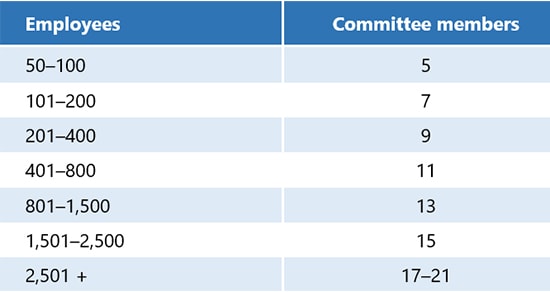
The legal basis for these employee committees is the Labor Relations Act B.E. 2518 (LRA), which stipulates that in any workplace with at least 50 employees, the employees or their labor union of the business establishment is entitled to establish an employee committee. Members are elected (or, in the case of a labor union, appointed) to three-year terms on the committee, with the total number of committee members depending on the size of the workforce, as shown in the table.

Membership Requirements
Among partially unionized workforces, labor unions are generally given precedence when it comes to control of the committee. If a labor union whose members account for more than 20% of the total employees in a workplace, the union gets to appoint the majority of the employee committee members (e.g., four out of a seven-person committee, five of a nine-person committee, etc.). Moreover, if a union’s membership accounts for more than 50% of the employees, it is entitled to appoint all employee committee members. Any labor union appointees would have their term begin on the date of their appointment, regardless of when an election is held for the non-union members of the employment committee.

In a situation where a workplace has multiple labor unions that have appointed separate employee committees, exceeding the number of the employee committee members stated by the LRA, the employer is entitled to refuse to recognize the employee committees.

Employers must meet with their employee committee at least once every three months, or whenever the labor union or more than 50% of employee committee members request it. The topics to be discussed include employee welfare, new work rules, employee complaints, and disputes and compromises in the workplace.

If an employee committee considers that an employer has acted unfairly against or caused excessive trouble for employees, the committee (or the relevant employee or the labor union) may lodge a petition with the Labor Court.

Protection of the employee committee

The LRA requires employers to first obtain permission from the Labor Court before terminating the employment of committee members, reducing their wages, taking disciplinary actions against them, otherwise obstructing them from carrying out their duties, or performing any act resulting in a committee member being unable to continue working.  If an employer breaches the LRA by doing one of these things without permission from the court, the employer (including directors or authorized persons who act on behalf of the juristic person) risks facing criminal penalties, such as imprisonment for up to one month, a fine of up to THB 1,000, or both. These penalties will remain even if the employer later succeeds in obtaining permission from the Labor Court to terminate the employee—a position upheld by the Supreme Court because the offense was committed before the court issued an order, thus constituting a violation of the LRA.

This court order requirement extends to any scenario wherein an employee committee member violates company work rules, and the disciplinary action ultimately taken against that employee depends on both the employer’s work rules and the consideration of the court. This means that even if the work rules state that an offence can be punished by termination, the court may still opt to punish the offender less severely than what the rules would otherwise prescribe, particularly if it considers that the offence is not grievous enough to warrant outright termination. (This position is again supported by Supreme Court precedent.) If, on the other hand, the court does issue an order permitting the termination of an employee, any subsequent termination would not be considered an unfair labor practice, and the employee would not be entitled to submit a complaint to the Labor Relations Committee.

Some employers may also be surprised to learn that even if they close down their business permanently and terminate all employees, they must ask the Labor Court for permission to terminate the employee committee as well. Otherwise, the employer may face the criminal penalties described above.

Consequently, an employer should be aware of the potential risks before considering any type of disciplinary or other action against a member of an employee committee, as it can be construed as a violation of the LRA and punished with criminal penalties accordingly. Some might find this difficult to remember when involved in the thick of a labor dispute, a situation of employee wrongdoing, or simply the day-to-day challenges of running a business with a large workforce, but staying in control and acting prudently—with foresight into legal requirements and consequences—can help employers stay on the right side of the law.

RELATED INSIGHTS​ 

March 27, 2024
Cambodia’s Ministry of Labor and Vocational Training issued the Notification on the Compensation for Terminating an Employment Contract on March 21, 2024, clarifying the compensation due to employees upon the termination of their employment contracts. The notification outlines different requirements depending on the nature of the termination and the type of employment contract, as laid out below. Termination without Valid Reason and in Absence of Serious Misconduct If an employment contract has been terminated by an employer without a valid reason and the employee did not commit any serious misconduct as defined under the relevant article of the Labor Law, the employer must compensate the employee as follows: Fixed-Duration Contract: Wages that have not yet been paid; Unused and unpaid annual leave through the termination date; Severance payment equal to at least 5% of the wages paid to the employee during the length of the contract; and Damages for being laid off before the expiration date of the fixed-duration contract, at least equal to the wages the employee would have received had he or she completed the original contracted term of employment. Unspecified-Duration Contract: Wages that have not yet been paid; Unused and unpaid annual leave through the termination date; Compensation in lieu of notice if the employer did not give prior notice in accordance with the Labor Law; Seniority indemnity for the semester that the employee is terminated and total seniority back payments that have not been paid; and Damages for being laid off, in an amount equal to the seniority payment received during the employment contract. Termination in Cases of Serious Misconduct Employees who commit any serious misconduct as defined under the Labor Law (regardless of whether they are under a fixed-duration or unspecified-duration contract) are entitled only to the following compensation: Wages that have not yet
March 18, 2024
Lawyers from Tilleke & Gibbins’ labor and employment team have contributed a new Vietnam chapter to Thomson Reuters Practical Law’s Employment and Employee Benefits Global Guide. The guide provides a high-level comparative overview of employment laws and regulations across various jurisdictions around the world. Tilleke & Gibbins also contributed the Myanmar chapter of the guide. The Vietnam chapter covers a wide range of typical employment matters, such as limitations on working hours, paid leave requirements, minimum wage, and health and safety obligations. In addition, the guide provides insight on a number of topics of special interest to foreign investors doing business in Vietnam, including the following: Mandatory contents of a labor contract; Visas and permits required for expatriate employees; Employers’ obligations for protecting employees’ privacy and personal data; Procedural requirements for the dismissal of an employee; Employer and parent company liability. To view the latest version of Employment and Employee Benefits, please visit the Practical Law website and enroll in the free Practical Law trial to gain full access.
February 28, 2024
The Myanmar Investment Commission (MIC) has announced the opening of the trial period for MIC-permitted or MIC-endorsed companies to reenter investment data for using the Myanmar Investment Online (MyInO) system. The trial period is open until June 30, 2024. The MyInO system allows for the submission and recordal of applications for investment under the Myanmar Investment Law. With the implementation of phase 2 from September 1, 2023, applications for the appointment or resignation of foreign experts and employees within MIC-permitted or MIC-endorsed companies can now be submitted manually or through the Investment Monitoring System available on MyInO. To initiate the application process in MyInO, applicants are required to create an account on the platform. Subsequently, companies holding an MIC permit or endorsement must reenter all investment-related data since the obtaining of the relevant permits/endorsements, in compliance with the announcement. Following this data update, applications can be filed through MyInO. After this trial period, the submission of applications for appointments will be available online. The benefit of using MyInO to submit a foreign expert or employee appointment or resignation application is that the application can be submitted within 30 days of the foreign expert’s arrival in Myanmar. In contrast, hard copy applications must be submitted within seven working days of arrival. According to the Myanmar Investment Law, a foreign expert is one who qualifies as a senior manager, technical or operational expert, or advisor in permitted or endorsed companies within Myanmar. For assistance with completing the investment data reentry process or filing applications for appointment or resignation of foreign experts or employees, or for further details on any aspect of the Investment Monitoring System under MyInO, please contact Tilleke & Gibbins at [email protected].
February 9, 2024
Tilleke & Gibbins employment specialists in Myanmar have contributed an updated Employment and Employee Benefits in Myanmar overview for Thomson Reuters Practical Law, an online publication that provides an overview of employment and employee benefits in jurisdictions worldwide. The Myanmar overview was written by members of Tilleke & Gibbins’ Yangon office, including Yuwadee Thean-ngarm, director; Nwe Oo, senior associate; and Kyaw Min Tun, associate. The chapter covers a wide range of key employment topics, including employment status, background checks, regulation of the employment relationship, minimum wage, working hours and holidays, illness and injury of employees, discrimination and harassment, termination of employment, resolution of employer-employee disputes, redundancy/layoffs, employee representation and consultation, business transfer and insolvency, employee relocation, health and safety obligations, taxation of employment income, intellectual property issues, and more. Practical Law, one of the many legal reference resources from Thomson Reuters, publishes a wide range of guides for hundreds of jurisdictions and practice areas. The Employment and Employee Benefits Global Guide covers 44 jurisdictions around the world, with Tilleke & Gibbins also providing the Vietnam chapter of the guide. To view the latest version of the Employment and Employee Benefits in Myanmar overview, please visit the Practical Law website and enroll in the free Practical Law trial to gain full access.