
You are using an outdated browser and your browsing experience will not be optimal. Please update to the latest version of Microsoft Edge, Google Chrome or Mozilla Firefox. Install Microsoft Edge

May 19, 2020

Reinsurance Revolution in Myanmar

On May 12, 2020, Myanmar’s Insurance Business Regulatory Board (IBRB) issued Directive 4/2020—a game-changer for the insurance industry in Myanmar. Previously, reinsurance in Myanmar had only been available through the state-owned Myanma Insurance, without competition. However, when this directive comes into force on October 1, 2020, insurance companies (or cedants) will be able to obtain reinsurance from other insurers or reinsurers within Myanmar or abroad, with certain restrictions.

Reinsurance (and retrocession—the insurance or reinsurance of reinsurers) is a critical part of the insurance industry because it allows insurance companies to spread their risk and remain solvent in the event of large claims. It is expected that this new directive will result in Myanmar insurers—already undergoing tectonic shifts following the introduction of five foreign life insurer licenses and six foreign-Myanmar insurance joint ventures—seeking substantial reinsurance outside Myanmar. This greater spreading of insurance risk is a very positive development for the insurance market in Myanmar.

Reinsurance and Risk Retention

Under the directive, every insurer in Myanmar must retain risk up to the maximum amount commensurate with its financial strength, and must formulate a suitable retention policy for each insurance segment. In the case of life insurers and reinsurers transacting life insurance business, that must be a minimum of 20% of the sum at risk.

Every Myanmar insurer must also formulate a reinsurance program and retention policy and submit it to the IBRB at the beginning of each financial year.

Reinsurers and Licensing

Any reinsurer who wishes to operate within Myanmar must have a reinsurance license from the IBRB.

Foreign reinsurers or cross-border reinsurers who do not have a license to conduct insurance business in Myanmar will now also be permitted, subject to the following conditions:

  • They must have been licensed in their home country for at least the past three continuous years;
  • They must have a credit rating of at least BBB from S&P or equivalent for at least the past three continuous years;
  • They must have maintained a minimum solvency margin or capital adequacy as specified by their home country regulator for at least the past three continuous years;
  • Their past claims settlement must be satisfactory to the IBRB; and
  • They must comply with other requirements that may be stipulated by the IBRB.

Engaging a Reinsurer

Other than for life insurance, insurers must offer the best terms obtained to reinsurers in the following order:

  1. Myanma Insurance;
  2. Myanmar reinsurers or foreign reinsurers with representative offices in Myanmar; and
  3. Foreign reinsurers.

Insurers are obliged to follow this order of priority only if the terms offered are equaled (or bettered).

Again, other than life insurance, the IBRB has placed the following limits on cession to foreign reinsurers:
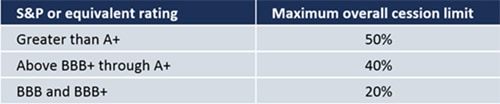
However, there is one catch that may prove frustrating. Section 20 of the directive provides that every Myanmar insurer, Myanmar reinsurer, and foreign reinsurer must cede a compulsory maximum of 10% of any insurance segment business to Myanma Insurance. Myanma Insurance is free to accept or reject the cession and will presumably be able to impose upon it such terms as it sees fit. Only if Myanma Insurance fails to offer such reinsurance is the insurer free to obtain cross border reinsurance from a foreign reinsurer for that original 10%. It seems probable that this provision will have a negative effect, because it will likely result in insurers being forced to comply with uncommercial terms from Myanma Insurance, despite better terms being available in Myanmar or abroad.

Insurance Pools

Insurance pools are another method by which smaller insurance companies can share risk. Insurance pools may now be formed in Myanmar, subject to a proposal being made to and approved by the IBRB.

Conclusion

Despite what some may see as the unwelcome involvement of Myanma Insurance, this directive is undoubtedly a giant step forward in the further liberalization and spreading of risk within the Myanmar insurance market, and is likely to herald large changes in reinsurance and retrocession both inside Myanmar and beyond.

For more information on this development, or on any aspect of doing business in Myanmar, please contact Tilleke & Gibbins’ Yangon office on [email protected]

RELATED INSIGHTS​ 

December 26, 2022
Tilleke & Gibbins’ insurance specialists in Yangon have contributed the Myanmar overview to the Insurance and Reinsurance Global Guide, published by Thomson Reuters Practical Law. The guide is a Q&A-style overview of insurance and reinsurance law, with entries from legal experts in 47 jurisdictions worldwide. Tilleke & Gibbins’ Myanmar contribution provides a comprehensive look at the market for insurance and reinsurance in the country, and it covers the following topics: Market trends Regulatory framework Authorization – Laws and bodies, insurance intermediaries, exemptions and foreign insurers, fronting, legal forms, restrictions and insurance activities Ownership restrictions Ongoing requirements Penalties for noncompliance Sales and marketing Transfer of risk Reinsurance contracts and risk Contracts and policies – Content requirements and common clauses, implied terms, customer protections, standard policies or terms Claims – Establishing a claim, time limits, subrogation, third-party claims, insurance of punitive damages, remedies for breach of policy Dispute resolution Insolvency Tax Insurtech The Q&A closes with a brief update on the new draft Insurance Business Law to reform the Myanmar insurance market. Practical Law brings together guides to key legal practice areas around the world for business lawyers. Tilleke & Gibbins contributes many overviews on various legal practice areas for all of the firm’s jurisdictions in Southeast Asia. To read the full Myanmar overview, please visit the Practical Law website.
September 19, 2022
Tilleke & Gibbins’ insurance specialists in Cambodia, Laos, Myanmar, Thailand, and Vietnam have contributed to the Subrogated Recoveries – Asia Pacific guide produced by RPC Premier Law Firm. The guide addresses how insurers can recover indemnifiable losses. For each jurisdiction in the Asia Pacific region, the guide addresses the following topics: Local legal framework on subrogation; Insurers’ right to subrogate; Investigations prior to subrogated proceedings; Limitation period for subrogated action; Responsibility for costs in subrogated action; Enforcement of judgements for insurers; and Subrogated actions against co-insured parties. The Subrogated Recoveries – Asia Pacific guide is available below.
September 1, 2022
On June 2, 2022, Thailand’s Office of Insurance Commission (OIC) issued Notification No. 6 Re: Investments in Other Business Operations for both life and non-life insurance companies. The two notifications, which took effect upon issuance, strengthen the OIC’s supervision of investments by insurance companies, with a focus on basic infrastructure relevant to the promotion of business competition and sustainability, and also allow and regulate additional investment types. Internal Governance of Investment Activities An insurance company’s board of directors is required to appoint a credit committee when engaging in credit activities. These activities include providing loans (excluding personal loans to employees or loans made under a guarantee by its insurance policies), car leasing services, avals for bills of exchange, and letters of guarantee for project performance. The credit committee has the following duties: Preparing the credit policy framework for the credit activities described above for further board approval; Supervising the credit activities; Overseeing good corporate governance, transparency, and prevention of conflict of interest in relation to credit activities; Ensuring that the work system, manpower, and data in relation to credit activities are sufficient; and Regularly reporting to the board of directors regarding credit activities. Credit policies must at least cover: Procedures and conditions for credit transactions. These include risk management, internal controls, data storage, and written reporting requirements. The procedures and conditions must comply with the relevant OIC regulations and the Bank of Thailand’s minimum standards for financial institutions. Persons responsible for operations relating to credit work, risk management for credit transactions, and verification of credit transactions. These roles include (1) the credit analyst, (2) the person who approves appropriate credit transactions, (3) the verifier of work accuracy after a credit transaction is approved, (4) the person in charge of reporting credit transaction risks, and (5) the person responsible for
November 24, 2021
Attorneys from Tilleke & Gibbins have provided the latest update to the Thailand contribution to Doing Business in…, a Q&A-style guide published by Thomson Reuters Practical Law that presents an overview of the legal framework for doing business in 63 jurisdictions worldwide. The Thailand chapter of the guide outlines Thailand’s legal system and key laws applicable to foreign companies doing business in the country. The chapter specifically covers the following main topics: Legal system: Thailand’s court system and codified legal system. Foreign investment: Lists of reserved business activities, restrictions on doing business with certain jurisdictions, exchange controls and currency regulations, and grants and incentives available to investors. Business vehicles: Ordinary partnerships, registered ordinary partnerships, limited partnerships, private limited companies, and public companies. Environment: Main laws and regulations, factory operation. Employment: Laws, employment contract requirements, work permits, and termination and redundancy. Tax: Taxes on employment, tax and nontax resident employees and businesses, corporate income tax, value added tax, special business tax, municipal tax, stamp duty, dividends, interest, intellectual property royalties. Competition: Important aspects of Thailand’s regulatory regime surrounding competition, centered around the updated Trade Competition Act. Antibribery and corruption: Laws, compliance requirements, regulatory authority. Intellectual property: Patents, trademarks, registered and unregistered designs, and copyright. Marketing agreements and advertising: Regulation of marketing agreements, Thailand’s Consumer Protection Act, direct marketing, role of the Consumer Protection Board and Food and Drug Administration. E-commerce: E-commerce laws and regulations, marketing and sales via online platforms. Data protection: An outline of Thailand’s Personal Data Protection Act. Product liability: Procedures and regulations for product liability and product safety, including the Unsafe Goods Liability Act and the Consumer Case Procedure Act. Product liability: Key regulatory authorities for trade competition, environmental issues, and financial services. To browse, download, or print the Thailand chapter, please visit the Practical Law website.