
You are using an outdated browser and your browsing experience will not be optimal. Please update to the latest version of Microsoft Edge, Google Chrome or Mozilla Firefox. Install Microsoft Edge

May 19, 2020

Reinsurance Revolution in Myanmar

On May 12, 2020, Myanmar’s Insurance Business Regulatory Board (IBRB) issued Directive 4/2020—a game-changer for the insurance industry in Myanmar. Previously, reinsurance in Myanmar had only been available through the state-owned Myanma Insurance, without competition. However, when this directive comes into force on October 1, 2020, insurance companies (or cedants) will be able to obtain reinsurance from other insurers or reinsurers within Myanmar or abroad, with certain restrictions.

Reinsurance (and retrocession—the insurance or reinsurance of reinsurers) is a critical part of the insurance industry because it allows insurance companies to spread their risk and remain solvent in the event of large claims. It is expected that this new directive will result in Myanmar insurers—already undergoing tectonic shifts following the introduction of five foreign life insurer licenses and six foreign-Myanmar insurance joint ventures—seeking substantial reinsurance outside Myanmar. This greater spreading of insurance risk is a very positive development for the insurance market in Myanmar.

Reinsurance and Risk Retention

Under the directive, every insurer in Myanmar must retain risk up to the maximum amount commensurate with its financial strength, and must formulate a suitable retention policy for each insurance segment. In the case of life insurers and reinsurers transacting life insurance business, that must be a minimum of 20% of the sum at risk.

Every Myanmar insurer must also formulate a reinsurance program and retention policy and submit it to the IBRB at the beginning of each financial year.

Reinsurers and Licensing

Any reinsurer who wishes to operate within Myanmar must have a reinsurance license from the IBRB.

Foreign reinsurers or cross-border reinsurers who do not have a license to conduct insurance business in Myanmar will now also be permitted, subject to the following conditions:

  • They must have been licensed in their home country for at least the past three continuous years;
  • They must have a credit rating of at least BBB from S&P or equivalent for at least the past three continuous years;
  • They must have maintained a minimum solvency margin or capital adequacy as specified by their home country regulator for at least the past three continuous years;
  • Their past claims settlement must be satisfactory to the IBRB; and
  • They must comply with other requirements that may be stipulated by the IBRB.

Engaging a Reinsurer

Other than for life insurance, insurers must offer the best terms obtained to reinsurers in the following order:

  1. Myanma Insurance;
  2. Myanmar reinsurers or foreign reinsurers with representative offices in Myanmar; and
  3. Foreign reinsurers.

Insurers are obliged to follow this order of priority only if the terms offered are equaled (or bettered).

Again, other than life insurance, the IBRB has placed the following limits on cession to foreign reinsurers:
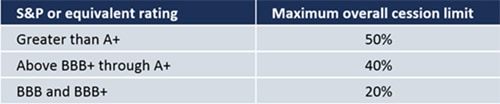
However, there is one catch that may prove frustrating. Section 20 of the directive provides that every Myanmar insurer, Myanmar reinsurer, and foreign reinsurer must cede a compulsory maximum of 10% of any insurance segment business to Myanma Insurance. Myanma Insurance is free to accept or reject the cession and will presumably be able to impose upon it such terms as it sees fit. Only if Myanma Insurance fails to offer such reinsurance is the insurer free to obtain cross border reinsurance from a foreign reinsurer for that original 10%. It seems probable that this provision will have a negative effect, because it will likely result in insurers being forced to comply with uncommercial terms from Myanma Insurance, despite better terms being available in Myanmar or abroad.

Insurance Pools

Insurance pools are another method by which smaller insurance companies can share risk. Insurance pools may now be formed in Myanmar, subject to a proposal being made to and approved by the IBRB.

Conclusion

Despite what some may see as the unwelcome involvement of Myanma Insurance, this directive is undoubtedly a giant step forward in the further liberalization and spreading of risk within the Myanmar insurance market, and is likely to herald large changes in reinsurance and retrocession both inside Myanmar and beyond.

For more information on this development, or on any aspect of doing business in Myanmar, please contact Tilleke & Gibbins’ Yangon office on [email protected]

RELATED INSIGHTS​ 

October 25, 2021
Michael Ramirez, a counsel in Tilleke & Gibbins’ dispute resolution group in Bangkok, has updated the firm’s contribution to the Global Attorney-Client Privilege Guide, published by Lex Mundi. The newly expanded guide provides information on what constitutes attorney-client privilege in over 70 countries around the world. The Thailand section of the guide contains in-depth information on the function and applications of attorney-client privilege in Thailand (or, as explained in the guide, an equivalent concept enshrined in Thai law), including coverage of the following topics: Privilege in corporations Common interest doctrine Litigation funding Crime-fraud exception Work product doctrine/litigation privilege Other privileges including mediation, accountant-client and settlement negotiation The interactive guide features expert contributions by Lex Mundi member firms from jurisdictions worldwide. Readers can browse the contributions, generate country-specific reports, and compare attorney-client privilege in multiple jurisdictions. For more information, please visit the Lex Mundi website.
October 14, 2021
As part of its membership in Lex Mundi, Tilleke & Gibbins has published an updated edition of its Guide to Doing Business in Thailand for 2021. This guide outlines all of the key factors for starting and operating a business in the Thai market. Issues covered include: Investment incentives Financial facilities Exchange controls Import and export regulations Structures for doing business Requirements for the Establishment of a Business Operation of the Business Cessation or Termination of the Business Labor legislation, relations, and supply Tax Immigration requirements This publication is part of Lex Mundi’s Guides to Doing Business series prepared by member firms in more than 100 jurisdictions worldwide. The guides serve as a useful resource when planning an international business strategy or researching a new market.
September 10, 2021
Thailand’s Ministry of Interior has issued new regulations requiring owners, occupants, and operators of certain types of buildings to obtain third-party life, body, and property liability insurance. The Ministerial Regulations Prescribing the Type or Category of Buildings Which Must Apply for Legal Liability Insurance B.E. 2564 (2021) were announced in the Government Gazette on September 6, 2021, and will come into effect on November 5, 2021. The new regulations, which repeal and replace similarly titled regulations from 2005, detail third-party liability insurance rules, procedures, conditions, and minimum insurance amounts for specific building types and activities. The new regulations clearly distinguish the building use phase from the construction, modification, relocation, and demolition phases. They also add a new requirement for the owner, occupant, or operator of large buildings to apply for third party liability insurance during the construction, modification, relocation, and demolition phases. Building Construction, Modification, Relocation, and Demolition When a permit for construction, modification, relocation, or demolition is granted for a building classified as a high-rise, large, or extra-large building, the owner, occupant, or operator who obtained the permit must apply for third-party liability insurance before work begins. If work is already in progress when the regulations come into effect, the permit holders will have 30 days to apply for third party liability insurance covering the remainder of the period specified in the permit. Building Usage Owners or occupiers of public assembly buildings, hotels with more than 80 rooms, entertainment venues of 200 square meters or more, and large freestanding or building-attached signboards and support structures must also apply for third party liability insurance covering accidents related to the condition or use of the structures. Owners or occupiers have 30 days from the completion of the construction, modification, relocation, or change of use of the buildings, as the case
August 2, 2021
Lawyers from Tilleke & Gibbins’ Bangkok office have authored the Thailand chapter of the 2021 edition of Chambers & Partners Aviation Finance & Leasing Guide. John Frangos, partner and deputy director of Tilleke & Gibbins’ dispute resolution practice; Santhapat Periera, partner in the firm’s corporate and commercial department; and Nuanchun Somboonvinij, senior associate in the firm’s dispute resolution group, provided the Thailand update for the publication, which covers the most important legal developments affecting aircraft lessors, lessees, and financiers in 32 jurisdictions worldwide. The guide provides in-depth details on the legal regimes affecting all aspects of aircraft sale and purchase, aircraft and engine leasing, and aircraft debt finance, including sale and lease agreement terms; taxation; lease registration and enforcement; lease assignment/novation; insurance and reinsurance; debt structuring; securities; liens; and many others that affect the day-to-day operations of leading players in the aviation industry. Chambers and Partners’ Global Practice Guides provide in-house counsel with expert legal commentary focusing on practical legal issues affecting business, and enable readers to compare legislation and relevant procedures across a range of key jurisdictions. The full Chambers & Partners Aviation Finance & Leasing Guide—including the Thailand chapter—is available for free on the Chambers and Partners website, and the Thailand chapter be downloaded as a stand-alone PDF through the button below.