
You are using an outdated browser and your browsing experience will not be optimal. Please update to the latest version of Microsoft Edge, Google Chrome or Mozilla Firefox. Install Microsoft Edge

May 19, 2020

Reinsurance Revolution in Myanmar

On May 12, 2020, Myanmar’s Insurance Business Regulatory Board (IBRB) issued Directive 4/2020—a game-changer for the insurance industry in Myanmar. Previously, reinsurance in Myanmar had only been available through the state-owned Myanma Insurance, without competition. However, when this directive comes into force on October 1, 2020, insurance companies (or cedants) will be able to obtain reinsurance from other insurers or reinsurers within Myanmar or abroad, with certain restrictions.

Reinsurance (and retrocession—the insurance or reinsurance of reinsurers) is a critical part of the insurance industry because it allows insurance companies to spread their risk and remain solvent in the event of large claims. It is expected that this new directive will result in Myanmar insurers—already undergoing tectonic shifts following the introduction of five foreign life insurer licenses and six foreign-Myanmar insurance joint ventures—seeking substantial reinsurance outside Myanmar. This greater spreading of insurance risk is a very positive development for the insurance market in Myanmar.

Reinsurance and Risk Retention

Under the directive, every insurer in Myanmar must retain risk up to the maximum amount commensurate with its financial strength, and must formulate a suitable retention policy for each insurance segment. In the case of life insurers and reinsurers transacting life insurance business, that must be a minimum of 20% of the sum at risk.

Every Myanmar insurer must also formulate a reinsurance program and retention policy and submit it to the IBRB at the beginning of each financial year.

Reinsurers and Licensing

Any reinsurer who wishes to operate within Myanmar must have a reinsurance license from the IBRB.

Foreign reinsurers or cross-border reinsurers who do not have a license to conduct insurance business in Myanmar will now also be permitted, subject to the following conditions:

  • They must have been licensed in their home country for at least the past three continuous years;
  • They must have a credit rating of at least BBB from S&P or equivalent for at least the past three continuous years;
  • They must have maintained a minimum solvency margin or capital adequacy as specified by their home country regulator for at least the past three continuous years;
  • Their past claims settlement must be satisfactory to the IBRB; and
  • They must comply with other requirements that may be stipulated by the IBRB.

Engaging a Reinsurer

Other than for life insurance, insurers must offer the best terms obtained to reinsurers in the following order:

  1. Myanma Insurance;
  2. Myanmar reinsurers or foreign reinsurers with representative offices in Myanmar; and
  3. Foreign reinsurers.

Insurers are obliged to follow this order of priority only if the terms offered are equaled (or bettered).

Again, other than life insurance, the IBRB has placed the following limits on cession to foreign reinsurers:
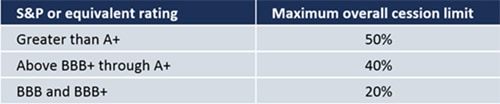
However, there is one catch that may prove frustrating. Section 20 of the directive provides that every Myanmar insurer, Myanmar reinsurer, and foreign reinsurer must cede a compulsory maximum of 10% of any insurance segment business to Myanma Insurance. Myanma Insurance is free to accept or reject the cession and will presumably be able to impose upon it such terms as it sees fit. Only if Myanma Insurance fails to offer such reinsurance is the insurer free to obtain cross border reinsurance from a foreign reinsurer for that original 10%. It seems probable that this provision will have a negative effect, because it will likely result in insurers being forced to comply with uncommercial terms from Myanma Insurance, despite better terms being available in Myanmar or abroad.

Insurance Pools

Insurance pools are another method by which smaller insurance companies can share risk. Insurance pools may now be formed in Myanmar, subject to a proposal being made to and approved by the IBRB.

Conclusion

Despite what some may see as the unwelcome involvement of Myanma Insurance, this directive is undoubtedly a giant step forward in the further liberalization and spreading of risk within the Myanmar insurance market, and is likely to herald large changes in reinsurance and retrocession both inside Myanmar and beyond.

For more information on this development, or on any aspect of doing business in Myanmar, please contact Tilleke & Gibbins’ Yangon office on [email protected]

RELATED INSIGHTS​ 

April 19, 2021
Thailand has made significant changes to its statutory interest rate framework for the first time in almost a century. Since 1925, the statutory interest rate codified in Thailand’s Civil and Commercial Code (the CCC) has remained at 7.5% per year. But with Covid-19 having an unprecedented impact on the Thai economy, the Thai Government, via emergency decree, has reduced the statutory rate. While the decree is largely aimed at providing relief to hard-hit SMEs and individual debtors, the amendments have broader implications for doing business in Thailand. Main Changes The new interest rate revisions are contained within the Emergency Decree Amending the Civil and Commercial Code B.E. 2564 (2021) (the Emergency Decree), which was published in the Government Gazette on April 10, 2021 and came into effect on April 11, 2021. The Emergency Decree amends Sections 7 and 224 of the CCC, which stated the previous statutory interest rate of 7.5% per year. The Emergency Decree makes three major changes. The first involves a reduction of the statutory interest rate from 7.5% per year to 3% per year in Section 7. The new 3% annual rate is subject to review every three years by the Ministry of Finance. The interest rate is subject to further change later by a royal decree. The second change concerns money debts under Section 224 of the CCC. The previous version of Section 224 stated, among other things, that a money debt based on a default bears interest of 7.5% per year. Under the Emergency Decree, the new actual statutory default interest rate is the statutory interest rate stated in Section 7 with an additional rate of 2% per year. The result is a 5% annual statutory default interest rate. Since the statutory default interest rate is based in part on the Section 7
March 3, 2021
The Office of Insurance Commission (OIC) is seeking public comments on their recently released draft guidelines on Thailand’s insurance regulatory sandbox. Once enacted, the draft notification will replace the existing OIC insurance regulatory sandbox notification, aiming to broaden the OIC’s authority in order to erase difficulties in the project approval process that have arisen under the current notification. One major change included in this draft notification is that business operators are no longer allowed to conduct “own sandbox” testing. Unlike the notification currently in effect, the new draft notification also does not specify the criteria and procedures for a business operator to apply for a temporary allowance of non-compliance with non-material, test-obstructing requirements in a notification or order from the OIC or the registrar. Participants Eligible participants in the insurance regulatory sandbox—which include life and non-life insurance companies, life and non-life brokers, and other types of business operators with expertise in technology—must have appropriate capital, systems, personnel, and experience for the planned provision of service. Participants in the sandbox must establish measures to ensure that insured parties will receive sufficient information in relation to the project, and a remedial plan must be in place in case of damage arising from errors connected to the project. These measures are similar to those in the existing OIC notification, which requires that such measures must at least cover consumer protection, risk management, reporting obligations, and compliance with applicable laws. Project Requirements The draft notification reduces the number of eligible sandbox project types allowed under the existing OIC notification. When the draft notification is enacted, projects that risk regulatory incompliance, and projects that may adversely affect consumers, financial stability, or trust in an insurance company or the industry as a whole, will no longer be allowed to participate in the insurance regulatory sandbox.
February 23, 2021
As many are already aware, following the change of government in Myanmar on February 1, 2021, a draft Cyber Security Law was proposed which attracted widespread criticism. However, less attention has been paid to significant amendments to two existing laws, some of which have a similar effect to parts of the draft Cyber Security Law. In other words, while the draft Cyber Security Law has not progressed further and is under public scrutiny, significant elements of it have found their way into law in Myanmar by other routes. Because these amendments are already law, it is very important that individuals and businesses in Myanmar understand their implications. Amendments to the Law Protecting the Privacy and Security of Citizens The Law Protecting the Privacy and Security of Citizens (2017), or the “Privacy Law,” was amended on February 13, 2021, less than two weeks after the military government came into power. These amendments chiefly address the power of the government to conduct searches, seizures, and arrests; to extend detention without judicial oversight; and to carry out broad surveillance and investigation activities that could intrude on individual privacy. The amendments accomplish this by suspending various sections of the Privacy Law for as long as the State Administration Council (the military body now governing Myanmar) is in power. The suspended sections include the following: Section 5: Search, seizure, and arrest without civilian observation The relevant part of Section 5 of the Privacy Law states, “The responsible authorities shall … when acting in accordance with existing law, not enter into a person’s residence or a room used as a residence, or a building, compound or building in a compound, for the purpose of search, seizure, or arrest, unless accompanied by minimum of two witnesses who should comprise Ward or Village Tract Administrators…”. The suspension