
You are using an outdated browser and your browsing experience will not be optimal. Please update to the latest version of Microsoft Edge, Google Chrome or Mozilla Firefox. Install Microsoft Edge

August 29, 2018

Panasonic Wins Passing Off Case for Packaging and Product Designs

Informed Counsel

Although the Thai Trademark Act provides protection for passing off, filing a lawsuit to defend an IP owner’s unregistered rights can still pose certain challenges. This is especially true where two registered trademarks are different, but the product packaging designs of both marks are confusingly similar. In these circumstances, the court occasionally decides upon a mere comparison of the two marks and may determine that the similarities of their packaging designs are not likely to cause confusion among public consumers due to their dissimilarity.

Recently, the Supreme Court rendered a remarkable and highly significant judgment on the grounds of passing off, which should serve as a landmark trademark infringement case in Thailand. Panasonic, the plaintiff, owns various trademark registrations worldwide. Among those registered marks, the most eye-catching mark is the PANASONIC mark itself. Panasonic registered this mark for use with manganese and alkaline batteries in Class 9 in Thailand in 1985. Panasonic exerted huge efforts and much research in designing the unique colors used with its batteries and the labeling on the packaging to let consumers recognize its products immediately as belonging to Panasonic.

Approximately five years ago, a Thai manufacturing company (defendants) was discovered to be manufacturing different types of batteries that were found to be similar to those manufactured by Panasonic under its own trademark. The defendants’ batteries were closely similar to Panasonic’s battery colors and the text was positioned almost identically to Panasonic’s packaging.

After trying unsuccessfully to reach an amicable settlement, Panasonic decided to bring a civil lawsuit against the defendants on the grounds of trademark infringement and passing off.
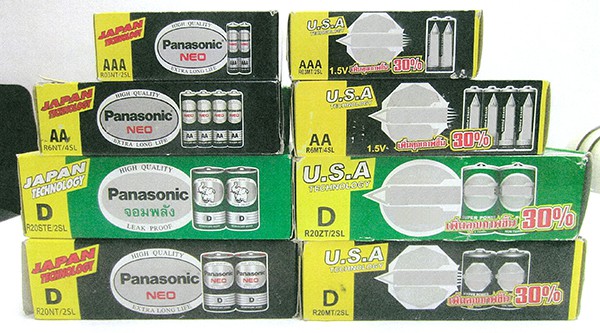
IP&IT Court Decision   

At the Intellectual Property and International Trade (IP&IT) Court, Panasonic argued that the appearance of its packaging was immediately recognizable among Thai public consumers and distinguishable from the packaging of other battery manufacturers. To support its claim, Panasonic conducted a public survey opinion poll comparing the overall appearances of its packaging and that of other battery manufacturers’ packaging. The survey results revealed that the average consumer readily recognizes Panasonic’s packaging without seeing the PANASONIC mark, and that there is a likelihood of confusion when consumers see the defendant’s packaging. Unfortunately, these survey results were not convincing evidence to the court. Without considering the defendant’s bad faith in imitating the color, size, and word arrangement of its battery packaging, the court instead took into consideration the trademark itself, and therefore considered that the defendant’s batteries were distinguishable when considering pronunciation and overall appearance.    

Panasonic disagreed with the court’s opinion and decided to appeal the case to the Supreme Court, arguing that the IP&IT Court failed to elaborate on the legal point of the defendants’ bad faith, as it was using similar packaging, labeling, and colors to its own product designs and benefiting from Panasonic’s widespread reputation.

The Supreme Court Decision   

The Supreme Court confirmed the IP&IT Court decision with regard to the dissimilarity of the registered marks, when considering pronunciation and the shape of the Roman characters of the marks. However, the Supreme Court disagreed with most other aspects of the IP&IT Court’s reasoning, especially in its failure to determine whether the defendants, by using a similar packaging, label, and product design to that of Panasonic’s, acted in bad faith and thereby infringed Panasonic’s unregistered trademark rights.    

The Supreme Court emphasized the importance of the bad faith intention of the defendants by determining the manner in which the trademark is used on goods and packages. The court found that even though the registered mark in dispute was not confusingly similar to the PANASONIC trademark in either appearance or pronunciation, the court must compare the characteristics of the batteries and the packaging of the defendants with those aspects of Panasonic’s batteries to determine whether the two companies’ products are similar.    

With regard to the color scheme, the Supreme Court took an approach contrary to the IP&IT Court’s reasoning. Even though color is a common feature that anyone can freely use, a certain color combination (e.g., green and silver; black and silver; or red, white, black and yellow), together with the placement of the colors, text, and images, creates a visual design and pattern indicating that Panasonic’s goods are different from others’ goods.   

The Supreme Court further elaborated that the appearance of the defendants’ batteries and packaging, which appear to be closely similar to Panasonic’s, clearly reflect the bad-faith intention of the defendants to use their registered mark with batteries in order to deceive the relevant consumers into believing that the batteries belong to Panasonic. The court held that such tortious conduct can only have the result of causing injury to Panasonic and is thus unlawful.    

The Supreme Court ruled that the defendants must cease using their product designs and packaging designs of similar coloring and patterns to those of Panasonic, and must not pass off their products as those of Panasonic. Moreover, the court awarded Panasonic compensatory damages, together with its attorneys’ fees and court fees.

Conclusion   

The trademark owner’s victory in this case offers a valuable lesson in determining that trademark infringement should not only consider the mark itself but also the manner in which an alleged infringer uses its mark to imitate a brand owner’s unique product designs and packaging, which can now be considered to be unregistered trademarks. This Supreme Court judgment establishes an exemplary guideline for brand owners facing similar issues, whereby brand owners can protect themselves from others imitating their unique product designs and packaging.

RELATED INSIGHTS​ 

August 9, 2023
Cambodia imports a substantial amount of food products to meet its domestic demand. Most of these imported products are from nearby ASEAN countries, with Thailand, Malaysia, and Vietnam providing the bulk of these food imports. However, food products from markets further away are becoming more popular each year, including brands from Australia, Japan, China, the EU, South-Korea, and the US. Many food product owners and distributors do not realize that all types of prepackaged food products, including imports, require product registration before they are permitted to be sold in Cambodia. This usually requires an assessment against mandatory Cambodian Standards and local technical regulations. There are general Cambodian Standards that cover all types of prepackaged food products, as well as product-specific standards and regulations that may be applicable. Furthermore, any type of prepackaged food product sold in Cambodia must bear a Khmer language label that meets the minimum consumer information standards, and the Cambodian Standards. This label requirement is often overlooked, with many products on the market bearing only a foreign language label. Product Registration & Labeling Requirements Back in 2000, a Cambodian Standard on prepackaged food labeling was adopted, clearly mandating Khmer language labeling for all types of prepackaged foods. Unfortunately, this labeling standard was not widely adopted by the industry, and even today compliance is low. Low compliance, combined with a lack of widespread enforcement efforts, led to a misguided understanding that imported food products were not subject to any standards, did not require product registration, and were not required to bear Khmer language labeling. Recent legal developments related to consumer protection and food safety clarified several of these misunderstandings. For example, the regulations clearly state that all types of food product must meet the applicable standards and technical regulations, which is assessed through registration. The new Law
July 28, 2023
Myanmar’s Ministry of Commerce (MOC) issued three notifications related to e-commerce on July 21, 2023, classifying online retail businesses as essential services, requiring them to register with the relevant authorities, and setting the criteria for their registration. Under Notification No. 49/2023 the MOC authorized the Department of Trade (DOT) to issue notifications, orders, and directives relating to online retail businesses. This was followed by Notification No. 50/2023, which classifies online retail businesses as essential services under the Essential Supplies and Services Law and requires them to register with the DOT within six months of the issuance of the notification (i.e., by January 21, 2024). Failure to register within the specified period will be punishable by imprisonment for six months to three years and a fine of up to MMK 500,000 (approx. USD 238). Finally, under Notification No. 51/2023, the MOC set out the criteria and requirements for the registration of online retail businesses by entities, business institutions, and individuals, as well as the duties and liabilities of sellers and consumers. Pursuant to this notification, registration should be completed via the DOT’s online system, fees must be paid digitally, and electronic registration certificates will be issued. Certificates are initially valid for two years, and can be renewed. The MOC will provide information at a later time on the prescribed forms, certificate format, registration and online fees, and online registration portal. In applying for registration, an entity or business institution established under the Myanmar Companies Law, Special Company Act, Co-operative Society Law, or any other existing Myanmar laws must have a website with its own domain name or an online channel with an exact address that is used for online sales and a registered business address within Myanmar. Individual applicants must be at least 18 years old, reside in Myanmar, and
June 5, 2023
Vietnam’s Law on the Protection of Consumer Rights (“Consumer Protection Law” or “CPL”) was passed in 2010 and has been effective since July 1, 2011, providing a legal framework for protecting the rights of consumers in Vietnam. Over the past 12 years of implementation and application, however, the CPL has revealed its shortcomings and limitations. For example, there are issues related to inconsistency between the CPL and other laws such as the Civil Code, Law on Competition, Enterprise Law, and Cybersecurity Law. The current CPL also has not kept pace with modern consumption practices, especially the rapid changes and emerging trends in e-commerce, cross-border transactions, and services via digital platforms. The government of Vietnam has therefore entrusted the Ministry of Industry and Trade (MOIT) to take the lead in drafting a new amended CPL to replace the old one, to improve the policies and legislation on consumer protection, and protect the vulnerabilities of consumers in transactions with businesses. During the 5th session of the National Assembly at the end of May 2023, the National Assembly discussed and reviewed the latest draft of the CPL (“Draft CPL”), which is expected to be approved on June 21, 2023. The following are some key contents of the Draft CPL: 1. Revised Subjects of Application Unlike the current CPL, which applies only to consumers; traders of goods and services; and agencies, organizations and individuals involved in consumer protection activities within the territory of Vietnam, the Draft CPL adds “the Vietnamese Fatherland Front, socio-political organizations and social organizations participating in protecting consumers’ interests” as new subjects of its application, and clarifies that “agencies, organizations, and individuals” include both domestic and offshore agencies, organizations, and individuals involved in activities of consumer rights protection. The Draft CPL also removes “within the territory of Vietnam” from the
June 2, 2023
Thailand’s labeling requirements have new rules on product label font size and readability following the issuance of Announcement of the Label Committee Re: Characteristics of the Label for Label-Controlled Goods No. 3, which is a bylaw of the Consumer Protection Act (CPA). The announcement takes effect on June 18, 2023, and applies to all “label-controlled goods,” which are described under the CPA and its bylaws as goods either produced by factories in Thailand or imported into Thailand for sale. The labels of these goods must meet current labeling requirements, such as having information about the product name, quantity, intended use, cautions, and expiry date. Label readability—specifically in terms of the size of text on labels—is also a mandatory requirement, and is the focus of this latest announcement. Text size requirements are an important part of ensuring that consumers are fully aware of the details of a product before deciding to purchase the goods. According to the announcement, any statement or text displayed on a label must be easily visible and readable. The size of the text must be proportional to the label area. Specifically, the text height must not be less than 2 millimeters (or 1.5 millimeters for labels with an area of less than 35 square millimeters). The announcement does not clarify exactly how the height of the text will be determined. Some companies have expressed concern that these requirements are too strict and will be challenging to meet, especially for small businesses. The text size requirements may be expensive to implement, as the larger text requires more space on the label, potentially leading to larger labels or packages, higher production costs, or even expensive recalls to affix new labels. In some cases, text size requirements may even make it impossible to fit all the required information on