
You are using an outdated browser and your browsing experience will not be optimal. Please update to the latest version of Microsoft Edge, Google Chrome or Mozilla Firefox. Install Microsoft Edge

August 29, 2018

Panasonic Wins Passing Off Case for Packaging and Product Designs

Informed Counsel

Although the Thai Trademark Act provides protection for passing off, filing a lawsuit to defend an IP owner’s unregistered rights can still pose certain challenges. This is especially true where two registered trademarks are different, but the product packaging designs of both marks are confusingly similar. In these circumstances, the court occasionally decides upon a mere comparison of the two marks and may determine that the similarities of their packaging designs are not likely to cause confusion among public consumers due to their dissimilarity.

Recently, the Supreme Court rendered a remarkable and highly significant judgment on the grounds of passing off, which should serve as a landmark trademark infringement case in Thailand. Panasonic, the plaintiff, owns various trademark registrations worldwide. Among those registered marks, the most eye-catching mark is the PANASONIC mark itself. Panasonic registered this mark for use with manganese and alkaline batteries in Class 9 in Thailand in 1985. Panasonic exerted huge efforts and much research in designing the unique colors used with its batteries and the labeling on the packaging to let consumers recognize its products immediately as belonging to Panasonic.

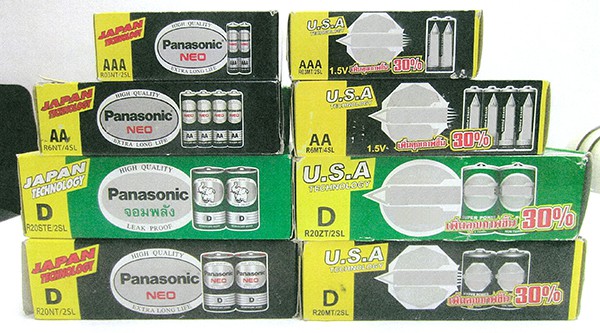
Approximately five years ago, a Thai manufacturing company (defendants) was discovered to be manufacturing different types of batteries that were found to be similar to those manufactured by Panasonic under its own trademark. The defendants’ batteries were closely similar to Panasonic’s battery colors and the text was positioned almost identically to Panasonic’s packaging.

After trying unsuccessfully to reach an amicable settlement, Panasonic decided to bring a civil lawsuit against the defendants on the grounds of trademark infringement and passing off.
IP&IT Court Decision   

At the Intellectual Property and International Trade (IP&IT) Court, Panasonic argued that the appearance of its packaging was immediately recognizable among Thai public consumers and distinguishable from the packaging of other battery manufacturers. To support its claim, Panasonic conducted a public survey opinion poll comparing the overall appearances of its packaging and that of other battery manufacturers’ packaging. The survey results revealed that the average consumer readily recognizes Panasonic’s packaging without seeing the PANASONIC mark, and that there is a likelihood of confusion when consumers see the defendant’s packaging. Unfortunately, these survey results were not convincing evidence to the court. Without considering the defendant’s bad faith in imitating the color, size, and word arrangement of its battery packaging, the court instead took into consideration the trademark itself, and therefore considered that the defendant’s batteries were distinguishable when considering pronunciation and overall appearance.    

Panasonic disagreed with the court’s opinion and decided to appeal the case to the Supreme Court, arguing that the IP&IT Court failed to elaborate on the legal point of the defendants’ bad faith, as it was using similar packaging, labeling, and colors to its own product designs and benefiting from Panasonic’s widespread reputation.

The Supreme Court Decision   

The Supreme Court confirmed the IP&IT Court decision with regard to the dissimilarity of the registered marks, when considering pronunciation and the shape of the Roman characters of the marks. However, the Supreme Court disagreed with most other aspects of the IP&IT Court’s reasoning, especially in its failure to determine whether the defendants, by using a similar packaging, label, and product design to that of Panasonic’s, acted in bad faith and thereby infringed Panasonic’s unregistered trademark rights.    

The Supreme Court emphasized the importance of the bad faith intention of the defendants by determining the manner in which the trademark is used on goods and packages. The court found that even though the registered mark in dispute was not confusingly similar to the PANASONIC trademark in either appearance or pronunciation, the court must compare the characteristics of the batteries and the packaging of the defendants with those aspects of Panasonic’s batteries to determine whether the two companies’ products are similar.    

With regard to the color scheme, the Supreme Court took an approach contrary to the IP&IT Court’s reasoning. Even though color is a common feature that anyone can freely use, a certain color combination (e.g., green and silver; black and silver; or red, white, black and yellow), together with the placement of the colors, text, and images, creates a visual design and pattern indicating that Panasonic’s goods are different from others’ goods.   

The Supreme Court further elaborated that the appearance of the defendants’ batteries and packaging, which appear to be closely similar to Panasonic’s, clearly reflect the bad-faith intention of the defendants to use their registered mark with batteries in order to deceive the relevant consumers into believing that the batteries belong to Panasonic. The court held that such tortious conduct can only have the result of causing injury to Panasonic and is thus unlawful.    

The Supreme Court ruled that the defendants must cease using their product designs and packaging designs of similar coloring and patterns to those of Panasonic, and must not pass off their products as those of Panasonic. Moreover, the court awarded Panasonic compensatory damages, together with its attorneys’ fees and court fees.

Conclusion   

The trademark owner’s victory in this case offers a valuable lesson in determining that trademark infringement should not only consider the mark itself but also the manner in which an alleged infringer uses its mark to imitate a brand owner’s unique product designs and packaging, which can now be considered to be unregistered trademarks. This Supreme Court judgment establishes an exemplary guideline for brand owners facing similar issues, whereby brand owners can protect themselves from others imitating their unique product designs and packaging.

RELATED INSIGHTS​ 

April 20, 2023
Food safety is one important area of focus as Cambodia continues to improve its regulatory framework surrounding consumer protection. Last year, the new Law on Food Safety set out the main principles to regulate the food sector, providing general rights and obligations of food businesses and requirements for food products traded in Cambodia. Then in the first months of 2023, two implementing regulations were issued to clarify the overarching principles of the Law on Food Safety, as well as its enforcement mechanisms. The adoption of these enforcement-related regulations is once again a clear signal to the market that the Cambodian government is taking the enforcement of consumer protection laws seriously. Food Surveillance, Seizure, and Recalls The first of these implementing regulations was Sub-Decree No. 13 on the Conditions, Formalities and Procedures for Food Surveillance and Seizure, dated January 6, 2023 (SD 13), followed the next month by Prakas No. 080 on the Forms and Procedures to Seize Unsafe Foods or Foods Not Complying with Technical Regulations, dated February 22, 2023 (Prakas 80). These implementing regulations give clarity on how the authorities will monitor and inspect the food sector, and in what cases the authorities may resort to recalls or seizure of foods. Prakas 80 also provides the necessary paperwork for both inspecting officers and companies to use when reporting on unsafe foods to authorities and the public. Lastly, the regulations further clarify the obligations for food businesses and the penalties for noncompliance. The Consumer Protection, Competition, and Fraud Repression Directorate-General (CCF) of the Ministry of Commerce takes a key role as the main enforcement authority under the regulations. The CCF receives reports on unsafe foods, manages voluntary recalls, publishes warnings to the public regarding unsafe foods, seizes unsafe or otherwise noncompliant goods, and applies the administrative fines and penalties
March 7, 2023
Intellectual property experts from Tilleke & Gibbins’ Hanoi office have written the Vietnam chapter of Practical Law Company’s Copyright Litigation Global Guide 2023, a high-level comparative overview of laws and regulations related to copyright law presented in an easy to read Q&A format. The Vietnam chapter, which includes changes introduced by the latest amendment of Vietnam’s Intellectual Property Law, covers the following topics and more: Sources of law and the court system Types of works that can be protected by copyright Acts that constitute copyright infringement Parties to litigation Enforcement options Procedure in civil courts To read the Vietnam chapter, please visit the Practical Law website or click on the link below.
March 1, 2023
In Cambodia, the Ministry of Commerce takes the lead on many consumer protection matters, issuing and enforcing regulations that contribute greatly to a fairer and more transparent legal framework. The regulations protect consumers while simultaneously creating a more a level playing field for businesses. On September 2, 2022, the ministry issued a new regulation concerning household chemical products. The regulation, named Prakas No. 192 on the Requirements for the Labeling of Household Chemical Products, is another big leap forward in light of the consumer protection framework that the Cambodian government has been rapidly updating in recent years. Interesting issues in the regulation include household chemical product classification, labeling and language requirements, product storage requirements, recall requirements, and obligations for companies engaging in business activities related to household chemicals. In addition, the regulation reminds household chemicals businesses operating online of the need to obtain additional e-commerce licensing. Cambodia’s consumer protection authority, the Consumer Protection, Competition and Fraud Repression Directorate-General—commonly known as the CCF—has already started to enforce the new regulation, as the three-month transition period under the regulation has now passed. Classifying and Defining Household Chemicals The regulation classifies household chemicals into three groups based on the product’s purpose—namely detergents, pesticides, and substances for home and garden protection. There is also a separate list of household chemicals identified as “chemicals not allowed for use in food.” This list is just a reminder, as existing legislation already prohibits the use of the identified chemicals in food. The regulation defines household chemicals as finished chemical products, or chemical additives to products, that can be harmful to health and that have one of the three purposes mentioned above. The regulation further states that the products are for use in “normal life,” such as in homes, workshops, or gardens, or for other public use.
February 28, 2023
Influencer marketing and the creation of sponsored content is an increasingly popular way for brands to reach their target audience. Although there is no universal definition of an “influencer,” the term is broadly used to describe people who are able to affect purchasing decisions of others through their relationship with their audience. In the context of social media and the creator economy, influencers are usually people with significant followings on platforms such as Instagram, TikTok, Twitch, or YouTube who are viewed as celebrities, opinion leaders, trendsetters, or experts in their respective field. Based on a study conducted by Nielsen in 2022, 80% of social media users in Asia who follow influencers are likely to purchase products recommended by the influencers. Brand owners should be aware of five key legal considerations when entering into influencer marketing agreements. 1. Making informed decisions through due diligence Every collaboration with an influencer is a business relationship. Brands must conduct thorough due diligence on potential influencers prior to engaging them. This may include deep dives into the individual’s old social media posts, as well as requests for disclosure of prior controversial incidents and existing brand associations. For example, a health and fitness brand may not want—for both legal and commercial reasons—to be publicly associated with an influencer who is a brand ambassador of electronic cigarettes, no matter how impressive the latter’s Instagram following or deadlift record is. Brands should also ensure that their influencer marketing agreements include relevant representations and warranties that the influencer has not and will not commit a crime or act in a way that may cause negative publicity for the brand. This may include racist, extremist, homophobic, violent, or misogynistic acts, or any other acts that are obscene or against public order. 2. Clearly defining the scope of engagement Brands