
You are using an outdated browser and your browsing experience will not be optimal. Please update to the latest version of Microsoft Edge, Google Chrome or Mozilla Firefox. Install Microsoft Edge

August 29, 2018

Panasonic Wins Passing Off Case for Packaging and Product Designs

Informed Counsel

Although the Thai Trademark Act provides protection for passing off, filing a lawsuit to defend an IP owner’s unregistered rights can still pose certain challenges. This is especially true where two registered trademarks are different, but the product packaging designs of both marks are confusingly similar. In these circumstances, the court occasionally decides upon a mere comparison of the two marks and may determine that the similarities of their packaging designs are not likely to cause confusion among public consumers due to their dissimilarity.

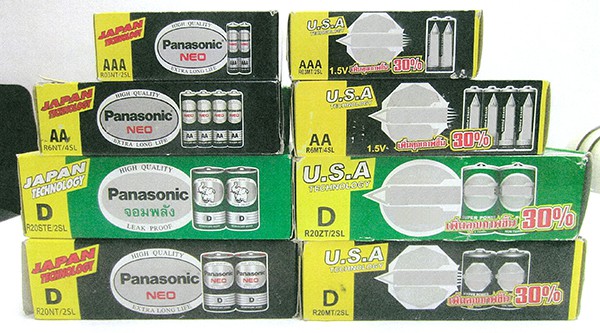
Recently, the Supreme Court rendered a remarkable and highly significant judgment on the grounds of passing off, which should serve as a landmark trademark infringement case in Thailand. Panasonic, the plaintiff, owns various trademark registrations worldwide. Among those registered marks, the most eye-catching mark is the PANASONIC mark itself. Panasonic registered this mark for use with manganese and alkaline batteries in Class 9 in Thailand in 1985. Panasonic exerted huge efforts and much research in designing the unique colors used with its batteries and the labeling on the packaging to let consumers recognize its products immediately as belonging to Panasonic.

Approximately five years ago, a Thai manufacturing company (defendants) was discovered to be manufacturing different types of batteries that were found to be similar to those manufactured by Panasonic under its own trademark. The defendants’ batteries were closely similar to Panasonic’s battery colors and the text was positioned almost identically to Panasonic’s packaging.

After trying unsuccessfully to reach an amicable settlement, Panasonic decided to bring a civil lawsuit against the defendants on the grounds of trademark infringement and passing off.
IP&IT Court Decision   

At the Intellectual Property and International Trade (IP&IT) Court, Panasonic argued that the appearance of its packaging was immediately recognizable among Thai public consumers and distinguishable from the packaging of other battery manufacturers. To support its claim, Panasonic conducted a public survey opinion poll comparing the overall appearances of its packaging and that of other battery manufacturers’ packaging. The survey results revealed that the average consumer readily recognizes Panasonic’s packaging without seeing the PANASONIC mark, and that there is a likelihood of confusion when consumers see the defendant’s packaging. Unfortunately, these survey results were not convincing evidence to the court. Without considering the defendant’s bad faith in imitating the color, size, and word arrangement of its battery packaging, the court instead took into consideration the trademark itself, and therefore considered that the defendant’s batteries were distinguishable when considering pronunciation and overall appearance.    

Panasonic disagreed with the court’s opinion and decided to appeal the case to the Supreme Court, arguing that the IP&IT Court failed to elaborate on the legal point of the defendants’ bad faith, as it was using similar packaging, labeling, and colors to its own product designs and benefiting from Panasonic’s widespread reputation.

The Supreme Court Decision   

The Supreme Court confirmed the IP&IT Court decision with regard to the dissimilarity of the registered marks, when considering pronunciation and the shape of the Roman characters of the marks. However, the Supreme Court disagreed with most other aspects of the IP&IT Court’s reasoning, especially in its failure to determine whether the defendants, by using a similar packaging, label, and product design to that of Panasonic’s, acted in bad faith and thereby infringed Panasonic’s unregistered trademark rights.    

The Supreme Court emphasized the importance of the bad faith intention of the defendants by determining the manner in which the trademark is used on goods and packages. The court found that even though the registered mark in dispute was not confusingly similar to the PANASONIC trademark in either appearance or pronunciation, the court must compare the characteristics of the batteries and the packaging of the defendants with those aspects of Panasonic’s batteries to determine whether the two companies’ products are similar.    

With regard to the color scheme, the Supreme Court took an approach contrary to the IP&IT Court’s reasoning. Even though color is a common feature that anyone can freely use, a certain color combination (e.g., green and silver; black and silver; or red, white, black and yellow), together with the placement of the colors, text, and images, creates a visual design and pattern indicating that Panasonic’s goods are different from others’ goods.   

The Supreme Court further elaborated that the appearance of the defendants’ batteries and packaging, which appear to be closely similar to Panasonic’s, clearly reflect the bad-faith intention of the defendants to use their registered mark with batteries in order to deceive the relevant consumers into believing that the batteries belong to Panasonic. The court held that such tortious conduct can only have the result of causing injury to Panasonic and is thus unlawful.    

The Supreme Court ruled that the defendants must cease using their product designs and packaging designs of similar coloring and patterns to those of Panasonic, and must not pass off their products as those of Panasonic. Moreover, the court awarded Panasonic compensatory damages, together with its attorneys’ fees and court fees.

Conclusion   

The trademark owner’s victory in this case offers a valuable lesson in determining that trademark infringement should not only consider the mark itself but also the manner in which an alleged infringer uses its mark to imitate a brand owner’s unique product designs and packaging, which can now be considered to be unregistered trademarks. This Supreme Court judgment establishes an exemplary guideline for brand owners facing similar issues, whereby brand owners can protect themselves from others imitating their unique product designs and packaging.

RELATED INSIGHTS​ 

February 21, 2023
On December 28, 2022, the Ministry of Health of Laos issued Decision No. 3789/MOH on the Control of Hemp for Medication and Products (the “Decision”). The Decision approves the regulated cultivation, extraction, production, processing, storage, distribution, utilization, import-export, and transport of hemp. The Decision also authorizes the use of hemp and hemp-related products by the general population, although use of certain products is limited to those with medical prescriptions. Background In 2019, the Lao government established an ad hoc committee to consider the legalization of cannabis, as reported previously. The government permitted certain local companies to grow cannabis in specific zones under pilot programs, although it continued to strictly prohibit the use and commercialization, as well as consumption, of cannabis-related products, regardless of the level of psychoactive tetrahydrocannabinol (THC) in the products. Overview of the Decision The Decision was issued by the Ministry of Health (which led the ad hoc committee) and permits authorized companies to engage in certain activities involving the use of hemp and the consumption of hemp and hemp-related products. The Decision defines hemp (“porkeo” in Lao) as a “plant that belongs to the same family as ganja and bears the scientific name Cannabis Sativa L. (Cannabis sativa L. subsp. sativa var. sativa) which is a subspecies of ganja (Cannabis Sativa L.).” This definition aims at differentiating hemp from the general definition of ganja or marijuana, which continues to be listed as a prohibited narcotic in Laos. The Law on Narcotics (2007) and the Penal Code (2017) still prohibit the production, trade and use of all types of cannabis. These laws will need to be amended to ensure that they are aligned with changes set out in the Decision.  Authorized Hemp Activities The Decision allows approved companies to engage in the cultivation, extraction, production, processing, storage,
February 9, 2023
Vietnam’s Ministry of Finance is drafting a circular on determining the origin of imported and exported goods. This circular, a draft version of which has been released for public comment (“Draft Circular”), consolidates prevailing regulations and guidelines on determining the origin of imported and exported goods that are stipulated in the following legal documents, which the Draft Circular would replace when it comes into effect: Circular No. 38/2018/TT-BTC dated April 20, 2018, of the Ministry of Finance regulating the determination of origin of imported and exported goods, as amended by Circular No. 62/2019/TT-BTC dated September 5, 2019, of the Ministry of Finance; Circular No. 47/2020/TT-BTC dated May 27, 2020, regulating the time to submit documents proving the origin of goods and form of the documents proving the origin of imported goods applied during the Covid-19 pandemic; and Circular No. 07/2021/TT-BTC dated January 25, 2021, regulating the time to submit documents proving the origin of imported goods under the EU-Vietnam Free Trade Agreement (EVFTA). Generally speaking, the Draft Circular does not increase the administrative procedures for importers and exporters, but rather seeks to codify the recent practices implemented by the customs authorities. The Draft Circular focuses on providing comprehensive guidance for importing/exporting companies when carrying out administrative procedures to certify the origins of imported and exported goods to be in line with current trade practices and international commitments under new-generation free trade agreements. In particular, the Draft Circular supplements guidelines on declaring origins and submitting Certificates of Origin (C/Os) of imported goods under the EVFTA and the Regional Comprehensive Economic Partnership Agreement (RCEP). The Draft Circular also provides some new guidelines to facilitate exports (and imports) and overcome some obstacles and issues when implementing the prevailing regulations. For example, the submission of C/Os online, which was only applicable during the
January 31, 2023
Thailand has issued a regulation on advertising content—including language-related requirements—securing the right of consumers to clear and fair advertising. The Committee on Advertisement, a subcommittee of the Consumer Protection Board under the Consumer Protection Act B.E. 2560 (2017) (the CPA), laid out the rules in Notification Re: Guidelines on Use of Advertisement Statements by Confirming Facts that are Difficult to Prove and Guidelines on Proof of Advertisement Statements B.E. 2565 (2022). The notification, which repeals and replaces two previous guidelines on the same subject matter, was published in the Government Gazette on January 13, 2023, and took effect the following day. Under the CPA, advertisements must not be false or exaggerative. If the Committee on Advertisement suspects an advertisement of breaching this restriction, the business operator may have to provide proof of the claims in their advertisement. This new notification clarifies the criteria for determining whether advertisements are false, exaggerative, or unfair to consumers, and also outlines the procedure and evidence for proof of the advertisement at issue. Mandated Content The notification requires that advertisements fulfill several requirements: Advertising statements must be in Thai; must be easily seen, heard, or read; and must not be misleading. If the advertisement is in a foreign language, the Thai translation must also be made available. The notification additionally sets detailed requirements for different types of advertisement media. The primary purpose of the advertisement must be to give consumers clear and sufficient understanding. For example, if an advertisement claims that services will be provided free, the services must not be conditional on any fees, so consumers understand correctly that they do not have to pay any fee for the services. Descriptions mentioned in advertisements—such as quantity, volume, size, number, or ingredients or elements—must reflect the actual products or services sold to the consumers.
January 16, 2023
The January–March 2023 issue of Asia Franchise & Business Opportunities magazine features an article by two franchising specialists in Tilleke & Gibbins’ Bangkok office. Written by Alan Adcock, partner, and Sher Hann Chua, consultant, the article provides a summary of the legislative developments of 2022 most relevant to franchisors and franchisees. The update looks especially at amendments to Thailand’s unfair trade practices in franchising, as well as the far-reaching Personal Data Protection Act, which is reshaping the way businesses—including franchises—are handling the personal data of customers, partners, and employees. The article is accompanied by a Chinese-language summary of the developments. The full article can be read online in the January–March 2023 issue of Asia Franchise & Business Opportunities.