You are using an outdated browser and your browsing experience will not be optimal. Please update to the latest version of Microsoft Edge, Google Chrome or Mozilla Firefox. Install Microsoft Edge

December 21, 2021

No Change for Thailand’s Land and Building Tax Rates for 2022

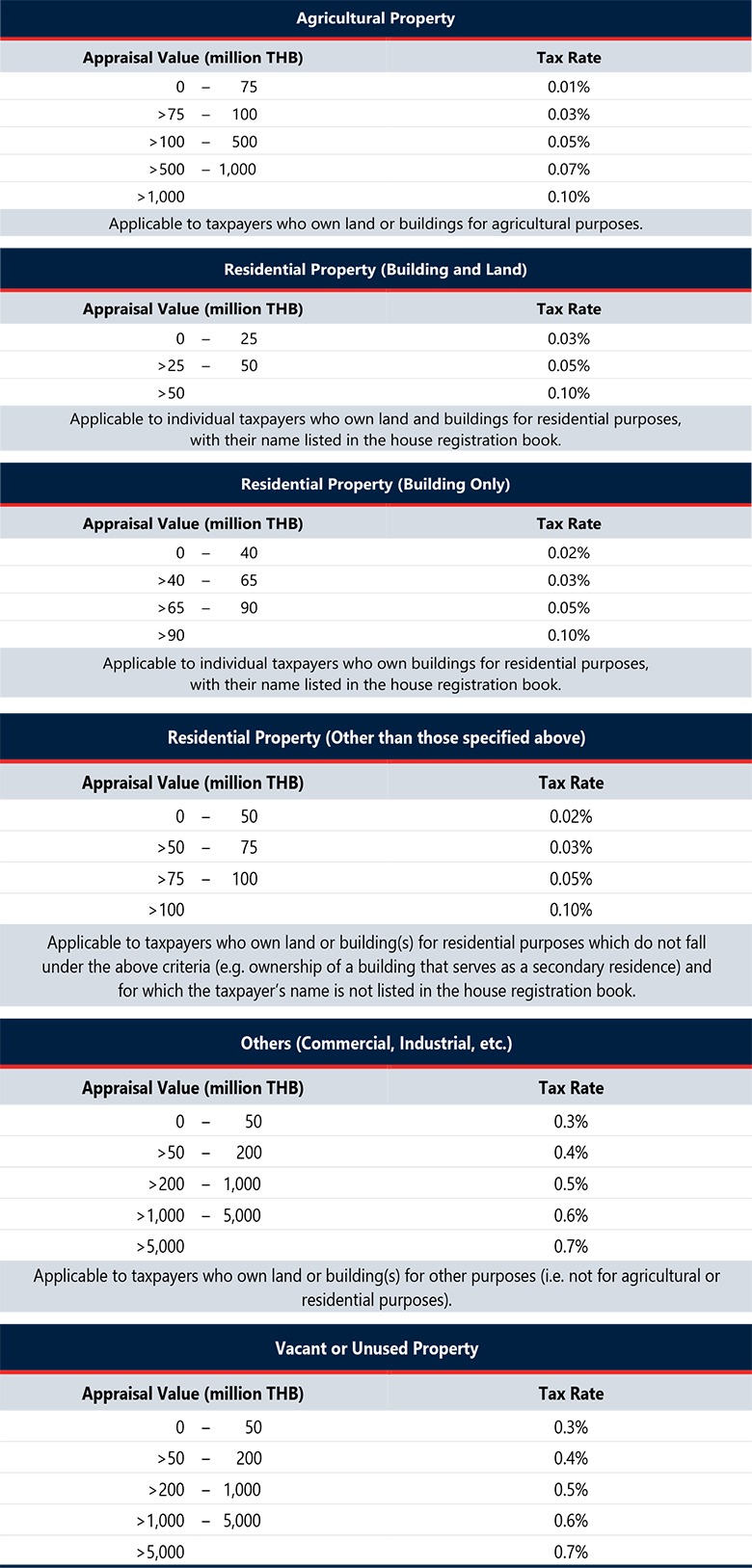
On December 13, 2021, the Royal Decree on the Stipulation of Land and Building Tax Rates B.E. 2564 (2021) was published in the Government Gazette. The royal decree, which was issued under the Land and Building Tax Act B.E. 2562 (2019) and takes effect on January 1, 2022, maintains the current land and building tax rates, which have been in place since 2020.

The land and building tax rates for each type of property stipulated under the royal decree are provided below:

RELATED INSIGHTS​ 

May 2, 2025
Attorneys from Tilleke & Gibbins have updated the latest edition of Doing Business in Thailand, a Q&A-style guide from Thomson Reuters Practical Law that offers an overview of key legal considerations for companies operating in jurisdictions worldwide. The contribution outlines the country’s legal and regulatory framework for foreign investment and business operations and reflects the latest legislative developments. The chapter addresses the following core topics: Legal system: Structure of the courts and the codified nature of Thai law. Foreign investment: Business restrictions under the Foreign Business Act, sector-specific regulations, exchange control rules, and investment incentives. Business vehicles: Overview of partnerships, private and public limited companies, and other legal entities. Employment: Labor protections, employment contracts, foreign worker requirements, and termination procedures. Tax: Corporate and personal income tax, indirect taxes, and tax obligations for residents and non-residents. Intellectual property: Registration and enforcement of patents, trademarks, designs, and copyrights. Data protection: Key provisions of the Personal Data Protection Act and related compliance obligations. Competition law: Regulatory framework under the Trade Competition Act. Anti-bribery and corruption: Relevant legislation and enforcement mechanisms. E-commerce and digital business: Legal regime for online transactions and digital platforms. Marketing and advertising: Consumer protection laws and regulations affecting advertising and marketing practices. Product regulation and liability: Safety standards, liability regimes, and roles of enforcement authorities. Practical Law, a legal reference resource from Thomson Reuters, publishes a range of guides for hundreds of jurisdictions and practice areas. The insurance and reinsurance guide is a valuable resource for legal practitioners, covering numerous jurisdictions worldwide. To view the latest version of the guide, please visit the Practical Law website and enroll in the free Practical Law trial to gain full access.
April 24, 2025
On April 8, 2025, Thailand passed a resolution to reduce the government fees for registering the sale and mortgage of immovable property. These reductions are outlined in two notifications issued by the Ministry of Interior and published in the Government Gazette on April 22, 2025. The measures are part of the government’s ongoing efforts to support the real estate sector and promote property ownership. The reduced fees apply to sale and mortgage registrations for certain types of properties—detached houses, semidetached houses, row houses, commercial buildings, accompanying land, and condominium units—with a sale price, official assessed value, or mortgage amount not exceeding THB 7 million. The reduced fees apply only when the buyer is an individual with Thai nationality. The reduced rates for registration fees are as follows: Sale: 0.01% of the officially assessed value (reduced from the normal rate of 2%) Mortgage: 0.01% of the mortgage amount (reduced from the normal rate of 1%) when registered at the same time as the sale of the property. These reduced rates are in effect from April 22, 2025, to June 30, 2026.
April 16, 2025
The recent earthquake in Myanmar on March 28, 2025, that also significantly affected parts of northern Thailand and Bangkok has raised concerns about building safety and structural resilience in Thailand. This event has reminded building owners and possessors in Thailand of the necessity of understanding earthquake-resistant building standards, their legal obligations regarding structural inspections, and compliance requirements under Thai law. Under Thai law, building owners and possessors have specific responsibilities regarding the structural integrity of their properties, particularly in areas prone to seismic activity. This article lays out the key legal requirements and outlines the potential penalties for noncompliance. Structural Design and Earthquake Resistance Requirements With respect to standards regarding earthquake resistance, Thailand’s Ministry of Interior has issued the Ministerial Regulation on Load Bearing, Durability, and Resistance of Buildings and Soil Foundations to Earthquake Forces B.E. 2564 (2021), replacing a previous ministerial regulation from 2007. The current ministerial regulation prescribes certain types of buildings in 43 designated provinces to comply with seismic design standards. These 43 provinces can be categorized into three main zones: Zone 1: Areas requiring monitoring due to the potential for impact on the structural integrity and stability of buildings when exposed to seismic waves, consisting of 14 provinces (e.g., Krabi, Surat Thani, Prachuap Khiri Khan, etc.). Zone 2: Areas where there may be moderate impact on the structural integrity and stability of buildings when exposed to seismic waves, consisting of 17 provinces (e.g., Bangkok, Nonthaburi, etc.) Zone 3: Areas where there may be significant impact on the structural integrity and stability of buildings when exposed to seismic waves, consisting of 12 provinces (e.g., Chiang Mai, Chiang Rai, Kanchanaburi, etc.) For buildings located in these categorized zones, the geometric configuration of the building structure must be designed to ensure stability in resisting seismic waves. Additionally, structural
March 13, 2025
Vietnam’s Ministry of Finance has released a draft Decree on Tax Administration for E-Commerce and Digital Platforms (“Draft Decree”), introducing significant tax compliance obligations that could reshape how digital platforms, and individuals and business households conducting business through the platforms, manage their tax responsibilities. Aimed at strengthening tax enforcement, the Draft Decree requires e-commerce and digital platforms to actively track and withhold taxes from business households and individual sellers, and remit payments to tax authorities. While it has not yet been promulgated, the Draft Decree is expected to take effect on April 1, 2025, leaving platforms with a limited window to prepare for compliance. Who Is Affected by the New Tax Rules? The Draft Decree significantly broadens the tax administration scope beyond traditional e-commerce platforms to cover a wide range of digital economy participants. Specifically, the Draft Decree places direct tax-related responsibilities on two major categories (collectively, “Regulated Operators”): E-commerce and digital platforms with payment functions (e.g., platforms that process buyer payments via e-wallets, bank transfers, cards, or cash-on-delivery); and Other digital-economy players that enable e-commerce transactions, including (i) intermediary service platforms connecting service providers with consumers, (ii) digital content platforms, (iii) online advertising providers, (iv) cloud computing and data storage providers, (v) social media platforms engaged in business activities (e.g., live-stream, in-app transactions), (vi) online education, gaming, and digital entertainment platforms generating revenue from digital transactions, (vii) Vietnam-based partners of foreign digital service providers facilitating local payments for overseas platforms, and (viii) intermediary payment service providers handling financial transactions for e-commerce activities. Under the Draft Decree, Regulated Operators will be required to track, report, and enforce tax compliance for both resident and nonresident individuals and households conducting business through their platforms (“Sellers”). What New Tax Obligations Do Platforms Face? Onshore platforms For the first time, Regulated Operators will