You are using an outdated browser and your browsing experience will not be optimal. Please update to the latest version of Microsoft Edge, Google Chrome or Mozilla Firefox. Install Microsoft Edge

December 21, 2021

No Change for Thailand’s Land and Building Tax Rates for 2022

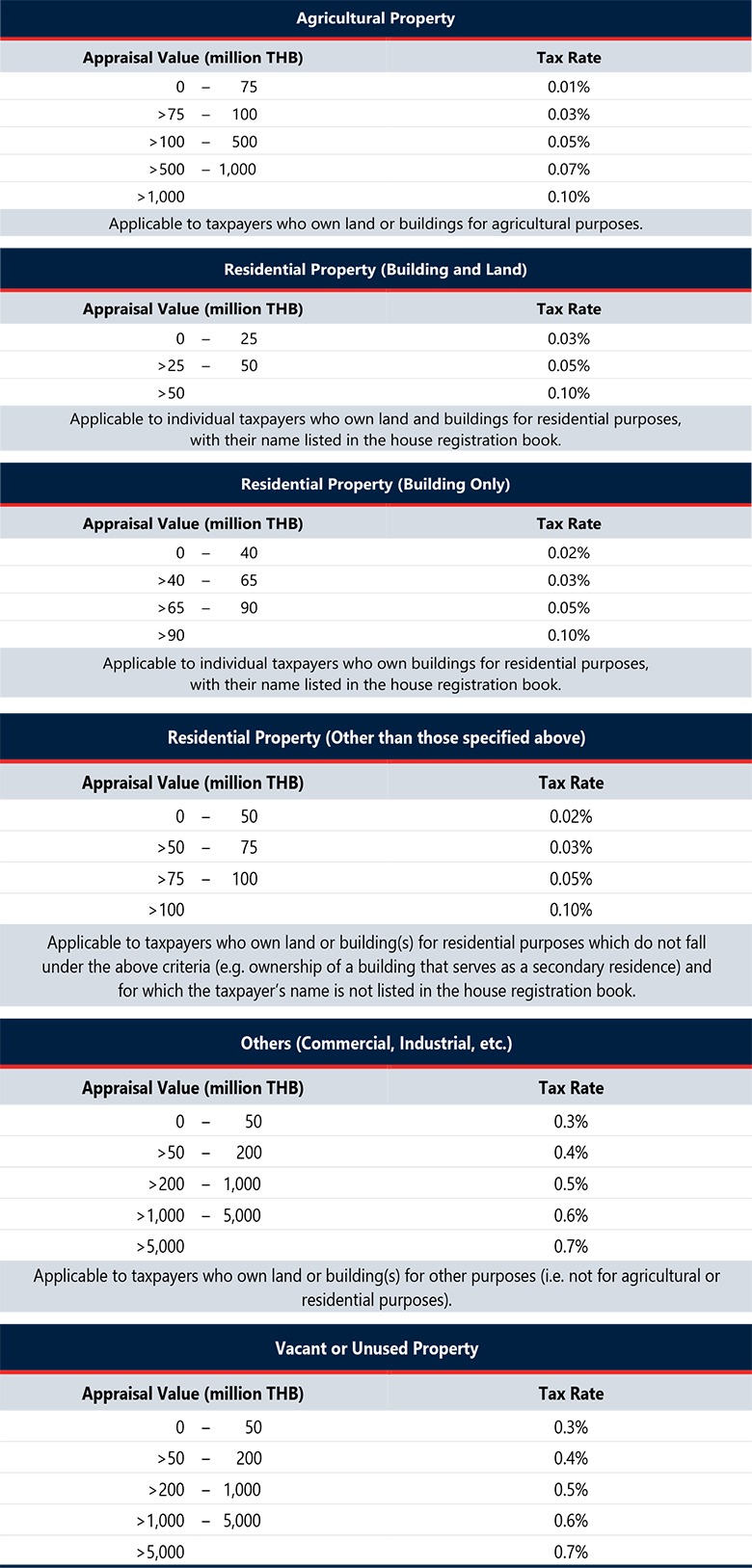
On December 13, 2021, the Royal Decree on the Stipulation of Land and Building Tax Rates B.E. 2564 (2021) was published in the Government Gazette. The royal decree, which was issued under the Land and Building Tax Act B.E. 2562 (2019) and takes effect on January 1, 2022, maintains the current land and building tax rates, which have been in place since 2020.

The land and building tax rates for each type of property stipulated under the royal decree are provided below:

RELATED INSIGHTS​ 

October 15, 2024
The Contract Committee of Thailand’s Office of the Consumer Protection Board (OCPB) has issued the Notification Prescribing the Business of Selling Condominium Units Through Reservations as a Contract-Controlled Business B.E. 2567 (2024). The notification was published in the Government Gazette on October 3, 2024, and is expected to come into effect 120 days after the publication date (i.e., January 31, 2025). This notification aims to prevent condominium project business operators/developers from exploiting consumers. Under the notification, the business of selling condominium units through reservations refers to a business in which a consumer enters into a reservation contract with a business operator to reserve a condominium unit in a condominium building, by paying a reservation fee (or other benefit similar to a reservation fee) that is not a security deposit or down payment, and committing the consumer to enter into a subsequent sales contract to buy the unit. This also extends to the sale of condominium units reserved through electronic channels. The reservation contract must be written in Thai and must include material terms and conditions as specified in the prescribed reservation contract form attached to the Notification (“Standard Reservation Contract”). In addition, the reservation contract must not contain any of the following terms and conditions: Exemption or limitation of the business operator’s liability arising from its breach of contract. The business operator’s right to change the contract or various conditions imposing an additional burden on the consumer, exceeding what was agreed upon at the time the contract was made. The business operator’s right to terminate the contract with the consumer without written notice, or without the material breach of contract by the consumer. The business operator’s right to confiscate all or part of the payment unless the consumer is in breach of the contract. The business operator’s right to
August 26, 2024
On July 19, 2024, Cambodia’s Ministry of Land Management, Urban Planning, and Construction (MLMUPC) issued Prakas No. 050 on the Formalities and Procedure for Registration of Private Units in Co-owned Buildings Constructed before December 19, 1997. This new regulation aims to address the lack of clear guidelines for registering units in co-owned buildings constructed prior to 1997 and ensure protection of legal ownership rights for private owners of co-owned buildings constructed before December 19, 1997. Background Cambodia’s real estate market, including co-owned buildings and condominiums, has been experiencing rapid growth. As more individuals acquire separate units in co-owned buildings, the demand for proper registration of each unit has increased. While existing mechanisms like Sub-Decree No. 46 on Systematic Land Registration and Sub-Decree No. 48 on Sporadic Land Registration provide frameworks for registering immovable properties, they do not specifically address the registration procedure for co-owned buildings constructed before 1997. Definition of Co-owned Building A co-owned building contains “private units” exclusively owned by individual co-owners and “common areas” used by all co-owners. This includes various categories such as villas, semi-villas, attached houses, condominiums, and other types of houses with common structures. Application Documents The new prakas introduces a more straightforward documentation process for registering private units in buildings constructed before December 19, 1997, compared to previous regulations (specifically, Sub-Decree No. 126 on the Management and Use of Co-Owned Buildings). The required application documents now include: One copy of application form in Khmer Two copies of certified identification documents for each co-owner Two copies of certified documents of property ownership (if any) Notably, certain documents, such as the internal regulations and detailed architectural plan of the co-owned building, are not required. These more lenient requirements encourage more owners to register their private units, as it makes it easier to secure certificates and

August 20, 2024
Following the enactment of the Tax Administration Law (TAL), Myanmar’s Ministry of Planning and Finance has issued Notification No. 44/2024, which outlines directives and procedures for addressing violations of tax law provisions. These procedures, which came into force on June 13, 2024, primarily focus on three key areas: tax evasion, impeding tax administration, and failure to preserve secrecy. The notification primarily aims to address tax evasion, impeding tax administration, and failure to preserve secrecy, classifying these offenses as either subject to arrest without warrant or not. Notably, tax evasion is classified as an offense subject to arrest without warrant, while impeding tax administration and failure to preserve secrecy are not. The notification also prescribed the forms for notifying taxpayers before taking any action. Tax Evasion Tax evasion refers to a taxpayer who willfully evades the assessment, payment, or collection of tax. Penalties for such offenses include fines of MMK 250,000 (approx. USD 120) or 100% of the evaded tax (whichever is greater), imprisonment for up to seven years, or both. The enforcement process for tax evasion requires the chief officer of the township revenue department or an officer in charge (the tax authority) to assess the relevant documents and information provided by the taxpayer. If a taxpayer is found to be evading tax, the tax authority must send a notice in the prescribed form for verification within 15 days. Taxpayers may apply for a one-time extension of 15 days to submit requested documents and make disclosures. If the taxpayer cannot fulfill the requirements as instructed, the tax authority will seek approval from the director general of the Internal Revenue Department (IRD) for criminal proceedings as cognizable offences. Impeding Tax Administration and Failure to Preserve Secrecy Impeding tax administration refers to obstruction or attempted obstruction of taxation staff or officers
July 30, 2024
In May and June 2024, Cambodia’s General Department of Taxation (GDT) issued two notable tax incentive packages that aim to encourage business growth in the country. The details of these incentives are outlined below. Tax Incentives for Expansion of Qualified Investment Projects The GDT’s May 10, 2024, regulation (Prakas No. 313 MEF. PrK. PD) provides income tax incentives for expansion of qualified investment projects (QIPs), including an income tax exemption for the following types of expansion: Expansion of existing production. Expansion through product line diversification within the same lines. Implementation of new technologies that enhance productivity or protect the environment. Other forms of expansion set out in future sub-decrees. The number of years for the income tax exemption depends on the investment activities of the QIP, in accordance with the business groupings provided in the Sub-Decree on the Implementation of the Investment Law in Cambodia—9 years for group 1, 6 years for group 2, and 3 years for group 3. After receiving approval for the QIP expansion from the Council for the Development of Cambodia (CDC) or one of its Provincial-Municipal Investment Sub-Committees (PMISs), the GDT will certify the income tax exemption period. The exemption begins on the date the enterprise first receives income from the QIP expansion. QIPs seeking this tax exemption need to declare the amount of money that they intend to use for the expansion. Once allowed, the company must use that money for construction materials or new production equipment before the expiration of the tax exemption period. The income tax exemption can be revoked if: The enterprise does not use the capital to expand the QIP by purchasing the construction material and new production equipment as requested for the expansion. The enterprise fails to invest the prescribed amount before the expiration of the tax exemption