You are using an outdated browser and your browsing experience will not be optimal. Please update to the latest version of Microsoft Edge, Google Chrome or Mozilla Firefox. Install Microsoft Edge

December 21, 2021

No Change for Thailand’s Land and Building Tax Rates for 2022

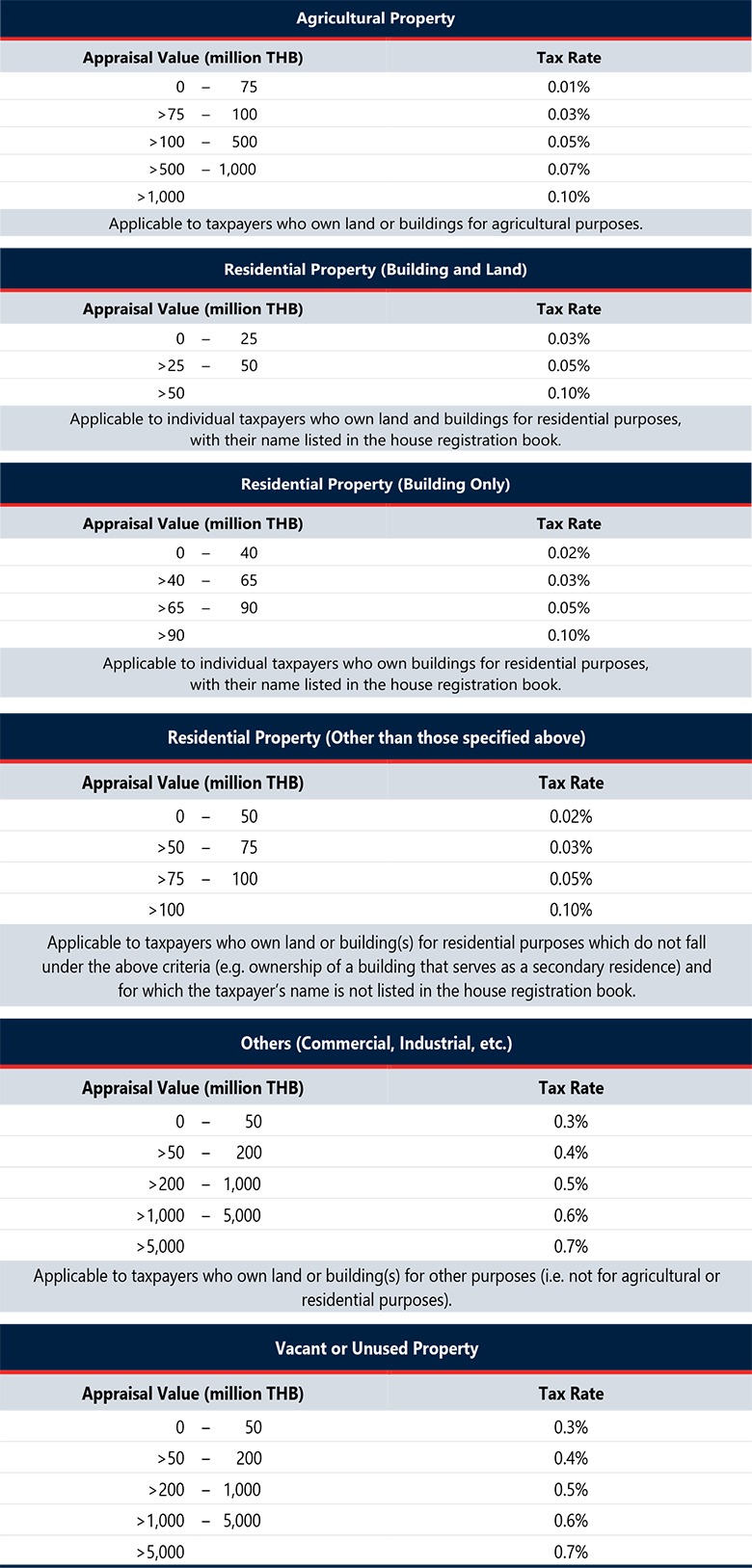
On December 13, 2021, the Royal Decree on the Stipulation of Land and Building Tax Rates B.E. 2564 (2021) was published in the Government Gazette. The royal decree, which was issued under the Land and Building Tax Act B.E. 2562 (2019) and takes effect on January 1, 2022, maintains the current land and building tax rates, which have been in place since 2020.

The land and building tax rates for each type of property stipulated under the royal decree are provided below:

RELATED INSIGHTS​ 

July 4, 2024
On June 28, 2024, Thailand’s Ministry of Interior issued the Ministerial Regulation Re: Exemption from the Government Fee for Hotel Business Operators B.E. 2567 (2024). The ministerial regulation, which was published in the Government Gazette on June 30, 2024, lifts the annual government fee for hotel business operations from July 1, 2024, to June 30, 2026. This extends the previous annual fee exemption period, which had been set to expire on June 30, 2024, in accordance with similar ministerial regulations in 2022. This measure aims to alleviate the financial burden on hotel business operators that may be affected by insufficient tourist revenue. For more information on this exemption, or on any aspect of Thailand’s legal and regulatory environment for hotel business operations, please contact Chaiwat Keratisuthisathorn at [email protected] or Chanchai Jhongsathit at [email protected].
June 6, 2024
On January 18, 2024, Vietnam’s National Assembly passed a new Land Law (“Land Law 2024”) that is scheduled to take effect on January 1, 2025, replacing the current Land Law 2013. To mitigate challenges faced by the real estate market, in late May 2024, the government proposed amendments to the Land Law that would move the effective date up five months, to August 1, 2024, pending approval by the National Assembly. One of the key sectors to be impacted by the Land Law 2024 is the energy sector, which requires large land areas for power plants and infrastructure, especially given Vietnam’s 2050 net zero emissions commitment. Below are highlights of how the new Land Law 2024 will affect Vietnam’s energy sector. Annual payment of land rental Under the Land Law 2013, investors implementing energy projects (e.g., solar power projects) are entitled to choose to lease land with either (i) an annual rental payment or (ii) a single upfront payment for the entire term of use. Under the Land Law 2024, these investors are only allowed to use land in the form of an annual rental payment. As the annual land rental is calculated in five-year cycles, based on the land price table decided by the state, this new restriction means that investors in energy projects will face an additional risk of a sudden increase in land rental, disrupting their financial planning. Investors using land sites leased with annual rental payments are also not allowed to mortgage their land-use rights, but can only mortgage assets attached to the land, at credit institutions licensed to operate in Vietnam. Accordingly, this may affect the ability of energy projects to obtain financing during the development stage, because they no longer have assets that can be mortgaged. Obtaining land Under the Land Law 2024,

May 10, 2024
Thailand’s Board of Investment (BOI) has issued a notification granting investment privileges to qualified new residential projects for low-income individuals. Notification No. Sor. 1/2567 Re: Promotion of Residential Activities for Low-Income People was published in the Government Gazette on May 3, 2024, and came into effect the following day. To be eligible for BOI promotion, at least 80% of the total residences in a project must meet the requirements for usable area and price. The minimum usable area is 24 square meters for condominium units and 70 square meters for town houses and detached houses. The residences can only be sold to individuals, and the sale price for each of these condominium units or houses (including the price of any land) must not exceed THB 1.5 million. Projects must also meet the following criteria: Projects must include a car park, closed circuit television (CCTV) throughout the project, a 24-hour security guard, cleaning staff, a common area, and other facilities in an appropriate proportion. The building plan and layout must be approved by the BOI. A permit for the construction of a building under building control laws and other relevant laws must be obtained. Approval must also be obtained from the Government Housing Bank prior to submission of the application to the BOI. However, ISO 9000, ISO 14000, or other similar international standard certification is not required. Under the notification, applications for such promotion must be submitted to the BOI by the end of 2025. New low-income residential projects promoted by the BOI will be granted a corporate income tax exemption for a period granted for A4-promoted activities (typically three years). For corporate income tax exemptions, the investment will only be calculated based on the construction costs for roads, other facilities, or public utilities that are commonly used within the
March 22, 2024
Laos has returned its value-added tax rate to 10% from the 7% rate that had been observed for the last two years. The new rate was specified in Ordinance No. 003/PDT, dated March 19, 2024, and announced on the website of the Ministry of Trade and Commerce. Prior to this, the last announcement of an adjustment in the VAT rate came in the last week of December 2021, when the Ministry of Justice published the Law Amending Certain Provisions of the Laws on Tax No. 01/NA, dated August 7, 2021, in the Government Gazette. This law, which entered into force in January 2022, amended the VAT rate from 10% to 7%. Under Lao law, the ordinance is effective from its date of signing by the president of Laos (i.e., March 19, 2024). However, the tax authorities have indicated that the new rate will not be enforced immediately but will be implemented in the near future, such as when it is published in the Lao Official Gazette. This change of the VAT rate to 10% does not come as a surprise. Some international experts and organizations had been recommending that Laos adopt a 10% VAT rate given its current economic challenges, arguing that Laos should prioritize collecting tax and replenishing the state budget. This was, for instance, recommended by the World Bank in the November 2023 Lao PDR Economic Monitor. Tilleke & Gibbins will continue to monitor the situation to determine when the 10% VAT rate will be enforced. For more details on the rate changes, or on any aspect of tax law in Laos, please contact Tilleke & Gibbins at [email protected].