You are using an outdated browser and your browsing experience will not be optimal. Please update to the latest version of Microsoft Edge, Google Chrome or Mozilla Firefox. Install Microsoft Edge

December 21, 2021

No Change for Thailand’s Land and Building Tax Rates for 2022

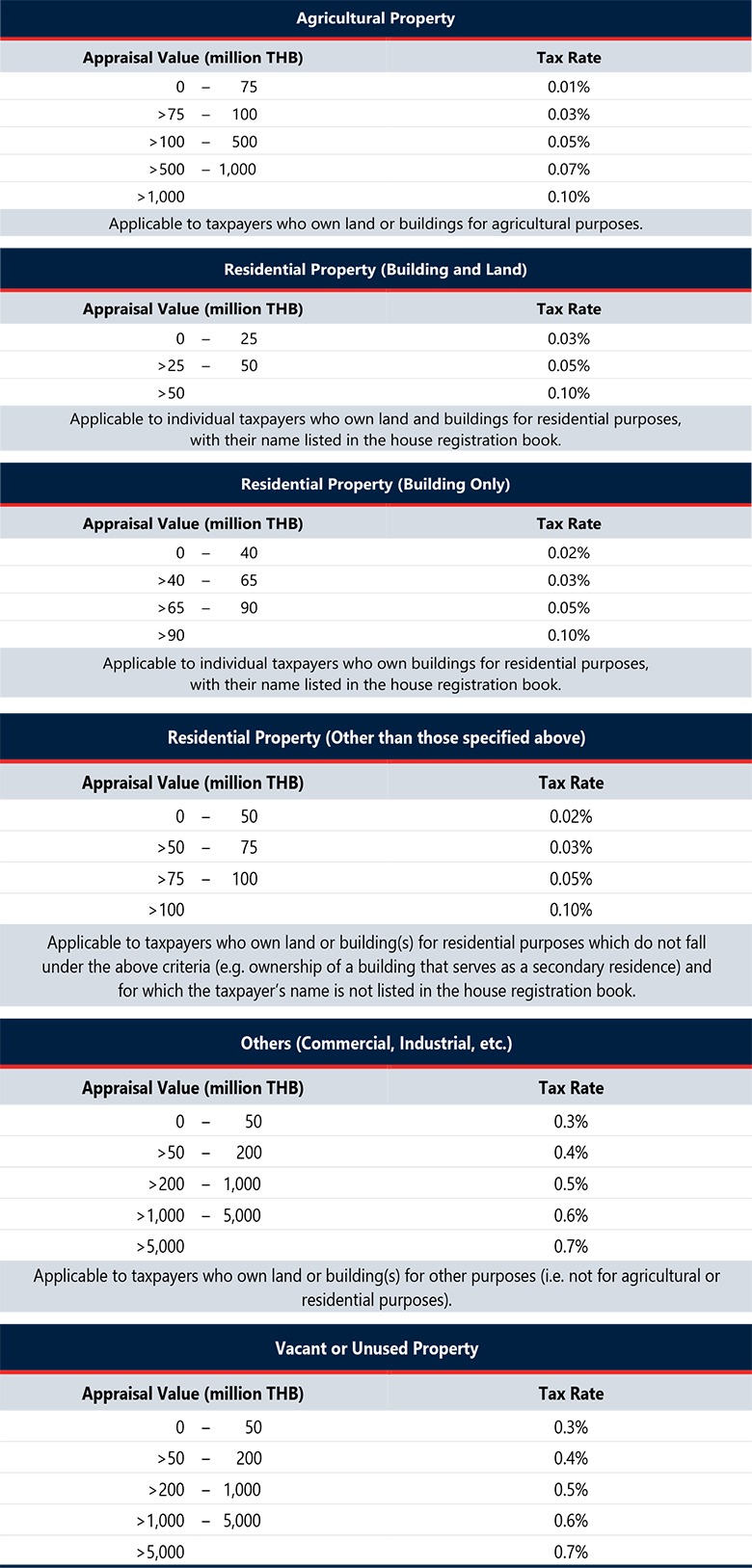
On December 13, 2021, the Royal Decree on the Stipulation of Land and Building Tax Rates B.E. 2564 (2021) was published in the Government Gazette. The royal decree, which was issued under the Land and Building Tax Act B.E. 2562 (2019) and takes effect on January 1, 2022, maintains the current land and building tax rates, which have been in place since 2020.

The land and building tax rates for each type of property stipulated under the royal decree are provided below:

RELATED INSIGHTS​ 

January 16, 2025
On January 13, 2025, Thailand’s cabinet approved in principle the draft Entertainment Complex Act, as proposed by the Ministry of Finance. This landmark legislative proposal, which would allow casinos as part of larger “entertainment complexes,” will now proceed through further parliamentary review and approval. Key provisions of the draft act are described below. Corporate structure: Entertainment complexes must be operated by Thai-registered limited companies or public limited companies with a minimum paid-up capital of THB 10 billion. Directors of the licensed entity must be individuals and have the qualifications and none of the prohibited characteristics specified in the draft act. The draft act does not impose restrictions on foreign-majority ownership structures; however, it is worth monitoring whether any amendments addressing this matter are introduced during the legislative process. Operating conditions: Each entertainment complex must be located in an area designated under a royal decree. It must also include at least four types of entertainment businesses listed in the annex to the draft act (e.g., shopping mall, hotel, sports stadium, amusement park), along with a casino. The allocation of casino space must comply with regulations to be specified at a later date. Licensing conditions: Licenses will be valid for 30 years, renewable in increments of up to 10 years. The license issuance fee is THB 5 billion, the annual fee is THB 1 billion, and the renewal fee is THB 5 billion. The Entertainment Complex Policy Committee, chaired by the prime minister, will review and approve applications. Online gambling restrictions: Licensees are prohibited from offering gambling through internet-connected systems or electronic devices that allow access from outside the casino premises. Labor requirements: Thai and foreign employee ratios must adhere to prescribed regulations. Land privileges: Lease agreements for land use are limited to 50 years. Renewal is permitted for up to

January 8, 2025
Thailand’s Board of Investment (BOI) has issued regulations revising its criteria for certain foreign companies that receive promotional privileges to own land under limited circumstances. The revised allowance is detailed in the Notification of the Board of Investment No. 16/2567 Re: Criteria for Permitting Foreign Juristic Persons Receiving Investment Promotion to Hold Land Ownership for Office and Residence, which was published in the Government Gazette on December 9, 2024, after having been officially issued on November 1, 2024. The notification was made in conjunction with the subordinate Notification of the Office of the Board of Investment No. Por. 8/2567 Re: Criteria and Conditions for Permitting Foreign Juristic Persons Receiving Investment Promotion to Own Land for Office and Residence for Operational-Level Workers to Operate Business Granted Investment Promotion, dated November 4, 2024. Under the new BOI notification and subordinate notification, foreign juristic persons that receive promotional privileges from the BOI, with paid-up registered capital of at least THB 50 million, are eligible to own land for office use or residential purposes, subject to certain criteria and conditions: Office use. Land used for this purpose must be for an office of the relevant BOI-promoted business, with an area limit of 5 rai (8,000 square meters). Residential use. Land used for this purpose must be for the residences of operational-level workers (i.e., unskilled laborers), with an area limit of 20 rai (32,000 square meters). In addition, there must be common facilities (e.g., parking, first-aid room, kitchen, and other amenities, as approved by the BOI). The land must be located within 10 kilometers of the place of business operation, and the number of rooms must be consistent with the number of workers. For more information on this notification, or on any aspect of property law in Thailand, please contact Chaiwat Keratisuthisathorn at  [email protected],
January 3, 2025
Thailand has adopted the OECD’s global minimum tax framework through the Emergency Decree on Top-Up Tax B.E. 2567 (2024). Published in the Government Gazette on December 26, 2024, this legislation implements a 15% global minimum effective tax rate for large multinational enterprise (MNE) groups. The emergency decree took effect on January 1, 2025. The emergency decree was enacted through expedited procedures to implement “pillar two” of the OECD’s Base Erosion and Profit Shifting (BEPS) 2.0 project’s Global Anti-Base Erosion (GloBE) Rules. This swift implementation ensures Thailand can collect relevant tax revenues and prevents potential revenue losses from MNEs that might otherwise shift profits to jurisdictions with lower tax rates or to countries that have already implemented similar top-up tax legislation. Key aspects of Thailand’s implementation of the global minimum tax through the emergency decree are described below. Top-Up Tax The emergency decree introduces a dual mechanism for collecting additional top-up tax from MNEs whose effective tax rate falls below 15%. The first mechanism is a domestic top-up tax that targets MNEs operating within Thailand when their local effective tax rate is lower than 15%. The second mechanism is the income inclusion rule, which determines when a company’s foreign income should be included in the parent (main) company’s taxable income. This rule applies to Thai-based entities—including ultimate parent entities (UPE), intermediate parent entities, and partially owned parent entities—that hold ownership stakes in low-tax foreign jurisdictions. Scope MNEs subject to Thailand’s implementation of the global minimum tax framework are defined in the emergency decree as those whose UPEs report consolidated revenue of at least EUR 750 million (approximately THB 28 billion) in at least two of the four accounting periods preceding the relevant fiscal year. Reporting and Payment In-scope MNEs must comply with specific reporting obligations to the Thai Revenue Department. The filing deadline is set
December 4, 2024
Thailand Legal Basics, a valuable primer for foreign investors, explores all aspects of living and doing business in Thailand. Written by specialists at Tilleke & Gibbins in Bangkok, it is the only comprehensive English-language guide to the Thai legal system with a focus on the concerns of foreign business and investment.