
You are using an outdated browser and your browsing experience will not be optimal. Please update to the latest version of Microsoft Edge, Google Chrome or Mozilla Firefox. Install Microsoft Edge

November 5, 2018

Myanmar-Language Labeling Required on Wide Range of Products

Myanmar’s Central Committee for Consumer Protection issued Notification 1/2018 on October 26, 2018, which requires labels containing certain information in Myanmar language, jointly or combined with another language, to be affixed to certain products sold in the country. The notification is intended to ensure the safety of consumers.

The notification states that Myanmar-language labels must contain the following information:

  • Directions for use;
  • Storage instructions;
  • Allergy alerts and/or warnings; and
  • Side effects (if any).

The Myanmar-language label must be affixed to consumer units, jointly or combined with labelling in another language, but the legislation does not cover other packaging, such as display boxes.

The list of priority products that require Myanmar-language labelling, jointly or combined with labelling in another language, is as follows: 
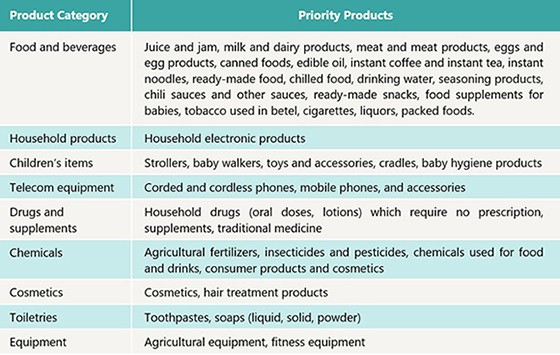
The committee may announce other products to be included in the list in the future.

Companies will have a six-month grace period from the notification date (October 26, 2018) to comply with the new regulation. Any violations after the grace period will leave companies vulnerable to the following sanctions under Section 19 of the Myanmar Consumer Protection Law 2014:

  • warning;
  • severe warning;
  • order to remedy the violation or compensate;
  • temporary prohibition of the sale and distribution of goods in violation;
  • product recall;
  • destruction of goods; and/or,
  • temporary or permanent revocation of business licenses or permits.

RELATED INSIGHTS​ 

January 18, 2018
With the benefit of advanced technologies, teams of doctors that are far from a patient’s location can receive information and images relating to the patient’s condition, diagnose the patient’s condition remotely, and prescribe appropriate treatment. This arrangement has tremendous possibilities to help those in developing countries like Vietnam, where the most modern technology and most experienced doctors are often located in just a few major cities. For very serious conditions, patients in Vietnam may benefit from the experience of doctors based abroad.
January 8, 2018
To better understand the food regulatory landscape in Asia, APFI has spoken to law firms that specialize in food law from five different countries across Asia, which include China, Thailand, Vietnam, Singapore and the Philippines.In the second part of the series, we look at food safety regulations in Thailand. Alan Adcock, partner and deputy director, intellectual property and regulatory affairs, Tilleke & Gibbins, shares his advice.
January 5, 2018
To better understand the food regulatory landscape in Asia, APFI has spoken to law firms that specialize in food law from five different countries across Asia, which include China, Thailand, Vietnam, Singapore and the Philippines. In the third part of the series, we look at food safety regulations in Vietnam. Hien Thi Thu Vu, head of regulatory affairs, Vietnam, Tilleke & Gibbins, shares her advice.
December 28, 2017
The Ministry of Health in Laos has issued a Decision on the Establishment of Businesses for the Import and Export of Medicine and Medical Products No. 1820/MoH dated August 25, 2017 (the Decision), to provide information on setting up and conducting businesses related to the import and export, distribution, wholesale, and manufacture of medicines and medical products/devices.